NACA member governments are: Australia, Bangladesh, Cambodia, China, Hong Kong SAR, India, Indonesia, I.R. Iran, Kingdom of Saudi Arabia, Korea (DPR), Lao PDR, Malaysia, Maldives, Myanmar, Nepal, Pakistan, Philippines, Sri Lanka, Thailand and Vietnam.
The 82nd edition of the Quarterly Aquatic Animal Disease report contains information from eleven governments. The foreword welcomes Dr Huang Jie, NACA's new Director General, a health specialist that has previously participated in the Asia-Pacific Regional Advisory Group on Aquatic Animal Health.
The 81st edition of the Quarterly Aquatic Animal Disease report contains information from twelve governments. The foreword discusses the proposed Regional Collaboration Framework on Aquatic Animal Diseases in Asia and the Pacific. This will initially focus on building a framework of actors with the aim of strengthening laboratory capacity for aquatic animal disease activities in Asia and the Pacific, for example to support emergency response.
The 80th edition of the Quarterly Aquatic Animal Disease report contains information from twelve governments. The foreword discusses revisions to the regional reporting system for 2019.
The 79th edition of the Quarterly Aquatic Animal Disease report contains information from eleven governments. The foreword discusses the outcomes of the 17th Meeting of the Asia Regional Advisory Group on Aquatic Animal Health, held in Bangkok, 13-14 November 2018.
The 78th edition of the Quarterly Aquatic Animal Disease Report contains information from twelve governments in the Asia-Pacific region. The foreword discusses three recent aquatic animal health consultations: The ASEAN Regional Technical Consultation on Aquatic Emergency Preparedness and Response Systems for Effective Management of Transboundary Disease Outbreaks in Southeast Asia; the Regional Consultation and Related Study on Antimicrobial Resistance Risk to Aquaculture in Asia; and the Preliminary Consultation on Monitoring of Antimicrobial Resistance in Bacterial Pathogens in Aquaculture.
The 77th edition of the Quarterly Aquatic Animal Disease Report contains information from nine governments. The foreword discusses an intensive seven-day training course on tilapia lake virus (TiLV) that was jointly organised by China's National Fisheries Extension Center, Sun Yat-Sen University and the Food and Agriculture Organization of the United Nations.
The 76th edition of the Quarterly Aquatic Animal Disease Report contains information from 14 governments. The foreword discusses the outcomes of a Stakeholder Consultation on Progressive Management Pathway to Improve Aquaculture Biosecurity, organised by the Food and Agriculture Organization of the United Nations, Mississippi State University and the World Bank.
The 75th edition of the Quarterly Aquatic Animal Disease Report contains information from 14 governments. The foreword discusses the 10th Symposium on Disease in Asian Aquaculture, and the 11th Technical Group Meeting and election of a new Executive Committee for the Fish Health Society (2018-2020).
The 74th edition of the Quarterly Aquatic Animal Disease Report contains information from 15 governments. The foreword describes an Emergency Regional Consultation for Prevention and Management of Tilapia Lake Virus (TiLV) in the Asia-Pacific region.
The 73rd edition of the Quarterly Aquatic Animal Disease Report contains information from 14 governments. The foreword provides a disease advisory on tilapia lake virus (TiLV), an emerging threat to farmed tilapia in the Asia-Pacific region.
The 73rd edition of the Quarterly Aquatic Animal Disease Report contains information from 14 governments. The foreword provides information about the implementation of a National Surveillance Programme for Aquatic Animal Diseases (NSPAAD) in India.
The 72nd edition of the Quarterly Aquatic Animal Disease Report contains information from 12 governments. The foreword provides information about the 15th Meeting of the Asia Regional Advisory Group on Aquatic Animal Health.
The 71st edition of the Quarterly Aquatic Animal Disease Report contains information from 15 governments. The foreword provides information about the 10th Symposium on Diseases in Asian Aquaculture.
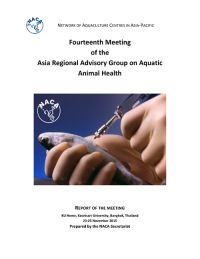
The Asia Regional Advisory Group on Aquatic Animal Health meets annually to discuss regional health issues including emerging disease threats. This report includes a review of regional disease status circa 2015, global and regional disease reporting arrangements, global issues and standards, progress in implementation of the the Regional Technical Guidelines on Health management for the Responsible Movement of Live Aquatic Animals, identification and designation of regional aquatic animal health resources and regional and international cooperation.
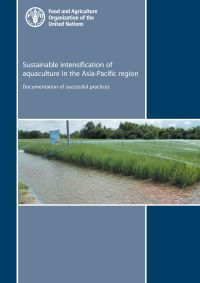
This publication is the major output of a regional programme jointly implemented by FAO and NACA in 2015 to document and disseminate successful practices that contribute to the sustainable intensification of aquaculture in the Asia-Pacific region. Twelve practices are described that contribute to at least one of the following: Improved production and resource use efficiency (land, water, feed, energy); improved environmental benefits; strengthened economic viability and farmers' resilience; and improved social acceptance and equity.
This report, the 71st in the series, contains information about the aquatic animal health status of sixteen states in the Asia-Pacific region. The foreword discusses changes to the Quarterly Aquatic Animal Disease Report, including a move to electronic-only distribution.
This report, the 70th in the series, contains information about the aquatic animal health status of nine states in the Asia-Pacific region. The foreword discusses tilapia lake virus, a new viral disease of farmed tilapia.
A Regional Proficiency Testing Program for Aquatic Animal Disease Diagnostic Laboratories in Asia-Pacific was developed to strengthen diagnostic capability across Asia. This capability was identified as a requirement to facilitate the sanitary safety of trade in aquatic animal products. The program provided 41 laboratories across the Asia-Pacific with the opportunity to assess their diagnostic performance for 10 regionally significant aquatic animal pathogens, and to adapt or modify practices where necessary to improve.
Due to the world’s rapidly growing population, which is expected to peak somewhere around 9.5 billion, food production will need to be massively increased over the next few decades. This increase must be achieved without further degrading the environment. The unit environmental footprint of food production must be significantly reduced from where it is today. This concept, termed sustainable intensification, applies as much to aquaculture as it does to other agricultural sectors.