NACA member governments are: Australia, Bangladesh, Cambodia, China, Hong Kong SAR, India, Indonesia, I.R. Iran, Kingdom of Saudi Arabia, Korea (DPR), Lao PDR, Malaysia, Maldives, Myanmar, Nepal, Pakistan, Philippines, Sri Lanka, Thailand and Vietnam.
This report, the 29th in the series, contains information about the aquatic animal health status of fourteen states in the Asia-Pacific region. The foreword discusses the outcomes of the fourth meeting of the Asia Regional Advisory Group on Aquatic Animal Health.
This report, the 28th in the series, contains information about the aquatic animal health status of seventeen states in the Asia-Pacific region. The foreword discusses the need for improved surveillance and transparent reporting of aquatic animal disease.
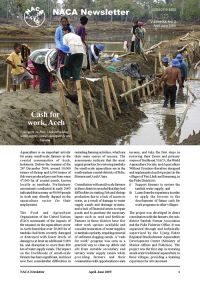
Cash for work, Aceh. HRH Chulabhorn opens new molecular genetics laboratory, Thailand. Aquatic epidemiology training. STREAM Regional Conference and BMP Workshop. Dr Modadugu V. Gupta awarded the 2005 World Food Prize. Study program on marine aquaculture and seafood markets in southern China, 2005. The third Regional Grouper Hatchery Production Training Course.
This report, the 27th in the series, contains information about the aquatic animal health status of fifteen states in the Asia-Pacific region. The foreword discusses identification of regional expertise in aquatic animal health, in terms of experts, resource centres and reference laboratories.
This report, the 26th in the series, contains information about the aquatic animal health status of fifteen states in the Asia-Pacific region. The foreword discusses responsible movement of live aquatic animals in the context of health and quarantine issues.
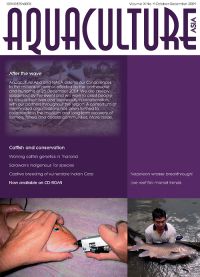
Captive breeding of vulnerable Indian carp Cirrhinus reba for conservation. Conservation of the Asiatic catfish Clarias batrachus through artificial propagation. A perspective on breeding and genetics of walking catfish in Thailand. Decline of wastewater-fed aquaculture in Hanoi. Artificial propagation of indigenous Tor species in Malaysia. Aquaculture of spotted babylon Babylonia areolata. First successful hatchery production of Napoleon wrasse Cheilinus undulatus. Trade and market trends in the live reef fish trade.
24 May 2004 | M.G. Bondad-Reantaso, J. Humphrey, S. Kanchanakhan and S. Chinabut | 3464 Downloads | .pdf | 2.2 MB
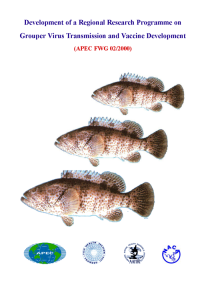
These are the proceedings of a workshop, funded by the APEC Fisheries Working Group Project 02/2000. The project developed a framework with nine major research components: Health and production at hatcheries, regional collaborative disease resource centers, regional disease monitoring and surveillance, improving regional diagnostic capabilities, responsible trans-boundary movement, farm health management, vaccines and vaccination, funding mechanisms and establishment of an ad-hoc working group.
This report, the 24th in the series, contains information about the aquatic animal health status of seventeen states in the Asia-Pacific region. The foreword discusses capacity building to prevent, prepare for an respond to aquatic animal health emergencies.
This report, the 23rd in the series, contains information about the aquatic animal health status of twenty states in the Asia-Pacific region. The foreword discusses a project on Capacity and Awareness Building on Import Risk Analysis for Aquatic Animals, funded by the APEC Fisheries Working Group.
The Asia Regional Advisory Group on Aquatic Animal Health meets annually to discuss regional health issues including emerging disease threats. This report includes a review of regional disease status circa 2003, global and regional disease reporting arrangements, global issues and standards, progress in implementation of the the Regional Technical Guidelines on Health management for the Responsible Movement of Live Aquatic Animals, identification and designation of regional aquatic animal health resources and regional and international cooperation.
This report, the 22nd in the series, contains information about the aquatic animal health status of seventeen states in the Asia-Pacific region. The foreword discusses the role of disease surveillance programmes and issues realted to the OIE Aquatic Animal Health Standards Commission.
This report, the 21st in the series, contains information about the aquatic animal health status of sixteen states in the Asia-Pacific region. The foreword discusses the outcomes of the second meeting of the Asia Regional Advisory Group on Aquatic Animal Health.
This report, the twentieth in the series, contains information about the aquatic animal health status of nineteen states in the Asia-Pacific region. The editorial discusses health risks associated with trans-boundary movement of live aquatic animals and the role of risk analyses.
This report, the nineteenth in the series, contains information about the aquatic animal health status of sixteen states in the Asia-Pacific region. The editorial discusses the role of the Quarterly Aquatic Animal Disease Reporting System.
This report, the eighteenth in the series, contains information about the aquatic animal health status of fifteen states in the Asia-Pacific region. The foreword discusses changes to the list of diseases covered in the report by the Asia Regional Advisory Group on Aquatic Animal Health.
This report, the seventeenth in the series, contains information about the aquatic animal health status of thirteen states in the Asia-Pacific region. The foreword discusses outcomes of the first meeting of the Asia Regional Advisory Group on Aquatic Animal Health.
1 May 2002 | Sih Yang Sim | 1950 Downloads | .pdf | 2.7 MB
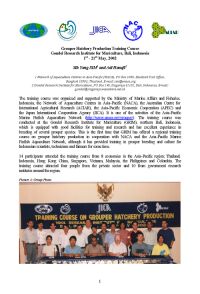
This report documents a training course that was held at the Research Institute for Mariculture, Bali, Indonesia in May 2003. The course covered both theoretical aspects of grouper husbandry via lectures and practical hands-on work in a grouper hatchery, including broodstock management, tank preparation egg collection, live feed production, health management, harvesting and transport and visits to commmercial grouper and milkfish hatcheries, grow-out facilities, markets and exporters.
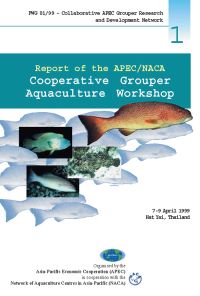
These are the proceedings of a workshop hosted by APEC and NACA under the project 'Collaborative APEC-NACA Grouper Aquaculture Network' (APEC Project FWG 01/99). The objectives of the workshop included the establishment of a regional research network to facilitate development of a sustainable grouper aquaculture industry; reduction of reliance on wild fingerlings for coastal grouper aquaculture, facilitate development of new aquaculture industries.