NACA member governments are: Australia, Bangladesh, Cambodia, China, Hong Kong SAR, India, Indonesia, I.R. Iran, Kingdom of Saudi Arabia, Korea (DPR), Lao PDR, Malaysia, Maldives, Myanmar, Nepal, Pakistan, Philippines, Sri Lanka, Thailand and Vietnam.
Mahajal – The Big Fishing Net was written by Mr Rakesh Raman, a playwright from Ranchi, Jharkhand, and performed by his theatre troupe. The play was written as an interpretation of the outcomes of the project case studies carried out in Jharkhand, Orissa and West Bengal. Act One sets the scene of fisherfolk’s livelihoods and the difficulties they face in a tribal village. Act Two places the project’s policy change recommendations within the context of their lives and aspirations.
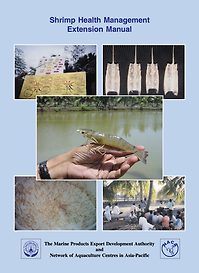
This extension manual summarises farm level risk factors and practical management practices that can be used to reduce risks of shrimp disease outbreaks and improve farm production. The recommendations are based on a study conducted in Andhra Pradesh, India. The publication is therefore of particular relevance to Andhra Pradesh, but many recommendations are still of use to farmers from other areas.
In this issue: Changes in Jabarrah. Palu Hijau in the Banggai Islands - using knowledge for change. Three stories from Nepal. Me and my work. Livelihoods approaches - skills learned, applied and shared. About the STREAM Journal. About STREAM. This edition is also available in Ilonggo and Vietnamese.
This report, the 28th in the series, contains information about the aquatic animal health status of seventeen states in the Asia-Pacific region. The foreword discusses the need for improved surveillance and transparent reporting of aquatic animal disease.
In this issue: Young people taking bolder steps. Providing a venue for voices to be heard. Rehabilitation of a bundu pond - STREAM's initiative and DOF's action. Coastal resources utilisation and conservation issues in Cox's Bazar, Bangladesh. People, fish and reefs - a livelihoods learning curve. Understanding the marine ornamental trade and its impact on the livelihoods of poor stakeholders in the Philippines. About the STREAM Journal. About STREAM. This edition is also available in Ilonggo and Vietnamese.
This report, the 27th in the series, contains information about the aquatic animal health status of fifteen states in the Asia-Pacific region. The foreword discusses identification of regional expertise in aquatic animal health, in terms of experts, resource centres and reference laboratories.
In this issue: Pasoso Project - local livelihoods and turtle conservation in a small island MPA in central Sulawesi, Indonesia. Fisheries development in Lao PDR. The jankar system for sustainable livelihoods: Lessons from the BRFP. Alternative livelihoods for landlocked areas in BFAR Region 6. Lessons learned and future replication from Trao Reef locally managed marine reserve. About the STREAM Journal. About STREAM. This edition is also available in Ilonggo.
This report, the 26th in the series, contains information about the aquatic animal health status of fifteen states in the Asia-Pacific region. The foreword discusses responsible movement of live aquatic animals in the context of health and quarantine issues.
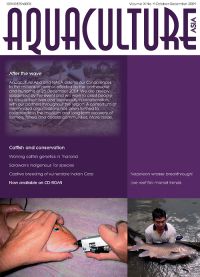
Captive breeding of vulnerable Indian carp Cirrhinus reba for conservation. Conservation of the Asiatic catfish Clarias batrachus through artificial propagation. A perspective on breeding and genetics of walking catfish in Thailand. Decline of wastewater-fed aquaculture in Hanoi. Artificial propagation of indigenous Tor species in Malaysia. Aquaculture of spotted babylon Babylonia areolata. First successful hatchery production of Napoleon wrasse Cheilinus undulatus. Trade and market trends in the live reef fish trade.
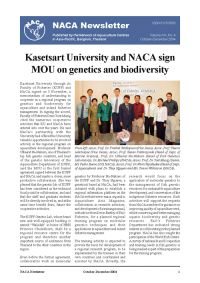
Kasetsart University and NACA sign MOU on genetics. Village shrimp health management project in Andhra Pradesh. A committee to manage fish health in Viet Nam. China to promote healthy shrimp farming. Father of China's shrimp aquaculture. NACA collaboration can extend to west and central Asia, Iran mission suggests. STREAM conducts monitoring & evaluation workshop. STREAM to support aquaculture in western Orissa.
This report, the 25th in the series, contains information about the aquatic animal health status of fifteen states in the Asia-Pacific region. The foreword discusses the outcomes of the third meeting of the Asia Regional Advisory Group on Aquatic Animal Health.
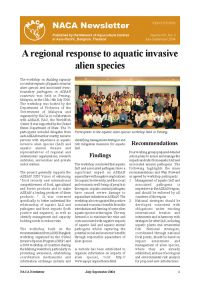
A regional response to aquatic invasive alien species. 6th Symposium on Diseases in Asian Aquaculture. Indonesia plan EC PREP seafood trade study. NACA Website: Guide to member services. Preparing and responding to health emergencies. New publication: Marine Finfish Aquaculture Magazine. STREAM Agreement with MOF Vietnam on Communications. STREAM Agreement with NAFEC Vietnam on Livelihoods Approaches. NACA-NACEE Cooperation. Training and study tours.
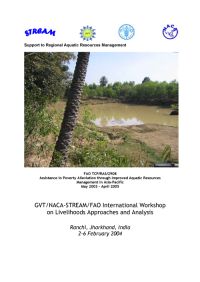
The purpose of the workshop was to develop and document mechanisms for training in livelihoods approaches and analysis, and to build national capacity to conduct livelihoods analysis. The workshop in Ranchi was a joint India-Nepal event. A central element of the workshop was a visit to the Jabarrah community, where participants learnt about the community’s livelihoods. In addition to gaining information about the Jabarrah community itself, participants also had important insights into how best to conduct livelihoods analyses.
This report, the 24th in the series, contains information about the aquatic animal health status of seventeen states in the Asia-Pacific region. The foreword discusses capacity building to prevent, prepare for an respond to aquatic animal health emergencies.
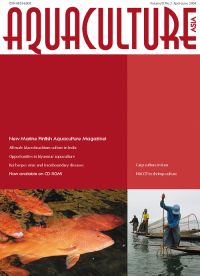
Genetic impacts of translocation on aquatic biodiversity in Asia. Carp culture in Iran. Opportunities and challenges in Myanmar aquaculture. Impacts of monosex Macrobrachium culture on seed availability in India. Use of new technology and skills for eco-friendly production of tiger shrimp Penaeus monodon. Larval rearing and spat production of the windowpane shell Placuna placenta. HACCP in shrimp farming. First breeding success of Napoleon wrasse Cheilinus undulatus and coral trout Plectropomus leopardus.
The recommendations are derived from discussions at the consultation and three expert working groups and were adopted during the final plenary session of the Expert Consultation. Together they represent a powerful set of recommendations in use of rapid diagnostic tools for better health management in shrimp aquaculture. They have been put together in this summary document for rapid dissemination to potential users, researchers and other interested parties, in India and elsewhere.
30 January 2004 | Graham Haylor, William Savage and S.D. Tripathi | 1370 Downloads | .pdf | 382.99 KB
The visit was to plan the proposed case studies, the State-level Workshops and the consensus-building process of the DFID NRSP Research Project R8100 entitled “Investigating Improved Policy on Aquaculture Service Provision to Poor People”. Meetings were held with GVT staff, jankars and farmers from communities in villages in Orissa, Jharkhand and West Bengal, and officials of Departments of Fisheries in Orissa, West Bengal and Jharkhand. Meetings were also held with GVT, ICAR and the Fisheries Commission.
30 January 2004 | S. Ayyappan, P. Bueno and G. Haylor | 1325 Downloads | .pdf | 97.9 KB
To organise, to form a union, to become an alliance, is a fundamental of human social behaviour. Farming is one of the earliest examples of sustained collective livelihood. This missive relates some early exciting experiences of associations of farmers that are emerging from amongst tribal communities, which constitute some of the most disadvantaged in India, and the work that these organisations and other partners have made towards poverty alleviation through support for aquaculture.
30 January 2004 | Graham Haylor, William Savage and | 1612 Downloads | .pdf | 320.32 KB
The three State-level Workshops were held in West Bengal, Jharkhand and Orissa in October 2002. The aim and objectives of the workshops were to contribute to “giving people a voice” in policy-making processes that have an impact on their livelihoods, to understand a process for transacting institutional and policy change, to provide feedback on case studies and to review emerging “indicators of change” and provide input into the subsequent Stakeholders Workshop.
30 January 2004 | Graham Haylor and William Savage | 1279 Downloads | .pdf | 103.51 KB
This paper is about a process and practice which is bringing representatives of tribal communities in three Indian states together with district, state and national government officials, around the issue of aquaculture services provision. The project comprises a series of visits, fieldwork, workshops, case studies, a consensus-building process, literature research and documentation. Among its aims are building shared understandings of government services provision among recipients, implementers and policy-makers, and facilitating an equitable dialogue towards policy change.