NACA member governments are: Australia, Bangladesh, Cambodia, China, Hong Kong SAR, India, Indonesia, I.R. Iran, Kingdom of Saudi Arabia, Korea (DPR), Lao PDR, Malaysia, Maldives, Myanmar, Nepal, Pakistan, Philippines, Sri Lanka, Thailand and Vietnam.
Exotic trout fisheries resources and potentialities in Uttarakhand; Scenario of captive production of Clarias magur in India; Strategies to reduce feed cost by improving gut health and nutrient utilisation of fish in aquaculture; Fish pituitary gland collection and supply as a vocation in West Bengal, India; Coral trout Plectropomus leopardus aquaculture research and fingerling production in Indonesia; Smartphone app improving smallholder shrimp farming practices in Bangladesh; NACA Newsletter.
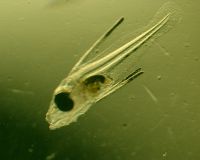
Coral trout Plectropomus leopardus is an emerging exported grouper commodity in Indonesia. The demand for coral trout fingerlings has been increasing and the value of this species is the highest among groupers. However, the rearing of coral trout larvae is notoriously more ‘difficult’ than other groupers. This article describes research on coral trout larval rearing protocols conducted by the Institute for Mariculture Research and Fisheries Extension, which has achieved a survival rate of 12%.
Mahseer sanctuaries of Meghalaya: A conservation and recreational perspective; Impacts of climate change on aquaculture in Vietnam: A review of local knowledge; Simple means of water aeration adopted by progressive fish breeders in West Bengal, India; Breeding striped snakehead (Channa striata) using the concrete tank method in the Cangkringan Area, Special Region of Yogyakarta; NACA Newsletter.
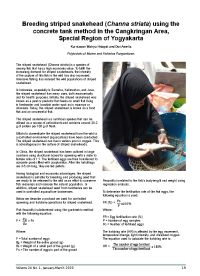
The striped snakehead (Channa striata) is a species of swamp fish that has a high economic value. Intensive fishing has reduced the wild populations. Hatchery production of this species has the potential for both commercial aquaculture supportive breeding programmes to conserve fish resources and increase the natural population. Below we describe a protocol we used for controlled spawning and hatchery operations for striped snakehead.
The 35th Session of Asia-Pacific Fishery Commission has identified the lack of effective governance as a major threat to sustainable aquaculture growth for greater contribution to achievement of the Sustainable Development Goals. The objectives of the consultation were to: Share the results of country studies on aquaculture governance in respective countries; identify gaps, issues and challenges in aquaculture governance; and recommend strategies and actions to improve and strengthen aquaculture governance.
Audio recording of presentation delivered at the Consultation on Strengthening Governance of Aquaculture for Sustainable Development in Asia-Pacific, 5-6 November 2019, Bangkok, Thailand.
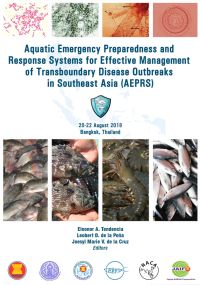
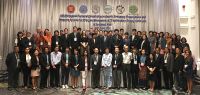
The ASEAN Regional Technical Consultation on Aquatic Emergency Preparedness and Response Systems for Effective Management of Transboundary Disease Outbreaks in Southeast Asia was held from 20-22 August 2018 in Bangkok, Thailand. The consultation discussed the status of and/or need for aquatic emergency preparedness and response systems for effective management of transboundary disease outbreaks in Southeast Asia. Issues were addressed through country reports, technical presentations and a workshop.
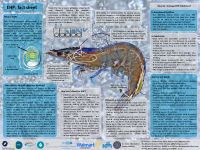
EHP or Enterocytozoon hepatopenaei is a fungal microsporidian parasite that infects the hepatopancreas (hp) of tiger shrimp (Penaeus monodon) and whiteleg shrimp (P. vannamei) in Thailand and results in slow growth and, in chronic infections, mortalities. EHP is also known from Brunei, China, India, Indonesia, Malaysia, Philippines, Venezuela and Vietnam. This fact sheet provides information on the EHP life cycle, signs of infection, diagnosis and management in both hatcheries and growout, as well technical contacts for further information.
Two consultations were held back to back in Thailand from 5-7 November, namely the Consultation on Strengthening Governance of Aquaculture for Sustainable Development in Asia-Pacific and the Consultation on Demographic Changes in Fishing Communities in Asia. The consultations were held at the Centara Grand Hotel at Ladprao, Bangkok. The consultations were attended by 29 participants from 15 countries in the Asia-Pacific region. The consultations were jointly organised by FAO and NACA. Audio recordings are available of some presentations.
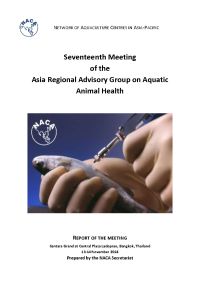
This report summarises the proceedings of the 17th meeting of the Advisory Group, held 13-14 November 2018 in Bangkok, Thailand. The group's role includes reviewing disease trends and emerging threats in the region, identifying developments in global aquatic disease issues and standards, evaluating the Quarterly Aquatic Animal Disease Reporting Programme and providing guidance on regional strategies to improve aquatic animal health management.
Fifty fellowships are available for young scientists and researchers under the ASEAN-India Research Training Fellowship Scheme (AIRTF), to study at Indian academic and R&D institutions. The fellowships are for a period of up to six months and include travel and financial support. The fellowships are intended to build capacity among young ASEAN researchers in science and technology and to further strengthen the bond between India and ASEAN member states.
On behalf of NACA the Secretariat wishes to express our condolences and solidarity with Indonesia in the wake of the devastating tsunami in Sulawesi. Our thoughts are with the people at this time. We wish for a speedy recovery from this disaster and our members look forward to supporting the Indonesian Government in rebuilding livelihoods in affected areas.
The ASEAN Regional Consultation on Aquatic Emergency Preparedness and Response Systems for Effective Management of Transboundary Disease Outbreaks in Southeast Asia was held in Bangkok, 20-22 August. The objective of the consultation was to bring together ASEAN member states and technical experts to discuss the current status of emergency animal disease preparedness and response systems, and to identify gaps and opportunities for regional cooperation in management of transboundary disease.
The EURASTiP Exchange Programme provides opportunities for industry, researchers and educators from Europe and south-east Asia to connect and gain new perspectives while sharing innvovative ideas to help develop long term partnerships. Bursaries of up to €3,000 per exchange are available (subject to eligibility criteria) to support international innovation and collaboration. The deadline for applications is 20 September 2018. For more information on how to apply please see the EURASTiP website.
The 76th edition of the Quarterly Aquatic Animal Disease Report contains information from 14 governments. The foreword discusses the outcomes of a Stakeholder Consultation on Progressive Management Pathway to Improve Aquaculture Biosecurity, organised by the Food and Agriculture Organization of the United Nations, Mississippi State University and the World Bank.
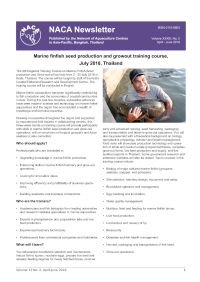
Marine finfish seed production and growout training course, Thailand; global fish passage forum to include first symposium on hydropower and fish; International Workshop on Rehabilitation, Propagation and Conservation of Mahseer, India; World Brackishwater Aquaculture Conference, January 2019, India; Offshore Mariculture Asia 2018, 15-17 May, Singapore; Video lectures: Regional Training Course on Culture-based Fisheries in Inland Waters; Youth and Fish Drawing Competition Art Book; Report of the Sixteenth Meeting of the Asia Regional Advisory Group on Aquatic Animal Health.
This report summarises the proceedings of the 16th meeting of the Advisory Group, held 26-27 August 2017 in Bali, Indonesia. The group's role includes reviewing disease trends and emerging threats in the region, identifying developments in global aquatic disease issues and standards, evaluating the Quarterly Aquatic Animal Disease Reporting Programme and providing guidance on regional strategies to improve aquatic animal health management. The meeting included discussion on Tilapia Lake Virus (TiLV) and developments in antimicrobial resistance.
This collection contains video recordings of the lectures from the Regional Training Course on Culture-based Fisheries in Inland Waters, held at Nha Trang University, Vietnam. The objective of the course was to provide participants with the skills to assist local communities to plan and manage culture-based fisheries; a relatively simple and low cost technology that can deliver nutritional and economic benefits to rural communities with few livelihood options. The course was sponsored by the United Nations University Fisheries Training Programme.
The first ever Regional Training Course on Culture-based Fisheries in Inland Waters was held at Nha Trang University from 30 October to 8 November. The objective of the course was to provide participants with the skills to assist local communities to plan and manage culture-based fisheries. These practices are an example of a relatively simple and low cost technology that can deliver nutritional and economic benefits to rural communities, which often have few livelihood options.
Since 2009, tilapia aquaculture has been threatened by mass die-offs in Israel and Ecuador, which have been caused by a novel Orthomyxo-like (RNA) virus named Tilapia lake virus. This has been reported as a newly emerging virus that causes syncytial hepatitis of tilapia. An emergency regional consultation was held in Guangzhou, China from 27-28 September 2017 to discuss and plan actions on the overall prevention and management of this disease.