NACA member governments are: Australia, Bangladesh, Cambodia, China, Hong Kong SAR, India, Indonesia, I.R. Iran, Kingdom of Saudi Arabia, Korea (DPR), Lao PDR, Malaysia, Maldives, Myanmar, Nepal, Pakistan, Philippines, Sri Lanka, Thailand and Vietnam.
WorldFish is seeking a Post Doctoral Fellow to coordinate and conduct research on emerging aquatic animal health challenges as a component of the Fish Health and Nutrition Research Cluster of the CGIAR Research Program on FISH. S/he will involve in epidemiological research on emerging fish diseases and engaging international and national research teams in Bangladesh, Egypt, Malaysia and other WorldFish focal and scaling countries and partners to deliver high quality research on aquatic animal health.
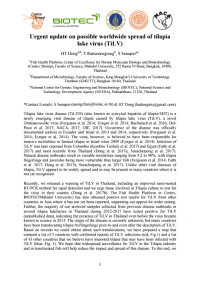
20 May 2017 | H.T. Dong, T. Rattanarojpong and S. Senapin | 5235 Downloads | .pdf | 375.4 KB
Recently, we released a warning of TiLV in Thailand and an improved RT-PCR detection methodology. The Fish Health Platform in Centex, BIOTEC/Mahidol University has also obtained positive test results for TiLV in other Asian countries where it has not yet been reported. Many countries have been translocating tilapia fry/fingerlings prior to and even after the description of TiLV. We have prepared a map listing countries with confirmed reports of TiLV infections and 43 other countries that we believe have imported infected fish.
The 73rd edition of the Quarterly Aquatic Animal Disease Report contains information from 14 governments. The foreword provides information about the implementation of a National Surveillance Programme for Aquatic Animal Diseases (NSPAAD) in India.
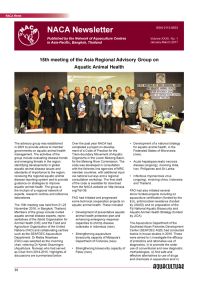
The 15th meeting of the Asia Regional Advisory Group on Aquatic Animal Health; a regional consultation on responsible production and use of feed in aquaculture; a report on the Giant Prawn 2017 conference; a preview of the new NACA website; and new initiatives on a very serious emerging issue - reducing the human and animal health risks from development of anti-microbial resistance in the aquaculture industry.
The development of resistant strains of disease-causing microorganisms is an important health issue of global concern. When microbes such as bacteria, fungi, parasites, and viruses become resistant to antimicrobial substances, the diseases they may cause become more difficult or impossible to treat. Resistance is developed by the indiscriminate use of antimicrobials and places human health at risk. The discovery of antibiotics revolutionised medicine, creating a belief that a 'magic bullet' had finally been found to control bacterial diseases. Antibiotics, a class of antimicrobial agents, kill or inhibit the growth of bacteria, but they have no significant effect on other types of microorganisms such as viruses.
7 March 2017 | Mohammed Suhaimee Bin Abdul Manaf | 11829 views | .mp3 | 6.31 MB
More than 293,000 tonnes of aquaculture feed was produced locally or imported to Malaysia in 2015. By 2020, it is estimated that almost 1.1 million tonnes of aquaculture feed will need to be produced. Discussions have been held with industry to expand capacity. DOF Malaysia is supporting good feed management, forumlation and nutrition practices by providing training courses for stakeholders. Farms and feed mills are audited with regards to feed and feeding processes based on MyGAP and legislative requirements.
The 15th meeting was held from 21-23 November 2016, in Bangkok, Thailand. A special session was held on addressing the use of anti-microbial substances in aquaculture and the development of anti-microbial resistance. This is an issue of global concern for both human and animal health, and it had been addressed by a resolution at FAO’s Thirty-ninth Conference in June 2015. The meeting reviewed in detail the status of aquatic animal disease in the region.
The 72nd edition of the Quarterly Aquatic Animal Disease Report contains information from 12 governments. The foreword provides information about the 15th Meeting of the Asia Regional Advisory Group on Aquatic Animal Health.
The Asia Regional Advisory Group on Aquatic Animal Health meets annually to discuss regional health issues including emerging disease threats. This report includes a review of regional disease status circa 2015, global and regional disease reporting arrangements, global issues and standards, progress in implementation of the the Regional Technical Guidelines on Health management for the Responsible Movement of Live Aquatic Animals, identification and designation of regional aquatic animal health resources and regional and international cooperation.
This report, the 71st in the series, contains information about the aquatic animal health status of sixteen states in the Asia-Pacific region. The foreword discusses changes to the Quarterly Aquatic Animal Disease Report, including a move to electronic-only distribution.
A Regional Proficiency Testing Program for Aquatic Animal Disease Diagnostic Laboratories in Asia-Pacific was developed to strengthen diagnostic capability across Asia. This capability was identified as a requirement to facilitate the sanitary safety of trade in aquatic animal products. The program provided 41 laboratories across the Asia-Pacific with the opportunity to assess their diagnostic performance for 10 regionally significant aquatic animal pathogens, and to adapt or modify practices where necessary to improve.
The Asia Regional Advisory Group on Aquatic Animal Health meets annually to discuss regional health issues including emerging disease threats. This report includes a review of regional disease status circa 2014, global and regional disease reporting arrangements, global issues and standards, progress in implementation of the the Regional Technical Guidelines on Health management for the Responsible Movement of Live Aquatic Animals, identification and designation of regional aquatic animal health resources and regional and international cooperation.
This report, the 68th in the series, contains information about the aquatic animal health status of thirteen states in the Asia-Pacific region. The foreword discusses harmonisation in ASEAN aquaculture certification.
12th Technical Advisory Committee held in Cha-am, Thailand. Audio recordings: WAS special session on regional cooperation for improved biosecurity. AFSPAN Final Technical Report now available! Pillay Aquaculture Foundation Awards for Scientists in Least Developed Countries. Gender seminar conducted and ASEAN Gender Network launched. A two-tube, nested PCR detection method for AHPND bacteria. 9th Regional Grouper Hatchery Production Training Course. Developing an environmental monitoring system to strengthen fisheries and aquaculture in the Lower Mekong Basin. Asia-Pacific Regional Workshop on the Status of Aquatic Genetic Resources for Food and Agriculture.
The objectives of the Aquaculture for Food Security, Poverty Alleviation and Nutrition (AFSPAN) project were to strengthen the knowledge base and develop new and more rigorous methodologies of quantifying the contribution of aquaculture to combat hunger and poverty, thus providing the evidence upon which sound strategies, policies and research programs can be developed to support the sustainable expansion of aquaculture to maximise its impact on food and nutrition security and poverty alleviation.
This report, the 67th in the series, contains information about the aquatic animal health status of fourteen states in the Asia-Pacific region. The foreword discusses the OIE Regional Workshop on Safe International Trade in Aquatic Animals and Aquatic Animal Products.
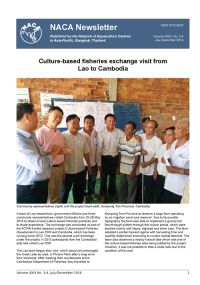
Culture-based fisheries exchange visit from Lao to Cambodia. National Fish Day, Cambodia. WAS Adelaide: Special Session on Regional Cooperation for Improved Biosecurity. Inbreeding and disease in tropical shrimp aquaculture: a reappraisal and caution. Shrimp EMS/AHPND Special Session at DAA9. 2nd International Symposium on Aquaculture and Fisheries Education. Report on Sustainable Fisheries and Aquaculture for Food Security and Nutrition.
The Asia Regional Advisory Group on Aquatic Animal Health meets annually to discuss regional health issues including emerging disease threats. This report includes a review of regional disease status circa 2013, global and regional disease reporting arrangements, global issues and standards, progress in implementation of the the Regional Technical Guidelines on Health management for the Responsible Movement of Live Aquatic Animals, identification and designation of regional aquatic animal health resources and regional and international cooperation.
This report, the 63rd in the series, contains information about the aquatic animal health status of fifteen states in the Asia-Pacific region. The foreword provides an update on acute hepatopancreatic necrosis disease of cultured shrimp, including a description of an improved PCR method for detection of AHPND bacteria.