NACA member governments are: Australia, Bangladesh, Cambodia, China, Hong Kong SAR, India, Indonesia, I.R. Iran, Kingdom of Saudi Arabia, Korea (DPR), Lao PDR, Malaysia, Maldives, Myanmar, Nepal, Pakistan, Philippines, Sri Lanka, Thailand and Vietnam.
This report, the 55th in the series, contains information about the aquatic animal health status of fourteen states in the Asia-Pacific region. The foreword discusses acute hepatopancreatic necrosis syndrome ("early mortality syndrome") in cultured shrimp in Asia.
This report, the 54th in the series, contains information about the aquatic animal health status of fourteen states in the Asia-Pacific region. The foreword discusses emerging aquatic animal diseases in the region, including acute hepatopancreatic necrosis disease and scale-drop syndrome.
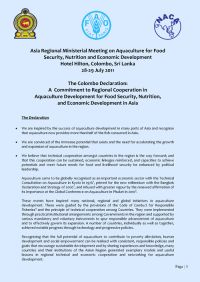
The Colombo Declaration is a commitment to regional cooperation in aquaculture development for food security, nutrition and economic development in Asia. It was developed and agreed on by delegations from 18 states at a ministerial-level meeting held in Colombo, Sri Lanka, 28-29 July 2011.
This report, the 5rnd in the series, contains information about the aquatic animal health status of thirteen states in the Asia-Pacific region. The foreword discusses the 8th Symposium on Diseases in Asian Aquaculture.
The recordings in this collection are the annual progress reports of NACA’s regional lead centres in India, Thailand, China and the Philippines, plus a summary of NACA’s progress over the past five years and a special address by Professor E.G. Silas. The presentations were made at the 22nd NACA Governing Council Meeting in Cochi, Kerala, from 9-11 May 2011, India.
This report, the 52nd in the series, contains information about the aquatic animal health status of thirteen states in the Asia-Pacific region. The foreword discusses transboundary disease issues and contingency planning.
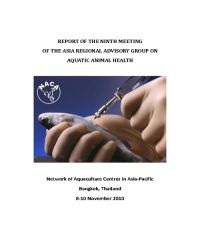
The Asia Regional Advisory Group on Aquatic Animal Health meets annually to discuss regional health issues including emerging disease threats. This report includes a review of regional disease status circa 2010, global and regional disease reporting arrangements, global issues and standards, progress in implementation of the the Regional Technical Guidelines on Health management for the Responsible Movement of Live Aquatic Animals, identification and designation of regional aquatic animal health resources and regional and international cooperation.
This report, the 51st in the series, contains information about the aquatic animal health status of twelve states in the Asia-Pacific region. The foreword discusses animal welfare in aquaculture.
This report, the 50th in the series, contains information about the aquatic animal health status of thirteen states in the Asia-Pacific region. The foreword discusses food safety and biosecurity.
This report, the 49th in the series, contains information about the aquatic animal health status of fifteen states in the Asia-Pacific region. The foreword discusses the outcomes of the ninth meeting of the Asia Regional Advisory Group on Aquatic Animal Health.
This report, the 48th in the series, contains information about the aquatic animal health status of fifteen states in the Asia-Pacific region. The foreword discusses current fish health concerns.
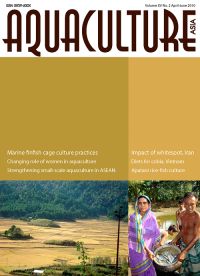
The Dedanaw Project, Myanmar. The changing face of women for small-scale aquaculture in Bangladesh. Strengthening capacity of small holders in ASEAN. Carp seed production in Orissa, India. Sustainable mountain paddy-fish farming of the Apatani tribes. The economic impacts of whitespot virus on shrimp production in Iran. Current practices of marine finfish cage culture in China, Indonesia, Thailand and Vietnam. Effects of trash fish on growth and body composition of cobia.
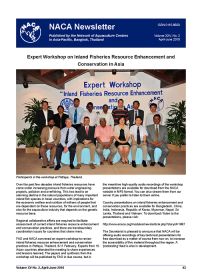
Expert Workshop on Inland Fisheries Resource Enhancement and Conservation in Asia. Reviews in Aquaculture: Special issue on the Use and Exchange of Aquatic Genetic Resources. Dr Ayyappan becomes the Director General of ICAR. CIBA training course - capacity building on entrepreneurship development in coastal aquaculture. Success Stories in Asian Aquaculture - now available for free download! Giant Prawn 2011. Peer reviewed publications. Meetings address climate change impacts on small scale milkfish farmers in the Philippines.
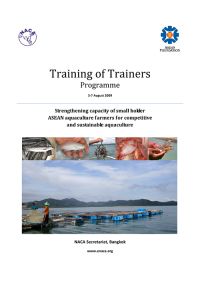
This is the manual for the "train the trainers" course aiming to increase the capacity of small-scale farmers in ASEAN countries. The manual focusses on five countries and commodities: Snakehead (Cambodia), Tilapia (Thailand), seaweed (Philippines), marine fish (Indonesia) and shrimp (Vietnam). In this volume, lectures presented by experts are included. The training program included technical aspects related to the culture of commodities, marketing, access to information, organization of farmer groups, gender and good culture practices.
This report, the 47th in the series, contains information about the aquatic animal health status of fifteen states in the Asia-Pacific region. The foreword discusses Asia-Pacific aquatic animal disease surveillance.
This report, the 46th in the series, contains information about the aquatic animal health status of sixteen states in the Asia-Pacific region. The foreword discusses important emerging diseases in the region and the outcomes of the 8th meeting of the Asia Regional Advisory Group on Aquatic Animal Health.
This report, the 45th in the series, contains information about the aquatic animal health status of sixteen states in the Asia-Pacific region. The foreword discusses the Sanitary and Phytosanitary (SPS) Agreement and its relationship to the OIE Aquatic Animal Health Standards.
This report, the 44th in the series, contains information about the aquatic animal health status of fifteen states in the Asia-Pacific region. The foreword discusses national aquatic animal health strategies.
This report, the 42nd in the series, contains information about the aquatic animal health status of fifteen states in the Asia-Pacific region. The foreword discusses import requirements for live aquatic animals and their products for the European Union.