NACA member governments are: Australia, Bangladesh, Cambodia, China, Hong Kong SAR, India, Indonesia, I.R. Iran, Kingdom of Saudi Arabia, Korea (DPR), Lao PDR, Malaysia, Maldives, Myanmar, Nepal, Pakistan, Philippines, Sri Lanka, Thailand and Vietnam.
12 May 2015 | T. Jutagate and W. Kwangkhang | 6087 Downloads | .pdf | 429.01 KB
Releasing of giant freshwater prawn (Macrobrachium rosenbergii) for the purposes of stock enhancement and to create a fishery has been conducted in Thailand since the 1980s. Average age at harvest is around 6 to 8 months, with an average total length of 20 cm. Overall, the success of stocking M. rosenbergii is poor since the recapture rate is generally less than 5 %. However, the economic return is high.
12 May 2015 | Sena De Silva, Brett Ingram and Simon Wilkinson | 53195 views | .pdf | 9.19 MB
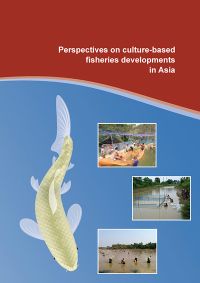
This book is the proceedings of the “Regional Consultation on Culture-Based Fisheries Development in Asia”, held in Siem Reap, Cambodia, 21-23rd of October 2014, under the auspices of the Australian Centre for International Agricultural Research (ACIAR), the Mekong River Commission (MRC) and the Network of Aquaculture Centres in Asia-Pacific (NACA). The consultation was jointly organised by NACA and the Fisheries Administration of the Royal Government of Cambodia.
The workshop, organised by FAO and NACA, was intended to enhance the capacity of national focal Points on Aquatic Genetic Resources within Asia-Pacific Region regarding the preparation of national reports on the current status of aquatic genetic resources for food and agriculture. These will be used as the major source of information for the first State of the World’s Aquatic Genetic Resources for Food and Agriculture report.
FAO and NACA convened a stakeholder consultation in Bangkok 25-27 March 2015 to discuss development of an environmental monitoring system for the lower Mekong Basin. The objective of the system is to strengthen the resilience of fisheries and aquaculture and to improve early warning for fishers and farmers. The workshop was preceded by baseline assessments of existing environmental monitoring and early warning systems relevant to fisheries and aquaculture in the target area.
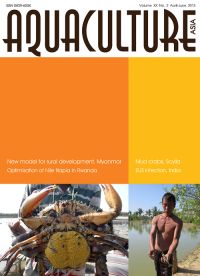
Anti-microbials and alternatives. Successful demonstration of new model for rural development in Myanmar. Optimisation of Nile tilapia (Oreochromis niloticus) production in ponds based on improved farm management practices in Rwanda. EUS infection in freshwater fishes of Andhra Pradesh. Development of pond-reared broodstock / spawners of green mud crab Scylla serrata. ASEAN Gender Network launched. A two-tube nested PCR detection method for AHPND bacteria. 9th Regional Grouper Hatchery Production Training Course.
12th Technical Advisory Committee held in Cha-am, Thailand. Audio recordings: WAS special session on regional cooperation for improved biosecurity. AFSPAN Final Technical Report now available! Pillay Aquaculture Foundation Awards for Scientists in Least Developed Countries. Gender seminar conducted and ASEAN Gender Network launched. A two-tube, nested PCR detection method for AHPND bacteria. 9th Regional Grouper Hatchery Production Training Course. Developing an environmental monitoring system to strengthen fisheries and aquaculture in the Lower Mekong Basin. Asia-Pacific Regional Workshop on the Status of Aquatic Genetic Resources for Food and Agriculture.
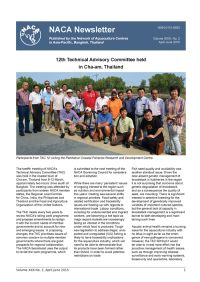
The twelfth meeting of NACA’s Technical Advisory Committee (TAC) was held in the coastal town of Cha-am, Thailand from 9-12 March. The TAC meets every two years to review NACA’s rolling work programme and propose amendments to realign it with the current needs of member governments and to account for new and emerging issues. In proposing changes, the TAC prioritises issues of common concern to member governments where there are prospects for regional collaboration.
The objectives of the Aquaculture for Food Security, Poverty Alleviation and Nutrition (AFSPAN) project were to strengthen the knowledge base and develop new and more rigorous methodologies of quantifying the contribution of aquaculture to combat hunger and poverty, thus providing the evidence upon which sound strategies, policies and research programs can be developed to support the sustainable expansion of aquaculture to maximise its impact on food and nutrition security and poverty alleviation.
The Gender and Aquaculture Seminar: Equity and Regional Empowerment in the Aquaculture Value Chain, a culminating activity for the NACA/USAID/MARKET Project’s Thematic Studies of Gender in Aquaculture, was held from 24 to 25 February 2015 in Bangkok. The project conducted research on womens’ roles and influence on selected aquaculture value chains in Cambodia, Lao PDR, Thailand and Vietnam. The goal of the research was to raise awareness and increase recognition of gender roles.
20 February 2015 | Sritunyalucksana, K., Dangtip, S., Sanguanrut, P., Sirikharin, R., Taengchaiyaphum, S., Thitamadee, S., Mavichak, R., Proespraiwong, P., Flegel, T.W. | 2506 Downloads | .pdf | 133.96 KB
A new method for the detection of AHPND-bacteria (AP4) has been published and is available for download. The advantage of the AP4 method over the previously published AP3 method is that it has 100 times higher sensitivity. Because of its higher sensitivity, the bacterial culture enrichment step needed when using the AP3 with low levels of AHPND bacteria may be omitted. However, the AP4 method should not be considered as a replacement for AP3.
The USAID Maximizing Agricultural Revenue through Knowledge, Enterprise Development, and Trade (MARKET) Project and NACA are hosting a Gender and Aquaculture Seminar: Equity and Regional Empowerment in the Aquaculture Value Chain on February 24-25 in Bangkok, Thailand. The USAID MARKET Project and NACA have undertaken a year-long research project on women’s roles and influence on selected aquaculture value chains in four countries in Southeast Asia.
This report, the 67th in the series, contains information about the aquatic animal health status of fourteen states in the Asia-Pacific region. The foreword discusses the OIE Regional Workshop on Safe International Trade in Aquatic Animals and Aquatic Animal Products.
Regional consultation on culture-based fisheries developments in Asia. Gender Assessment Synthesis Workshop. NACA participation in the 5th Global Symposium on Gender in Aquaculture and Fisheries, Lucknow, India. Broodstock Management in Aquaculture: Long term effort required for regional capacity building. Urgent appeal to control spread of the shrimp microsporidian parasite Enterocytozoon hepatopenaei (EHP).
A regional consultation was held to discuss culture-based fisheries development in Asia from 21 to 23 October 2014 in Siem Reap, Cambodia. The consultation was funded by the Australian Centre for International Agricultural Research as part of the project Culture-based fisheries development in Lao PDR and Cambodia. The consultation provided the opportunity to discuss the outcomes of a series successful projects that have been implemented over the past decade in the Asian region.
The NACA/USAID MARKET Gender Project organised a Gender Assessment Synthesis Workshop in Bangkok, Thailand from 29 September to 1 October 2014, which was attended by the MARKET gender project teams from Cambodia, Thailand and Vietnam. The objectives of the Synthesis Workshop were to assess the status of work on the in-country gender assessment reports and the case studies, including make a start on writing of case studies.
This report, the 66th in the series, contains information about the aquatic animal health status of fourteen states in the Asia-Pacific region. The foreword discusses key activities of the NACA Regional Aquatic Animal Health Programme.
The main objective of this symposium is to provide a venue for information sharing on extension of small-scale aquaculture, specifically targeted to those individuals and relevant organizations involved in various aquaculture development projects. The symposium will also assess and present the effectiveness of “farmer-to-farmer extension” approach in the implementation of relevant aquaculture development projects in the region. The symposium was organised for stakeholders in JICA-assisted projects in SE Asia and Africa.
This report, the 65th in the series, contains information about the aquatic animal health status of thirteen states in the Asia-Pacific region. The foreword discusses the outcomes of the 13th meeting of the Asia Regional Advisory Group on Aquatic Animal Health.
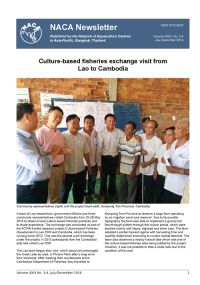
Culture-based fisheries exchange visit from Lao to Cambodia. National Fish Day, Cambodia. WAS Adelaide: Special Session on Regional Cooperation for Improved Biosecurity. Inbreeding and disease in tropical shrimp aquaculture: a reappraisal and caution. Shrimp EMS/AHPND Special Session at DAA9. 2nd International Symposium on Aquaculture and Fisheries Education. Report on Sustainable Fisheries and Aquaculture for Food Security and Nutrition.
We describe a new method for detecting isolates of Vibrio parahaemolyticus that cause acute hepatopancreatic necrosis disease (AHPND). This method is based on the gene sequence of a protein discovered in a sub-fraction of cell-free culture broth from isolates of V. parhaemolyticus that cause AHPND, but not from V. parahaemolyticus or other bacteria that do not cause AHPND. This cell-free preparation caused the typical signs of acute AHPND when administered to shrimp by reverse gavage.