NACA member governments are: Australia, Bangladesh, Cambodia, China, Hong Kong SAR, India, Indonesia, I.R. Iran, Kingdom of Saudi Arabia, Korea (DPR), Lao PDR, Malaysia, Maldives, Myanmar, Nepal, Pakistan, Philippines, Sri Lanka, Thailand and Vietnam.
This report, the 43rd in the series, contains information about the aquatic animal health status of fifteen states in the Asia-Pacific region. The foreword discusses emerging amphibian diseases in the region.
This report provides an appraisal of the status of mangrove ecosystems and linkages with associated communities and their livelihoods. The report addresses ecosystem health and function, the livelihoods of poor people, goods and services and gender issues. The major causes of impacts to mangrove forest and related aquatic resources are considered along with community perceptions of trends in natural resource quantity, economy, social relations and conflicts. Relevant policies and laws are briefly reviewed.
This report, the 42nd in the series, contains information about the aquatic animal health status of fifteen states in the Asia-Pacific region. The foreword discusses import requirements for live aquatic animals and their products for the European Union.
An increasingly secure future for wastewater-fed aquaculture in Kolkata, India? First culture-based fisheries growth cycle in Lao PDR is overhwelmingly encouraging. Revival of abandoned shrimp farms in Andhra Pradesh. Growth of industries linked with aquaculture in Kolleru Lake area, India. Applications of nutritional biotechnology in aquaculture. Technical and management aspects of catfish hatcheries in Vietnam. Asian seabass farming. Mariculture development opportunities in southeast Sulawesi, and much more.
Regional technical cooperation in reducing dependence on trash fish. Culture, capture conflicts in Indonesian reservoirs: Phase 2. Progress on the IFC/NACA ACEH Shrimp Project. Indian shrimp farmer societies succeed through better management practices. Multidisciplinary situation appraisal of mangrove ecosystems in Thailand. New CIFA Director appointed. FAO Glossary of Aquaculture.
In this report, we summarise the outcome of the first MANGROVE Project stakeholder workshop in Nakhon Si Thammarat in the Gulf of Thailand. The objectives of the workshop, held 6 March 2008, were to review and discuss project problem definition from different stakeholder perspectives, to understand how different stakeholders are affected in different ways, and to understand what kind of solutions are presented and by whom? The workshop was attended by community, local government and NGOs.
This report, the 41st in the series, contains information about the aquatic animal health status of sixteen states in the Asia-Pacific region. The foreword discusses emerging crustacean diseases.
Possible improvements to carp culture in Andhra Pradesh. Aquaculture and environmental issues in the region of Nai Lagoon, Vietnam. Selection potential for feed efficiency in farmed salmonids. Freshwater prawn broodstock concern in Bangladhesh hatcheries. Production of Cirrhinus molitorella and Labeo chrysophekadion for culture-based fisheries in Lao PDR: Nursery and grow-out. Mussel farming: Alternate water monitoring practice. Use of poultry by-product meals in pelleted feed for humpback grouper Cromileptes altivelis.
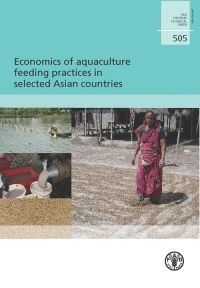
This technical paper provides an analysis of the economic implications of, and the reasons for, adopting various feeding practices for different fish species and aquaculture systems in Asia. The systems studied include extensive/traditional, semi-intensive and intensive farms for a number of different species including sutchi and pangasiid catfishes (Bangladesh and Viet Nam), hybrid catfish (Thailand), carp polyculture (India and China), prawn and milkfish polyculture (the Philippines).
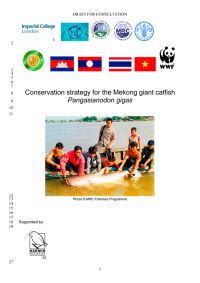
This is a draft conservation strategy for the Mekong giant catfish prepared under the project Development of a conservation strategy for the critically endangered Mekong giant catfish, released for public consultation. The strategy considers the population and legal status, conservation vision and goals, factors affecting the wild population and outlines a conservation strategy. The document also considers monitoring, research and adaptive management and implementation issues given the transboundary and multi-institutional nature requirements for effective implementation.
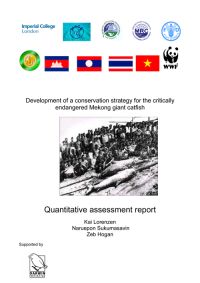
This report provides a quantitative assessment of the conservation of the Mekong giant catfish, Pangasianodon gigas, and an evaluation of the likely effectiveness of different conservation options. The report conisders the history of fisheries exploitation and environmental change, the estimated wild population size of P. gigas, the role of captive populations held by the Thailand Department of Fisheries and interactions with cultured fish. It makes a series of recommendations for conservation of this species.
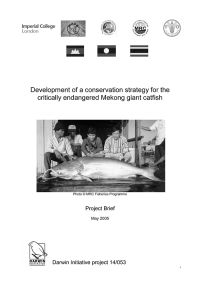
This is a brief of a project to develop an overarching conservation strategy for the Mekong giant catfish integrating supportive breeding with harvest and habitat management. This will involve (1) quantitative assessment of population status based on existing information, (2) quantitative assessment of the likely effectiveness of different conservation measures (3) review and improvement of captive breeding procedures; (4) promotion of appropriate adaptive policies for the further development of the strategy; and (5) definition of an overall conservation strategy.
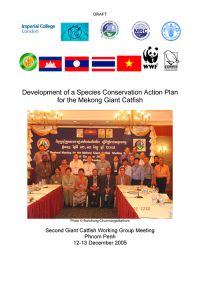
This is the report of the Second Mekong Giant Catfish Working Group Meeting, held in Phnom Penh 12-13 November 2005, under the project Development of a conservation strategy for the critically endangered Mekong giant catfish. The purpose of the workshop was to review existing knowledge on Mekong giant catfish, identify future conservation and research priority activities, and to continue the joint planning process aimed at developing an overarching conservation strategy.
From integrated carp polyculture to intensive monoculture in the Pearl River Delta, China. Better management practices for Vietnamese catfish. Ipomoea aquatica - an aquaculture friendly macrophyte. Status of fisheries and aquaculture development in Pakistan. The changing face of post-grad education in aquaculture: Contributing to soaring production and sustainable practices. Hatchery management in Bangladesh. Production of Cirrhinus molitorella and Labeo chrysophekadion for culture-based fisheries in Lao PDR and much more.
The Asia Regional Advisory Group on Aquatic Animal Health meets annually to discuss regional health issues including emerging disease threats. This report includes a review of regional disease status circa 2007, global and regional disease reporting arrangements, global issues and standards, progress in implementation of the the Regional Technical Guidelines on Health management for the Responsible Movement of Live Aquatic Animals, identification and designation of regional aquatic animal health resources and regional and international cooperation.
This report, the 39th in the series, contains information about the aquatic animal health status of fifteen states in the Asia-Pacific region. The foreword discusses the 7th Symposium on Diseases in Asian Aquaculture.
Developing guidelines for sustainable freshwater aquaculture planning in Vietnam. Aquaculture production, certification and trade for small-scale farmers. Backyard hatcheries for crustaceans in Thailand. Alternative carp species for diversification in India. Genetic and reproduction technologies for aquaculture and fisheries management of Murray cod. Status of sahar domestication in Nepal. Comparative advantage analysis of shrimp production in Asia. Strategies to improve the livelihoods of the rural poor, Vietnam, and more.
Better management practices for catfish aquaculture in the Mekong Delta, Vietnam. Developing better management practices for marine finfish aquaculture. Workshop on modelling carrying capacity for tropical finfish cage culture: Towards a consensus view. First comprehensive genetic management plan for Asian fish species: Mahseer. NACA and World Fisheries Trust sign agreement on collaboration. Fish Health Master Class. Second Workshop on Application of Molecular Genetic Techniques in Inland Fisheries and Aquaculture Management. Two new species of spiny eels described from Myanmar. Importance of species identification in conservation. Koh Yao Noi mangrove replanting in celebration of 80th birthday of His Majesty the King of Thailand. Responsible movement of live food finfish within ASEAN: Implementation workshop. Consultation on aquaculture certification guidelines. Strengthening regional mechanisms to maximise benefits to small-holder shrimp farmer groups adopting better management practices.
This report describes a training course on marine finfish hatchery protocols, which was convened at the Karabi Coastal Fisheries Research and Development Center, Thailand at the request of the Secretariat of the Pacific Community. The main goal of the training was to carry out hands-on practical work in finfish hatchery techniques, with an emphasis on grouper. This work involved spawning induction, incubation and larval rearing until day 12.
This report, the 38th in the series, contains information about the aquatic animal health status of seventeen states in the Asia-Pacific region. The foreword discusses the OIE/NACA Regional Workshop on Aquatic Animal Health.