NACA member governments are: Australia, Bangladesh, Cambodia, China, Hong Kong SAR, India, Indonesia, I.R. Iran, Kingdom of Saudi Arabia, Korea (DPR), Lao PDR, Malaysia, Maldives, Myanmar, Nepal, Pakistan, Philippines, Sri Lanka, Thailand and Vietnam.
This report is the outcome of a study conducted by NACA to assess the impact of the 2004 Indian Ocean tsunami and of the introduction of US anti-dumping duties on the shrimp farming sectors of countries in the Asia-Pacific region, with special focus on the effect that these unusual events had on shrimp prices and stakeholders' livelihoods. The assessment was conducted by collecting data from a wide range of stakeholders involved with shrimp farming.
This report, the 34th in the series, contains information about the aquatic animal health status of fourteen states in the Asia-Pacific region. The foreword discusses efforts towards international harmonisation in aquatic animal health standards.
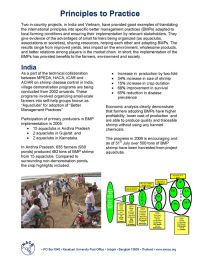
Two in-country projects, in India and Vietnam, have provided good examples of translating the International Principles on Responsible Shrimp Farming into specific better management practices (BMPs) adapted to local farming conditions and ensuring their implementation by relevant stakeholders. The results range from improved yields, less impact on the environment, wholesome products, and better relations among players in the market chain. In short, the implementation of the BMPs has provided benefits to the farmers, environment and society.
28 August 2006 | Nguyen Song Ha and Edward Smith | 2104 Downloads | .pdf | 772.08 KB
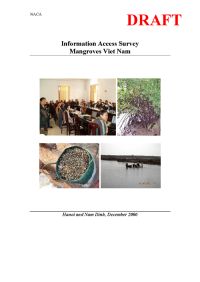
Viet Nam's mangrove forests have been severely impacted by human interventions, with a reduction in forestation from 408,000 ha in 1943 to a low of 150,000 ha in 2000. This study provides an overview of the information needs and communication issues surrounding people living in mangrove regions of Viet Nam. It is hoped that this study will help to raise the awareness of issues surrounding mangrove environments and improve the accessibility to information, for all stakeholders.
22 August 2006 | Song Ha Nguyen, Mai Tran Ngoc, Edward Smith, Aniza Suspita and Graham Haylor | 3836 Downloads | .pdf | 458.72 KB
The practical application of livelihoods approaches is still relatively new in development work and guidance is much sought by field teams. The concept aims to build a comprehensive picture of how people within communities live, rather than approaching development planning from a sectoral perspective such as agriculture, forestry or fisheries, to assist in planning interventions that will benefit present and future generations. This document discusses the concepts of livelihoods and sustainable livelihoods analyses with these objectives in mind.
7 May 2006 | Wilfredo G. Yap, Simon Funge-Smith, M. Rimmer, M.J. Phillips, Sih Yang Sim, H. Kongkeo and Pedro B. Bueno | 1675 Downloads | .pdf | 196.38 KB
This paper provides an overview of seafood consumption production in southeast Asia circa 2006. It forecasts a need for aquaculture to expand area under culture and intensity; highlights the potential for fishmeal to constrain growth, and identifies a trend towards cultivation of high-value species. Sources for the review included a regional synthesis of aquaculture developed for a regional workshop in 2005, a review of marine finfish hatchery development and a regional survey of cage fish culture.
20 April 2006 | Gonzales, E., Maung Soe, K., Mukherjee, R., Nguyen, S.H., Suspita, A., Wattoo, J.M. and Bulcock, P. | 3008 Downloads | .pdf | 287.29 KB
This report examines the role mariculture could play in reducing poverty and providing alternative livelihood opportunities for people living in coastal areas. This includes a review of the current status of coastal poverty, coastal livelihoods and vulnerabilities within the Asia-Pacific region and the experiences and examples of sustainable economic development through mariculture. This review then identifies key follow-up actions and recommends strategies for future pro-poor mariculture development.
This manual provides guidelines for attaining better practices in culture-based fisheries, an emerging practice in rural areas in the Asian region. It deals with the principles of culture-based fishery practices, primarily based on relatively long-term experiences in Sri Lanka and Vietnam. It deals with the gross factors that are applicable to improving fish yields and therefore revenue; and sustaining culture based fisheries as a development activity in the long-term.
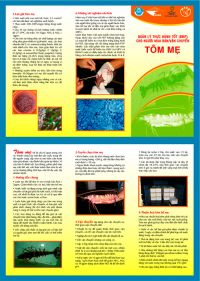
A series of leaflets on better management practices for Penaeus monodon shrimp aquaculture in Vietnam. The leaflets are available in both Vietnamese and English and cover: Broodstock management for suppliers, postlarvae selection and transportation for seed traders, shrimp seed quality, pond preparation, good pond management, shrimp health management.
This is the proceedings of the workshop on Building capacity to combat impacts of aquatic invasive alien species and associated trans-boundary pathogens in ASEAN countries, held in Penang, Malaysia, on the 12th-16th July 2004. The workshop built on the recommendations from a 2002 workshop organised by the Global Invasive Species Program and a 2003 workshop of countries sharing the Mekong watershed, in promoting awareness, coordination mechanisms and information exchange systems and identifying management and risk mitigation measures.
These are the proceedings of two Workshops on Capacity Building for Situation Analysis of Mangroves Ecosystem and Communities, held in Hanoi and Nam Dinh, 4-8 December 2006. The workshop focused on developing the knowledge and skills of the VNU team in Sustainable Livelihoods Analysis through the application of Participatory Rural Appraisal (PRA) techniques. The workshops were funded under the European Union Mangrove Project (2005-2008) in preparation for commencement of field-based activities and situation analysis.
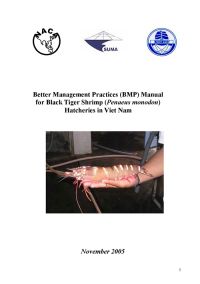
In order to provide practical and effective technical guidance for shrimp hatchery management, it is necessary to establish a set of better management practices (BMPs) which underpin an effective hatchery production system. This document is not a complete manual on the management of P. monodon hatcheries but concentrates on the implementation of BMPs for the hatchery covering all of the critical stages and processes in the production cycle, which are currently believed to be causing problems in Vietnamese hatcheries.
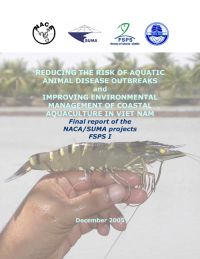
This report describes the experiences and lessons learnt from activities conducted by NACA in Viet Nam to support the sustainable development of the aquaculture sector using better management practices and harmonised strategies for the management of aquatic animal health and environmental problems. Achievements included reducing the risk of diseases from seed and on farms, developing capacity at the provincial and national levels, developing an effective surveillance system and wide dissemination of experiences.
This report, the 31st in the series, contains information about the aquatic animal health status of fourteen states in the Asia-Pacific region. The foreword discusses recent activities to strengthen aquatic animal health management in ASEAN.
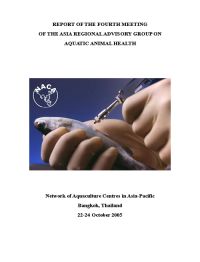
The Asia Regional Advisory Group on Aquatic Animal Health meets annually to discuss regional health issues including emerging disease threats. This report includes a review of regional disease status circa 2005, global and regional disease reporting arrangements, global issues and standards, progress in implementation of the the Regional Technical Guidelines on Health management for the Responsible Movement of Live Aquatic Animals, identification and designation of regional aquatic animal health resources and regional and international cooperation.
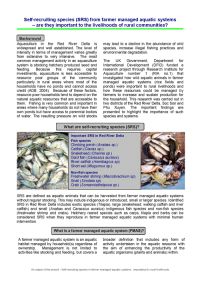
Self-recruiting species are defined as aquatic animals that can be harvested from farmer managed aquatic systems without regular stocking. This may include indigenous or introduced, small or larger species. Identified self-recruiting species in the Red River Delta includes exotic species (tilapia), large (snakehead, walking catfish and river catfish) and small (Anabas and Carassius auratus) indigenous fish species and non-fish species (freshwater shrimp and crabs).
In this issue: Seaweed culture and farmer incomes in Bekasi, Indonesia. Significant change for a self-help group. Conflict over fishing in Jharkhand. Critical steps in preparing coastal communities for effective policy changes. New guidelines on data collection and information sharing for co-management. About the STREAM Journal. About STREAM. This edition is also available in Ilonggo.
This report, the 30th in the series, contains information about the aquatic animal health status of sixteen states in the Asia-Pacific region. The foreword discusses capacity building and harmonisation in aquatic animal health within ASEAN.
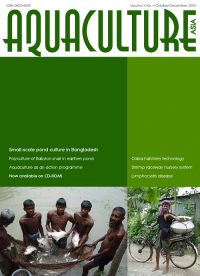
Small-scale pond culture in Bangladesh. Issues and challenges in community-based aquaculture. Aquaculture as an action programme building confidence and self-worth. Transforming policy recommendations into pro-poor service provision. Grow out of spotted Babylon to marketable size in polyculture with seabass. Influence of economic conditions and global shocks on grouper markets. Status of cobia hatchery technology in Vietnam. Organic shrimp raceway system. Macrobrachium rosenbergii in Vembanad Lake. Management of monogenean parasites.
20 September 2005 | Flavio Corsin, Michael Phillips, Pham Van Khang and Nguyen Tu Cuong | 1398 Downloads | .pdf | 852.99 KB
This presentation provides an overview of Vietnamese experience on the implementation of better management Practices (BMPs) and good aquaculture practices (GAP) in shrimp aquaculture. Practices were implemented collectively by encouraging small-scale farmers to form groups that collaborate on issues such as screening seed for disease and improving water quality management. Improvements to crop outcomes were observed. The results presented include the profitability of BMP adopted ponds.