NACA member governments are: Australia, Bangladesh, Cambodia, China, Hong Kong SAR, India, Indonesia, I.R. Iran, Kingdom of Saudi Arabia, Korea (DPR), Lao PDR, Malaysia, Maldives, Myanmar, Nepal, Pakistan, Philippines, Sri Lanka, Thailand and Vietnam.
3 February 2004 | Haylor, G., Briggs, M.R.P., Pet-Soede, L., Tung, H., Yen, N.T.H., Adrien, B., O'Callaghan, B., Gow, C., De Vantier, L., Santos, R., Pador, E., de la Torre, M., Bulcock, P., and Savage, W. | 25525 views | .pdf | 2.25 MB
Wild-harvest fisheries for live reef fish are largely over-exploited or unsustainable. Sustainable aquaculture – such as that of groupers – is one option for meeting increasing demand for reef fish as well as potentially maintaining livelihoods of coastal communities. This report draws upon secondary literature, media sources and four diverse case studies from at-risk reef fisheries, to frame a strategy for encouraging sustainable aquaculture as an alternative to destructive fishing practices. It was commissioned by the APEC Secretariat.
3 February 2004 | IUCN Vietnam Program | 1647 Downloads | .pdf | 376.38 KB
This case study describes the present status and trends, and provides recommendations for the improvement of aquatic resources management within Hon Mun Marine Protected Area (MPA), Nha Trang Bay, Khanh Hoa Province, Vietnam. The case study also evaluates options for improving the livelihoods of local villagers through the development of ecologically sustainable aquaculture and fisheries, which include diversification following careful selection and trial of appropriate culture species, and application of “best practice” culture methods.
This Learning Workshop on Livelihoods Analysis was held in Long An Province, Vietnam from 19-20 November 2002. It was part of an ongoing series of activities that will inform the implementation of the Ministry of Fisheries Strategy on Sustainable Aquaculture for Poverty Alleviation under the Vietnamese Government’s Hunger Eradication and Poverty Reduction (HEPR) Program. The recruitment in October of Nguyen Song Ha, STREAM Vietnam Communications Hub Manager, improved preparations within the Vietnamese national context.
A scoping Meeting on “Sustainable Aquaculture for Poverty Alleviation” was held in Hanoi , 23-25 May 2000. The meeting was held to review the role of aquaculture development (freshwater, brackish water and marine environments) in poverty alleviation and hunger eradication in Vietnam, to identify strategies for the more effective application of aquaculture and aquatic resources management to poverty alleviation, to review a draft framework for a programme on sustainable aquaculture for poverty alleviation and to prepare an appropriate action plan.
In this issue: Creating understanding and ownership of collaborative research results through 'learning by doing'. Fish culture, farming, markets and promotion - an integrated, sustainable approach to aquaculture and rural development. Fisheries policy reform impact assessment in Cambodia - understanding policy and poor people. "Shrimp hero" Phan The Phuong. Coral farming in Vietnam. The global fisheries market - can rural poor people benefit? Issues raised by STREAM Media Monitoring reports. About the STREAM Journal. About STREAM. This edition is also available in Ilonggo.
This report, the 23rd in the series, contains information about the aquatic animal health status of twenty states in the Asia-Pacific region. The foreword discusses a project on Capacity and Awareness Building on Import Risk Analysis for Aquatic Animals, funded by the APEC Fisheries Working Group.
1 January 2004 | Geoff Allan and Don Fielder (eds.) | 2225 Downloads | .pdf | 376.27 KB
To review mud crab aquaculture in Australia and Southeast Asia, ACIAR funded a scoping study, followed by a workshop to review the study and discuss status and problems in different regions of Australia and Southeast Asia. The primary conclusion from the scoping study, verified by workshop discussion, was that the substantial crab farming operations which exist throughout Southeast Asia are still mainly based on wild caught crablets.
Outcomes of the 15th Governing Council. Aquaculture seminar. Council Chair for 2004-2005. Shrimp disease and coastal management - four years. New Import Risk Analysis publications. Reducing the risk of shrimp disease outbreaks in Vietnam. Network of Aquaculture Centres in Central and Eastern Europe. OASIS: The One Stop Aqua Shop Information Service. Other recent STREAM activities. New faces at NACA.
23 November 2003 | Tran Van Nhuong, Michael J. Phillips and Raymon Van Anrooy | 1261 Downloads | .pdf | 102.66 KB
This case study was carried out in the North and North Central of Vietnam. The study was based on discussions and structured interviews with farmers, extension officers and other stakeholders. The objectives of the study were to describe the current coastal aquaculture practises, the impact on the livelihood of the coastal inhabitants and on the environment, to discuss the current situation in relation to the Code of Conduct for Responsible Fisheries and identify issues where BMPs should be introduced.
The goal of this project was to optimise the economic yield from mixed shrimp aquaculture-mangrove forestry farming systems in Ca Mau Province, Vietnam, in a sustainable manner. Specific objectives were to investigate factors controlling the yields of shrimp and wood from shrimp farming-mangrove systems, experiment with shrimp pond and mangrove forest management to evaluate different culture options, identify improved practices and assist government to transfer the results of the project to the wider coastal farming community.
This collection of publications originates from the International Consortium Program on Shrimp Farming and the Environment, which was implemented by the World Bank, the Network of Aquaculture Centres in Asia-Pacific (NACA), the World Wildlife Fund (WWF), the Food and Agriculture Organization of the United Nations (FAO), and the United Nations Environment Programme (UNEP). The consortium supported 35 complementary case studies prepared by more than 100 researchers in more than 20 shrimp farming countries.
19 November 2003 | De Silva, S.S., S.Y. Sim and M.J. Phillips (eds.) | 2075 Downloads | .pdf | 960.92 KB
The Expert Consultation on Aquaculture Education in the Asia-Pacific was held in, Vietnam, 2000. The consultation was the final activity of APEC project FWG/02/99 “Collaborative Aquaculture Education Program”. This report gives the findings and papers presented to the Expert Consultation, including the follow-up recommendations for establishing an Aquaculture Educational Consortium, in the form of a network, comprising academic and training institutions in the Asia and Oceania regions.
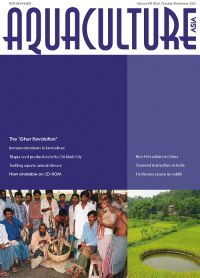
Freshwater prawn Macrobrachium nobilii for rural nutrition. Snapshots of a socially responsible farm in Sri Lanka. Introduction of rainbow trout in Nepal. Tilapia seed production in Ho Chi Minh City, Vietnam. Seaweed mariculture - scope and potential in India. Growth enhancement of carp and prawn through dietary suppliementation with salt. Fertilisation and water quality management in small ponds. The "Gher Revolution". Exercising responsibilities to tackle aquatic animal disease. Immunostimulants in aquaculture.
In this issue: Livelihood improvements through fisheries in the Pode community in Pokhara, Nepal. Women's participation in coastal resources management and livelihoods in Khanh Hoa Province, Vietnam. Supporting people's efforts and interactions in coastal resources management in Indonesia. Planning for a community fisheries M&E system. Identifying needs and recommendations for efficient stakeholder communications through an information access survey. IEC Seminar-Workshop in Support of Fisheries Ordinance Implementation in Roxas City, Philippines. About the STREAM Journal. About STREAM.
The Second STREAM Regional Conference was held in Tagaytay City, Philippines, from 8-10 June 2003 with the participation of 23 people from Australia, Cambodia, India, Nepal, Philippines, Thailand, Vietnam and Yunnan Province of China. Following a regional overview of STREAM’s themes, country partners, donors and funding, and activities, participants visited four “stations” on the themes of livelihoods, institutions, policy development, and communications, working in groups representing National Coordinators, Communications Hub Managers, and Partners. STREAM operations were discussed.
1 May 2003 | Sih Yang Sim | 1529 Downloads | .pdf | 830.7 KB
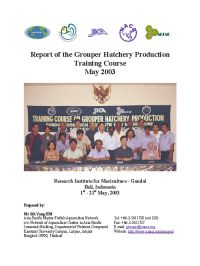
This report documents a training course that was held at the Research Institute for Mariculture, Bali, Indonesia in May 2003. The course covered both theoretical aspects of grouper husbandry via lectures and practical hands-on work in a grouper hatchery, including broodstock management, tank preparation egg collection, live feed production, health management, harvesting and transport and visits to commmercial grouper and milkfish hatcheries, grow-out facilities, markets and exporters.
In this issue: Livelihoods and languages - a SPARK-STREAM learning and communications process. Towards broader contextual understandings of livelihoods. Using tools to build shared understandings, using a sustainable livelihoods framework to learn. Learning about rattan as a livelihood. Meanings of "community-managed area". Lessons learnt about processes for learning and communicating. About the STREAM Journal. About STREAM. This edition is also available in Bahasa (Indonesia), Ilonggo, Vietnamese, Bengali and Oriya.
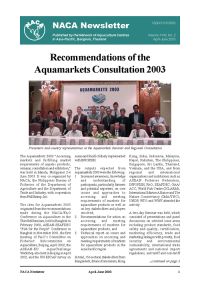
Recommendations of the Aquamarkets Consultation 2003. EC-funded project targets seafood trade and poverty. Shrimp disease control and coastal management. Fisheries and Adaptive Learning project. Shrimp aquaculture certification: Request for information & advice on a new web site. Workshop on control and responsible use of alien species. MPEDA/NACA Technical Assistance on Shrimp Health and Coastal Management. Changes to the regional list of aquatic animal diseases. STREAM SAPA Stakeholder Workshop in Hanoi. Regional Training Course on Grouper Hatchery Production. Review on low food chain species for marine fish culture. NACA/Deakin University to visit Indonesia 2-7 April 2003.
In this issue: Learning insights from the Fisheries Resource Management Project. An orientation on the SIAD approach and participatory local development planning. Group-building, production success and the struggle to prevent capture of the resource. Urban agriculture, water reuse and local economies: Case study of coastal riverine settlements of Ondo State, Nigeria. Livelihoods analysis: Actual experience from using PRA. A sustainable livelihoods approach to fisheries development for poverty alleviation in southeastern Vietnam. About the STREAM Journal. About STREAM.
This report, the nineteenth in the series, contains information about the aquatic animal health status of sixteen states in the Asia-Pacific region. The editorial discusses the role of the Quarterly Aquatic Animal Disease Reporting System.