This is a historical report describing the establishment of a marine finfish and shrimp aquaculture research programme by the SEAFDEC Aquaculture Department at its Tigbauan station. The report describes the facilities that were established, with diagrammes of the facility layout and list of personnel. It also summaries research findings and makes recommendations on future research directions, including on broodstock manturation, development of larval and compound feeds, health and extension of technology.
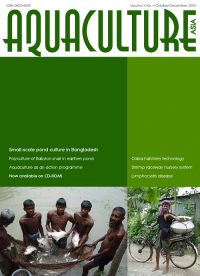
In this issue:
Small-scale pond culture in Bangladesh. Issues and challenges in community-based aquaculture. Aquaculture as an action programme building confidence and self-worth. Transforming policy recommendations into pro-poor service provision. Grow out of spotted Babylon to marketable size in polyculture with seabass. Influence of economic conditions and global shocks on grouper markets. Status of cobia hatchery technology in Vietnam. Organic shrimp raceway system. Macrobrachium rosenbergii in Vembanad Lake. Management of monogenean parasites.

This presentation provides an overview of Vietnamese experience on the implementation of better management Practices (BMPs) and good aquaculture practices (GAP) in shrimp aquaculture. Practices were implemented collectively by encouraging small-scale farmers to form groups that collaborate on issues such as screening seed for disease and improving water quality management. Improvements to crop outcomes were observed. The results presented include the profitability of BMP adopted ponds.
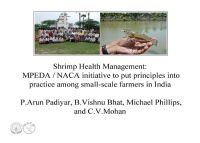
Presentation on a MPEDIA/NACA intiative to implement better management practices for shrimp farming amongst small-scale farmers in India via formation of farmer groups. The practices are based on the International Principles for Responsible Shrimp Farming. Adoption of improved farming practices reduces the incidence of disease and improves crop outcomes for small-scale farmers. This presentation was made at the World Aquaculture Society Conference in Bali, Indonesia, 2005.
Sổ tay nẩy với mục đích giúp đỡ cho cán bộ khuyến ngư hướng dẫn người nông dân kỹ thuật nuôi tôm nhằm mục đích đạt được sản lương và thu nhập ngày càng cao trong hệ thống nuôi kết hơp tôm - rừng ở Đồng bằng Sông Cửu Long. Với những kỹ thuật đơn giản, thông thường giúp cho ngư dân từng bước gia tăng sản lương mà ít bị rủi ro.