A free training course on mariculture technologies will be offered online via Zoom from 18 October to 5 November, by the Yellow Sea Fisheries Research Institute (YSFRI), People’s Republic of China. The course will cover genetics and breeding of mariculture species; large-scale propagation; disease control and prevention; nutrition research and feed development; technology for different farming models; equipment research, engineering and construction of farming facilities; quality and safety inspection technology for aquatic products. Space is limited, applications close 11 October.
Opinion: Benefits of animal welfare in Indian aquaculture; Imparting skill on formulated fish feed preparation to women’s self-help groups in villages – an experience; Farming of the anadromous shad, Tenualosa ilisha: Signs of taking off in India; Some facts on cannibalism in Wallago attu and its management during captive seed production; NACA Newsletter.
29 September 20212756 Downloads | .pdf | 1004.63 KB
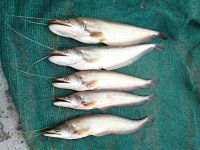
Wallago attu is a large catfish reaching 45 kg found in the Indian subcontinent, Thailand, Vietnam, Cambodia and Indonesia. Early attempts at captive production encountered high losses due to cannibalism during early life stages. This article discusses the causative factors governing cannibalism in this catfish, including rapid transfer from live to commercial feed, size differences during stocking, seasonal changes, feeding at long intervals, high density rearing, feed distribution, feeding method and size of feed, and management strategies for minimising losses during the seed rearing period.
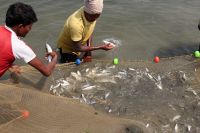
The andadromous shad Tenualosa ilisha (also known as hilsa) is an economically important food fish in south and southeast Asia. Populations of the species are declining globally, largely due to overexploitation and habitat modification. Its fishery has drastically declined in the Bay of Bengal bordering India. Considering the excessive demand and very high market price there have been efforts for domestication and farming of the species in India. Early efforts were not measurably successful. However, momentum on developing captive breeding and farming technologies for this species has been re-invigorated with research funding from the Indian Council of Agricultural Research.
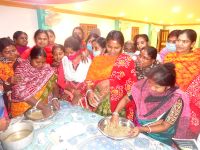
Preparation of locally made floating pelleted fish feed can be a profitable and sustainable income generating entrepreneurial activity for women's self-help groups in rural areas. Using such feed can also help small-scale marginal fish farmers to improve production and reduce their operating costs. This article describes initiatives to train women's self-help groups in formulated feed production in West Bengal, India.