12 May 2015J. Chandrasoma, K.B.C. Pushpalatha and W.A.J.R. Fernando | 2881 Downloads | .pdf | 453.97 KB
Sri Lanka is blessed with a large number of irrigation reservoirs. Culture-based fisheries (CBF) in seasonal reservoirs was initiated in the 1980’s and the government has recognised CBF as an effective way of increasing fish supplies in rural areas, at affordable prices, while providing employment and income to farmers and thereby contributing towards alleviation of poverty. The role of fisher community based organisations and fisheries management for effecting successful CBF are discussed.
12 May 2015T. Jutagate and W. Kwangkhang | 6097 Downloads | .pdf | 429.01 KB
Releasing of giant freshwater prawn (Macrobrachium rosenbergii) for the purposes of stock enhancement and to create a fishery has been conducted in Thailand since the 1980s. Average age at harvest is around 6 to 8 months, with an average total length of 20 cm. Overall, the success of stocking M. rosenbergii is poor since the recapture rate is generally less than 5 %. However, the economic return is high.
12 May 2015Q. Wang, J. Liu, Z. Li and T. Zhang | 2378 Downloads | .pdf | 1.48 MB
In this paper, the culture-based fisheries in lakes are presented, with special reference to mandarin fish and mitten crab stocking in lakes in China. The stocking rate of mandarin fish is determined by food consumption rates, which are mainly related to water temperature and fish size, and prey fish productivity. A bioenergetics model of mandarin fish was established to predict the growth and consumption of prey fish in stocked lakes.
12 May 2015Sena De Silva, Brett Ingram and Simon Wilkinson | 53255 views | .pdf | 9.19 MB
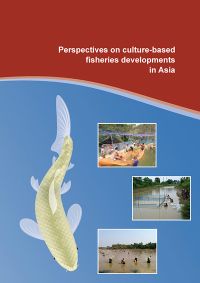
This book is the proceedings of the “Regional Consultation on Culture-Based Fisheries Development in Asia”, held in Siem Reap, Cambodia, 21-23rd of October 2014, under the auspices of the Australian Centre for International Agricultural Research (ACIAR), the Mekong River Commission (MRC) and the Network of Aquaculture Centres in Asia-Pacific (NACA). The consultation was jointly organised by NACA and the Fisheries Administration of the Royal Government of Cambodia.
The workshop, organised by FAO and NACA, was intended to enhance the capacity of national focal Points on Aquatic Genetic Resources within Asia-Pacific Region regarding the preparation of national reports on the current status of aquatic genetic resources for food and agriculture. These will be used as the major source of information for the first State of the World’s Aquatic Genetic Resources for Food and Agriculture report.