Regional Workshop Launches Third Asia-Pacific Laboratory Proficiency Testing Program for Aquatic Animal Diseases
8 September 2025 | 1918 views
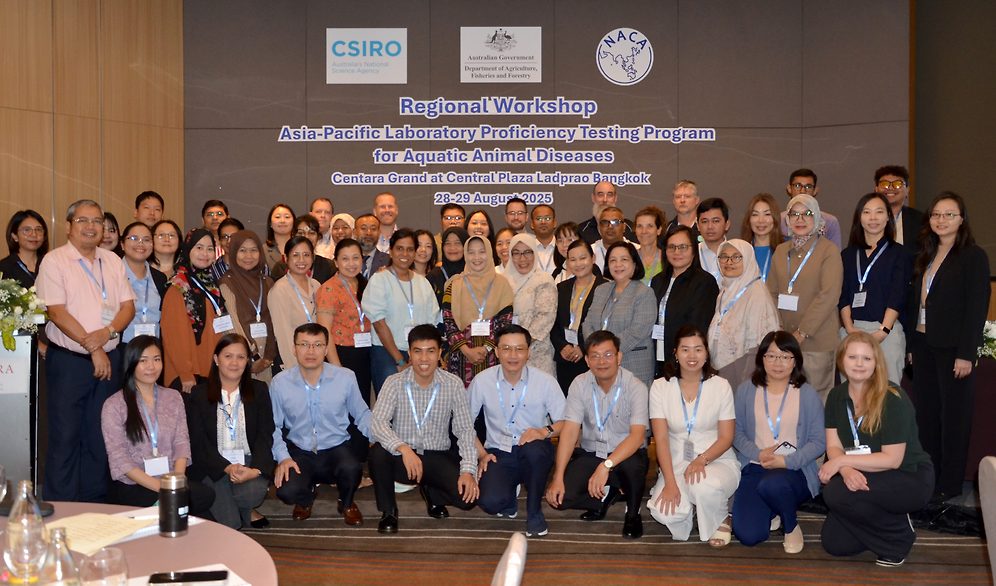
The third Asia-Pacific Laboratory Proficiency Testing Program for Aquatic Animal Diseases (APL-PT) has been launched at a workshop convened in Bangkok, Thailand, from 28–29 August 2025. The workshop brought together 50 laboratory representatives, government officials, and technical experts from thirteen countries and territories to strengthen cooperation in aquatic animal health diagnostics.
The APL-PT program is a long-standing collaboration between NACA, the Australian Government Department of Agriculture, Fisheries and Forestry (DAFF), and CSIRO’s Australian Centre for Disease Preparedness (ACDP). Its objective is to improve the accuracy and reliability of aquatic animal disease diagnostics across the Asia-Pacific through structured, region-wide proficiency testing and capacity building. Strengthening laboratory performance not only safeguards aquaculture livelihoods, but also underpins safe trade, protects aquatic resources, and contributes to regional food security.
Building on more than a decade of progress
Australia first launched a regional proficiency testing program in 2012, engaging 41 laboratories from 12 countries to test for 10 priority pathogens of fish and crustaceans. Over four rounds of testing, every laboratory improved their diagnostic performance, with relative gains of 7–32 percent.
The second program, conducted from 2019 to 2023, involved 34 laboratories from 13 countries and delivered eight rounds of testing over four years. Again, the results showed measurable improvements in diagnostic capacity, helping countries strengthen their aquatic animal health systems and build confidence in disease reporting.
This third program, beginning in 2025, continues the legacy. It will expand opportunities for laboratories to benchmark their performance, harmonise methods, and share experiences on technical challenges.
Workshop activities
The two-day workshop combined presentations, technical sessions, and group discussions. Key topics included:
- The importance of aquatic animal disease diagnostics for trade and transboundary disease detection.
- Overview of the new APL-PT program design and quality control systems.
- Technical presentations on PCR laboratory design, workflows, sample preparation, method validation, and use of controls.
- Updates to the World Organisation for Animal Health (WOAH) Aquatic Manual.
- Quality assurance and accreditation (ISO 17025, ISO 17043).
- Breakout sessions on troubleshooting, standard operating procedures, internal audits, and future directions of the APL-PT program.
Participants also explored options for the future operation of the program, including the selection of pathogens and panel designs, and discussed strategies to sustain collaboration and continuous improvement in laboratory performance.
Thanks to our sponsors and partners
NACA extends its sincere appreciation to the Australian Government Department of Agriculture, Fisheries and Forestry, and to CSIRO’s Australian Centre for Disease Preparedness, for their generous support and leadership in sponsoring the program and organising the workshop. Their continued investment has been instrumental in strengthening regional diagnostic capacity and in fostering a spirit of cooperation among Asia-Pacific laboratories.
NACA also thanks all participating laboratories for their commitment to improving aquatic animal health in the region. Through collaborative initiatives like the APL-PT, Asia-Pacific countries are better equipped to detect and manage aquatic animal diseases, supporting sustainable aquaculture and regional food security.
Creative Commons Attribution.