Governance and Policy

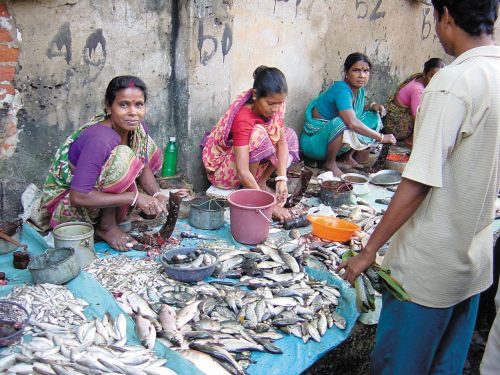
Governance must support the needs of small-holders, economically disadvantaged and marginalised people.

The Governance and Policy Programme supports the institutional and regulatory frameworks that underpin aquaculture development among NACA members. The programme focuses on enhancing governance structures, policy formulation on emerging and strategic issues, and implementation practices to ensure sustainable and effective aquaculture management.

The aim of the programme is to ensure that governance and policy frameworks are responsive to the needs of the aquaculture sector, promote sustainable development, meet the needs of rural communities, and are inclusive of women, youth, the elderly, and economically disadvantaged and marginalised groups.

Key activities

  • Assessing governance needs: Identifying gaps and opportunities in governance and policy frameworks.
  • Policy development support: Providing technical assistance and expertise to support the creation and implementation of inclusive and effective policies and regulations.
  • Capacity building: Organising workshops, seminars, and policy dialogues to build the capacity of policymakers and stakeholders in governance and regulatory practices.
  • Sharing best practices: Facilitating the exchange of best practices and experiences among members to improve governance and policy approaches.
  • Regional collaboration: Coordinating with member governments, regional and international organisations to align policies and strategies with global standards and trends.

Creative Commons Attribution.
Related

Subject tags

A collection of subject tags relating to technical matters.

In this collection

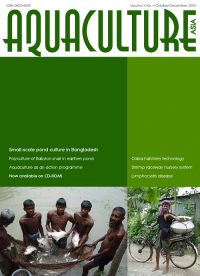
Aquaculture Asia Magazine, October-December 2005

In this issue:

Small-scale pond culture in Bangladesh. Issues and challenges in community-based aquaculture. Aquaculture as an action programme building confidence and self-worth. Transforming policy recommendations into pro-poor service provision. Grow out of spotted Babylon to marketable size in polyculture with seabass. Influence of economic conditions and global shocks on grouper markets. Status of cobia hatchery technology in Vietnam. Organic shrimp raceway system. Macrobrachium rosenbergii in Vembanad Lake. Management of monogenean parasites.

Science and society in the Gulf of Fonseca: The changing history of mariculture in Honduras

Shrimp farming in southern Honduras has generated considerable controversy around the issues of natural resource access and management. This case study reviews the reasons for and history of that controversy. The study relies on an extensive literature review and insights from the author’s previous research trips to southern Honduras between 1991 and 2000. In addition, representatives from several government offices, the shrimp industry, and the primary nongovernmental organisations were interviewed in May 2000.

Thematic review on management strategies for major diseases in shrimp aquaculture

This document presents the report of the Expert Workshop on Management Strategies for Major Diseases in Shrimp Aquaculture. The report includes summaries of fifteen national review papers on the history and current national status of major shrimp diseases, including their socioeconomic impacts and an evaluation of the successes and failures of state and private sector interventions to solve major disease problems and to develop more sustainable shrimp culture industries, and four thematic reviews.

Thematic review on coastal wetland habitats and shrimp aquaculture

This review documents the status of shrimp aquaculture in relation to mangrove forest ecosystems. The environmental, social and economic impacts of shrimp farming are discussed, with examples covering both the negative and positive aspects of the sector. The review considers interventions and other activities to improve the sustainability of shrimp farming in the context of coastal zone management and the protection of mangrove ecosystems. The effectiveness of these interventions is considered in the light of experience based on case studies.

Codes of practice and conduct for marine shrimp aquaculture

The rapid expansion of marine shrimp aquaculture in many tropical developing countries has proceeded without effective environmental regulation. Most countries with shrimp farming do not have an established regulatory apparatus to monitor and enforce environmental and socioeconomic standards. Therefore, voluntary codes of conduct are a possibility for improving overall management and possibly profitability of the marine shrimp aquaculture industry until effective governmental regulation is implemented. This paper reviews the status of existing codes of conduct for shrimp farming.

Report of the third meeting of the Asia Regional Advisory Group on Aquatic Animal Health, 23-25 November 2004

The Asia Regional Advisory Group on Aquatic Animal Health meets annually to discuss regional health issues including emerging disease threats. This report includes a review of regional disease status circa 2004, global and regional disease reporting arrangements, global issues and standards, progress in implementation of the the Regional Technical Guidelines on Health management for the Responsible Movement of Live Aquatic Animals, identification and designation of regional aquatic animal health resources and regional and international cooperation.

Aquaculture Development Beyond 2000: The Bangkok Declaration and Strategy

The main output of the International Conference on Aquaculture in the Third Millennium. The Declaration summarises the key impediments and opportunities in aquaculture development that are likely to arise over the next 20 years and provides strategic policy guidance for sustainable aquaculture development. The Declaration was adopted by conference participants in a plenary session.

Philippines country strategy paper

In 2002, the Philippines Government signed a Partnership Agreement with the NACA-STREAM Initiative. The initial focal point for STREAM work is Western Visayas, including the Sapian Bay and Banate Bay areas where BFAR Region 6, the STREAM country host, has on-going engagements, and also areas within Regions 6 and 7 where marine ornamentals collection and trading occur. The key disadvantaged groups for whom aquatic resources are a source of livelihood are the primary stakeholders for the initiative.

Vietnam country strategy paper

Although Vietnam has long been listed among the poorest countries of the world, it has recently made large strides in reducing poverty and improving food security. However, the dramatic gains in poverty reduction in Vietnam still remain quite fragile. There is growing evidence to indicate that dependence on aquatic resources is correlated to poverty, and that aquatic resources constitute an important component of wider livelihoods strategies (largely from the Mekong Delta, Central Coast and the Northern Mountains).

Management options for the shrimp fry fishery: A regional stakeholder workshop in Coxes Bazar

In February 2002 the shrimp fry collection ban was placed into abeyance pending further review of how biodiversity could be conserved at the same time as protecting the livelihoods of 400,000 fry collectors. A Shrimp Action Plan for the period April - September 2002 was drawn up to identify trends impacting on distribution and growth in the shrimp sector, and to explore alternative models for the management of fry resource and to assess their social, institutional and economic implications.

Basic overview of the regulatory procedures for authorisation of veterinary medicines with emphasis on residues in food animal species

This report presents a précis of the regulatory procedures for authorisation of veterinary medicines in Europe and the USA. In particular it concentrates upon the requirements for consumer safety in regard to presence of residues of veterinary medicines in the edible tissues of food animal species. In both Europe and the USA the regulations in regard to veterinary residues and consumer safety require that countries wishing to export into those markets demonstrate equivalent standards to the domestic requirements.

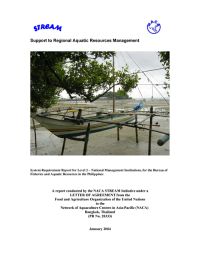
System requirements report for level 2 - national management institutions

This System Requirement Report describes national level requirements for data collection and sharing mechanisms for fisheries co-management in the Philippines. It also provides a broad picture of the following for the national fisheries management level in the Philippines.

Aquatic resources in the Philippines and the extent of poverty in the sector

This report presents an overview of the state of aquatic resources in the Philippines, its performance and importance in the Philippine economy, and explores the situation of poverty in the "aquatic resources sector." The report describes the policy environment that guides the action of key actors in the sector. A general analysis of some trends in relation to factors that keep the poor from participating and benefiting from aquatic resource management is also provided.

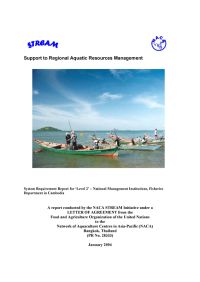
System requirements report for 'level 2' - national management institutions, Fisheries Department in Cambodia

This report describes the national-level requirements for data collection and sharing mechanisms for fisheries co-management in Cambodia. It presents the findings from a thorough literature review and workshops, group and individual interviews. Community fisheries in Cambodia are at a very early stage of development, and the exact management responsibilities are still poorly understood by many stakeholders. This report relates the information needs voiced by participants in this study.

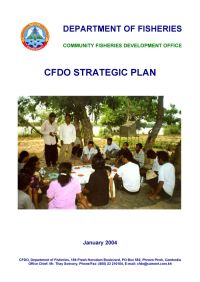
Community Fisheries Development Office Strategic Plan

In October 2000 the government of Cambodia announced a major change in fisheries management policy. The core elements of the new policy are the reduction of fishing lot concession areas by 56%, the broader participation of fishing communities in the management of fisheries and a focus on the efficient, sustainable and equitable use of the living aquatic resources. This document details the Strategic Plan for the CFDO in the Department of Fisheries (DoF) based on its mandate.

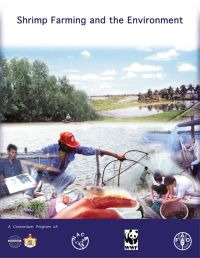
Shrimp Farming and the Environment: Can Shrimp Farming be Undertaken Sustainably?

This report is intended primarily as a discussion paper, to serve as the basis for informed dialogue and policy development to encourage more detailed guidelines following further study and consultation. It seeks, in particular, to answer three commonly posed questions: Is sustainable shrimp farming possible? Can poor coastal communities benefit from it? And, if so, what role can agencies like the World Bank play to ensure that basic minimal requirements to achieve this are met?

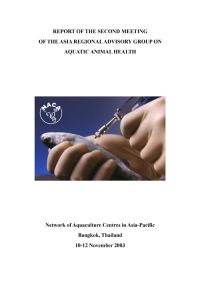
Report of the second meeting of the Asia Regional Advisory Group on Aquatic Animal Health, 10-12 November 2003

The Asia Regional Advisory Group on Aquatic Animal Health meets annually to discuss regional health issues including emerging disease threats. This report includes a review of regional disease status circa 2003, global and regional disease reporting arrangements, global issues and standards, progress in implementation of the the Regional Technical Guidelines on Health management for the Responsible Movement of Live Aquatic Animals, identification and designation of regional aquatic animal health resources and regional and international cooperation.

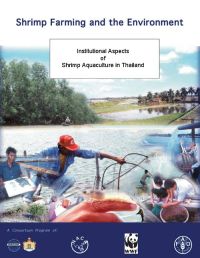
A case study on institutional aspects of shrimp aquaculture in Thailand

This case study documents the success and lessons learnt from local co-management approaches involving farmers associations and local government in Thailand. The case study also shows the linkages and relationships of institutions operating at different levels of administration from farm to national levels and their effect on management. The case study provides an analysis of institutional supports and mechanisms needed for successful shrimp farming management via case studies.

Code of good management practices for shrimp aquaculture in Sri Lanka (abstract)

The code development work was undertaken by the NARA in collaboration with the NAQDA, MFNWP, PEA, Shrimp Farmers and Exporters Associations, Shrimp Breeders Association, feed suppliers and manufacturers. This was developed mainly conducting consultations with different stakeholders of the industry and discussed at a forum with the representation of all stakeholders to reach consensus. The code includes technical specifications for the siting, design, construction and operation of shrimp hatcheries and farms.

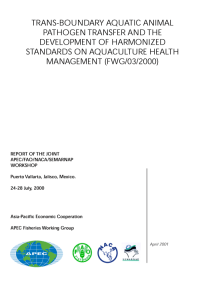
Trans-boundary aquatic animal pathogen transfer and the development of harmonized standards on aquaculture health management

This document provides the report of the joint APEC/FAO/NACA/SEMARNAP workshop on “Trans-boundary aquatic animal pathogen transfer and the development of harmonized standards on aquaculture health management,” held at Puerto Vallarta, Mexico, 2000. The workshop reviewed the impacts of trans-boundary pathogens, management strategies and harmonisation of of aquatic animal health management measures. Participants adopted the “Puerto Vallarta Plan of Action” incorporating recommendations for to control the spread of serious aquatic animal pathogens.