Freshwater finfish

Information relating to aquaculture of freshwater finfish.

Creative Commons Attribution.

Related

Species / commodity tags

Major farmed commodity or species groups.

In this collection

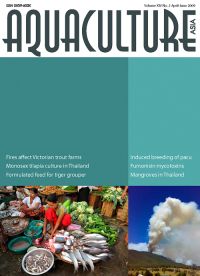
Aquaculture Asia Magazine, April-June 2009

In this issue:

GLOBALGAP standard in Thai shrimp farms: Mission (im)possible? The Victorian trout industry and the bushfires. Small-scale aquaculture in the Ayeyarwady Delta, Myanmar. The history, status and future prospects of monosex tilapia culture in Thailand. Mangroves of Nakhon Si Thammaarat Province in Souther Thailand. Induced breeding of pacu Piaractus brachypomus in captivity. Fumosins - mycotoxins of increasing importance in fish. Microsatellite DNA markers, a fisheries perspective. Formulated feed for tiger grouper grow out.

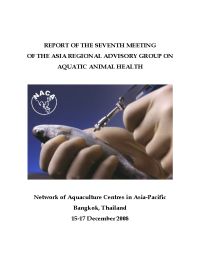
Report of the seventh meeting of the Asia Regional Advisory Group on Aquatic Animal Health, 15-17 December 2008

The Asia Regional Advisory Group on Aquatic Animal Health meets annually to discuss regional health issues including emerging disease threats. This report includes a review of regional disease status circa 2008, global and regional disease reporting arrangements, global issues and standards, progress in implementation of the the Regional Technical Guidelines on Health management for the Responsible Movement of Live Aquatic Animals, identification and designation of regional aquatic animal health resources and regional and international cooperation.

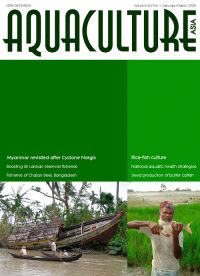
Aquaculture Asia Magazine, January-March 2009

In this issue:

Myanmar revisited. Harvesting, traditional preservation and marketing of fishes of Chalan Beel, Bangladesh. Role of community in production and supply of larger, quality fingerlings. Can rice-fish farming provide food security in Bangladesh? Nutritional and food security for rural poor through multi-commodity production from a lake of eastern Uttar Pradesh. Emerging boost in Sri Lankan reservoir fish production. Farming the freshwater prawn Macrobrachium malcolmnsonii. Breeding and seed production of catfish Ompok pabda.

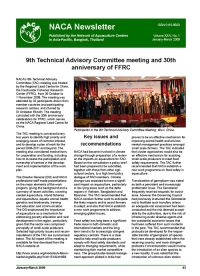
NACA Newsletter Volume XXIV, No. 1, January-March 2009

In this issue:

9th Technical Advisory Committee meeting and 30th anniversary of FFRC. Training Workshop on the Use of Molecular Genetics in Conservation held at USM, Malaysia. Japan International Award for NACA Staff. Consortium on freshwater finfish genetics and breeding. Shrimp Farming eNews. Seventh Meeting of the Asia Regional Advisory Group on Aquatic Animal Health. Sri Lankans learn pisciculture at CIFA. India's Central Institute for Freshwater Aquaculture observes 33rd Foundation day.

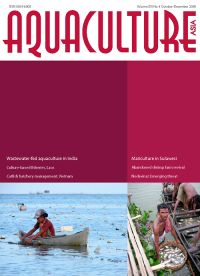
Aquaculture Asia Magazine, October-December 2008

In this issue:

An increasingly secure future for wastewater-fed aquaculture in Kolkata, India? First culture-based fisheries growth cycle in Lao PDR is overhwelmingly encouraging. Revival of abandoned shrimp farms in Andhra Pradesh. Growth of industries linked with aquaculture in Kolleru Lake area, India. Applications of nutritional biotechnology in aquaculture. Technical and management aspects of catfish hatcheries in Vietnam. Asian seabass farming. Mariculture development opportunities in southeast Sulawesi, and much more.

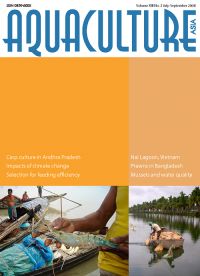
Aquaculture Asia Magazine, July-September 2008

In this issue:

Possible improvements to carp culture in Andhra Pradesh. Aquaculture and environmental issues in the region of Nai Lagoon, Vietnam. Selection potential for feed efficiency in farmed salmonids. Freshwater prawn broodstock concern in Bangladhesh hatcheries. Production of Cirrhinus molitorella and Labeo chrysophekadion for culture-based fisheries in Lao PDR: Nursery and grow-out. Mussel farming: Alternate water monitoring practice. Use of poultry by-product meals in pelleted feed for humpback grouper Cromileptes altivelis.

NACA Newsletter Volume XXIII, No. 3, July-September 2008

In this issue:

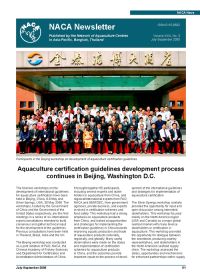
Aquaculture certification guidelines development process continues in Beijing, Washington D.C. Development of BMPs for catfish farming in Vietnam - survey of management practices. NACA extends cooperation with ADB for tsunami rehabilitation in Indonesia. International hands-on training programme on molecular biology techniques. Cage aquaculture carrying capacity tool now available. 6th Regional Grouper Hatchery Production Training Course completed. 2008 Forum on Fisheries Science and Technology, 25-27 September 2008, Shanghai, China. Aquaculture success stories 'write shop'. Bookshelf: New publications for free download.

Myanmar aquaculture and inland fisheries

Fish and fish products are crucial in the nutrition and livelihoods of the Myanmar people. However, little information is available on their patterns of consumption, inter-regional differences, availability and types of fish consumed. This report is the outcome of two concurrent missions, one to coastal areas and one to inland areas. The report includes the findings of the missions as well as conclusions and recommendations in support of the long-term sustainability of fishery resources in Myanmar.

Economics of aquaculture feeding practices in selected Asian countries

This technical paper provides an analysis of the economic implications of, and the reasons for, adopting various feeding practices for different fish species and aquaculture systems in Asia. The systems studied include extensive/traditional, semi-intensive and intensive farms for a number of different species including sutchi and pangasiid catfishes (Bangladesh and Viet Nam), hybrid catfish (Thailand), carp polyculture (India and China), prawn and milkfish polyculture (the Philippines).

Development of a conservation strategy for the critically endangered Mekong giant catfish: Quantitative assessment report

This report provides a quantitative assessment of the conservation of the Mekong giant catfish, Pangasianodon gigas, and an evaluation of the likely effectiveness of different conservation options. The report conisders the history of fisheries exploitation and environmental change, the estimated wild population size of P. gigas, the role of captive populations held by the Thailand Department of Fisheries and interactions with cultured fish. It makes a series of recommendations for conservation of this species.

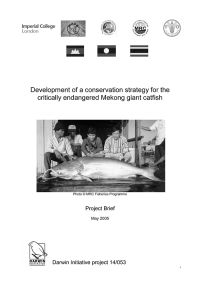
Development of a conservation strategy for the critically endangered Mekong giant catfish: Project brief

This is a brief of a project to develop an overarching conservation strategy for the Mekong giant catfish integrating supportive breeding with harvest and habitat management. This will involve (1) quantitative assessment of population status based on existing information, (2) quantitative assessment of the likely effectiveness of different conservation measures (3) review and improvement of captive breeding procedures; (4) promotion of appropriate adaptive policies for the further development of the strategy; and (5) definition of an overall conservation strategy.

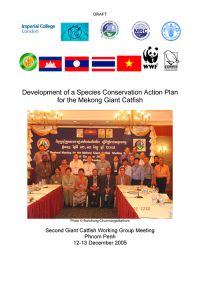
Development of a species conservation action plan for the Mekong giant catfish

This is the report of the Second Mekong Giant Catfish Working Group Meeting, held in Phnom Penh 12-13 November 2005, under the project Development of a conservation strategy for the critically endangered Mekong giant catfish. The purpose of the workshop was to review existing knowledge on Mekong giant catfish, identify future conservation and research priority activities, and to continue the joint planning process aimed at developing an overarching conservation strategy.

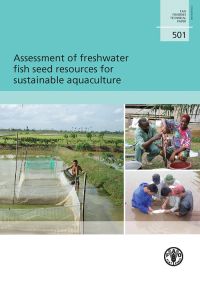
Assessment of freshwater fish seed resources for sustainable aquaculture

This publication contains the proceedings and major recommendations of the expert workshop which tackled three major themes: Seed quality, genetics, technology and certification; seed networking, distribution, entrepreneurship and certification; and how rural fish farmers can benefit from the seed sector. It also contains the outcomes of a desk study consisting of three regional syntheses, twenty-one country case studies and five thematic reviews (seed quality, genetics and breeding, seed networks, role of seed supply, farmer innovations and womens' involvement).
Aquaculture Asia Magazine, April-June 2008

In this issue:

From integrated carp polyculture to intensive monoculture in the Pearl River Delta, China. Better management practices for Vietnamese catfish. Ipomoea aquatica - an aquaculture friendly macrophyte. Status of fisheries and aquaculture development in Pakistan. The changing face of post-grad education in aquaculture: Contributing to soaring production and sustainable practices. Hatchery management in Bangladesh. Production of Cirrhinus molitorella and Labeo chrysophekadion for culture-based fisheries in Lao PDR and much more.

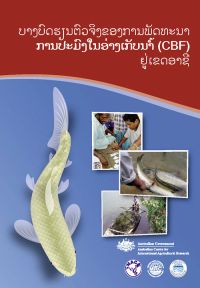
Better-practice approaches for culture-based fisheries development in Asia (Lao translation)

The primary objective of this manual is to provide guidelines for attaining better practices in culture-based fisheries, an emerging practice in rural areas in the Asian region. It deals will the principles of culture-based fishery practices, primarily based on relatively long-term experiences in Sri Lanka and Vietnam. It is not only targeted at researchers per se, but also at stakeholders at the grass root levels, as well as planners and policy developers.

Report of the sixth meeting of the Asia Regional Advisory Group on Aquatic Animal Health, 12-14 December 2007

The Asia Regional Advisory Group on Aquatic Animal Health meets annually to discuss regional health issues including emerging disease threats. This report includes a review of regional disease status circa 2007, global and regional disease reporting arrangements, global issues and standards, progress in implementation of the the Regional Technical Guidelines on Health management for the Responsible Movement of Live Aquatic Animals, identification and designation of regional aquatic animal health resources and regional and international cooperation.

Report of the Workshop on Research Needs in Sustaining the Aquaculture Sector in Asia-Pacific to Year 2025 and Beyond

IDRC and NACA convened a workshop to identify the main research issues and needs to sustain Asian aquaculture into the first quarter of the 21st century, and also to bring them to the notice of relevant planners, managers and policy makers, and potential donors. The workshop was held in Rayong, Thailand from 4-7 June 2007. This report contains the issues papers drafted in preparation for the meeting and a summary of the discussions.

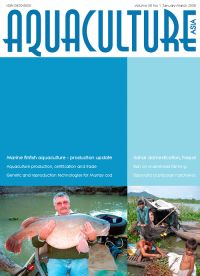
Aquaculture Asia Magazine, January-March 2008

In this issue:

Developing guidelines for sustainable freshwater aquaculture planning in Vietnam. Aquaculture production, certification and trade for small-scale farmers. Backyard hatcheries for crustaceans in Thailand. Alternative carp species for diversification in India. Genetic and reproduction technologies for aquaculture and fisheries management of Murray cod. Status of sahar domestication in Nepal. Comparative advantage analysis of shrimp production in Asia. Strategies to improve the livelihoods of the rural poor, Vietnam, and more.

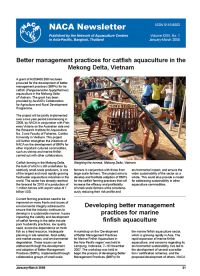
NACA Newsletter Volume XXIII, No. 1, January-March 2008

In this issue:

Better management practices for catfish aquaculture in the Mekong Delta, Vietnam. Developing better management practices for marine finfish aquaculture. Workshop on modelling carrying capacity for tropical finfish cage culture: Towards a consensus view. First comprehensive genetic management plan for Asian fish species: Mahseer. NACA and World Fisheries Trust sign agreement on collaboration. Fish Health Master Class. Second Workshop on Application of Molecular Genetic Techniques in Inland Fisheries and Aquaculture Management. Two new species of spiny eels described from Myanmar. Importance of species identification in conservation. Koh Yao Noi mangrove replanting in celebration of 80th birthday of His Majesty the King of Thailand. Responsible movement of live food finfish within ASEAN: Implementation workshop. Consultation on aquaculture certification guidelines. Strengthening regional mechanisms to maximise benefits to small-holder shrimp farmer groups adopting better management practices.

Guidelines for genetic management and conservation of empurau, Tor tambroides and semah, Tor douronensis

This document presents current status on genetic diversity of empurau and semah in Sarawak, Malaysia, including taxonomic status and a management guideline based on genetic data. Inadvertent mixing of the two species, especially during breeding, may lead to hybridisation, a threat to the genetic integrity of wild populations. Surveys on current status of genetic variability of empurau and semah are reported herein, and the results from which are used as baseline data for development of a genetic management plan.