Freshwater finfish

Information relating to aquaculture of freshwater finfish.

Creative Commons Attribution.

Related

Species / commodity tags

Major farmed commodity or species groups.

In this collection

NACA Newsletter Volume XX, No. 4, October-December 2005

In this issue:

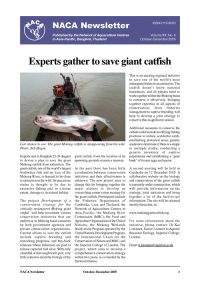
Experts gather to save giant catfish. Workshops on dissemination of better practice models for culture-based fisheries. Dr Chris Baldock, 1947-2005. MAHSEER 2006. MOU signing on conservation of Mahseer in Malaysia and Indonesia. Application of molecular genetics in aquaculture and inland fisheries management. New president of Iran Fisheries Organization. Workshop on the fishery management tool 'EnhanceFish'. Regional Mariculture Development Workshop in China, March 2006. Invitation to apply for position of Director General of NACA. MPEDA expands program on shrimp farmer clubs.

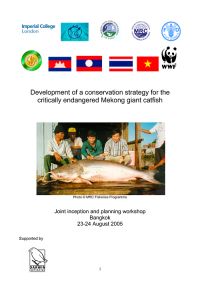
Development of a conservation strategy for the critically endangered Mekong giant catfish: Joint inception and planning workshop

This is the report of an inception workshop for the Mekong Giant Catfish Working Group. The Mekong giant catfish Pangasianodon gigas is listed as critically endangered in the 2003 IUCN Red List. The purpose of the workshop was to exchange information on the current state of the Mekong giant catfish and the relevant conservation and research activities of key organisations, and to establish a joint planning process aimed at developing an overarching conservation strategy for the Mekong giant catfish.

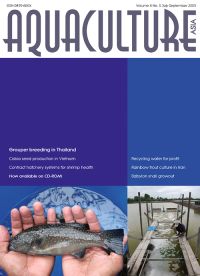
Aquaculture Asia Magazine, July-September 2005

In this issue:

Asian Development Bank study on aquaculture and poverty. The consequences of converting to organic shrimp farming. Recycling water and making money with Artemia. Advances in the seed production of cobia Rachycentron canadum in Vietnam. Australian success with barramundi cod Cromileptes altivelis. Recent grouper breeding developments in Thailand. Application of probiotics in rotifer production systems. Contract hatchery systems. Rainbow trout culture in Iran. Spotted babylon Babylonia areolata growout in earthern ponds.

Primary aquatic animal health care in rural, small-scale aquaculture development

This document is the technical proceedings of the Asia Regional Scoping Workshop on “Primary Aquatic Animal Health Care in Rural, Small-scale, Aquaculture Development,” held in Dhaka, Bangladesh from 27 - 30 September 1999. The objectives of the workshop were  to review information on socio-economic impacts, risks of disease incursions and health management strategies in rural, small-scale aquaculture and enhanced fisheries programmes; and to identify potential interventions for their better health management and appropriate followup actions.

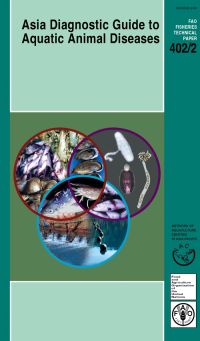
Asia diagnostic guide to aquatic animal diseases

The Asia Diagnostic Guide to Aquatic Animal Diseases or ‘Asia Diagnostic Guide’ is a comprehensive diagnostic guide in support of the implementation of the Asia Regional Technical Guidelines on Health Management for the Responsible Movement of Live Aquatic Animals. It was developed from technical contributions of members of the Regional Working Group and Technical Support Services and other aquatic animal health scientists in the region and outside who supported the Asia-Pacific Regional Aquatic Animal Health Management Programme.

Asia Diagnostic Guide to Aquatic Animal Diseases

The most comprehensive aquatic disease guide ever published in the region. It covers economically significant diseases of molluscs, fish and crustaceans. Contains information on laboratory and diagnostic techniques, causative agents and distribution, host range, clinical aspects, screening methods, diagnostic procedures, modes of transmission, control measures. Includes contact details for technical support services throughout the region and national health coordinators.

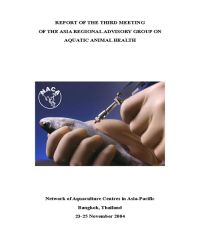
Report of the third meeting of the Asia Regional Advisory Group on Aquatic Animal Health, 23-25 November 2004

The Asia Regional Advisory Group on Aquatic Animal Health meets annually to discuss regional health issues including emerging disease threats. This report includes a review of regional disease status circa 2004, global and regional disease reporting arrangements, global issues and standards, progress in implementation of the the Regional Technical Guidelines on Health management for the Responsible Movement of Live Aquatic Animals, identification and designation of regional aquatic animal health resources and regional and international cooperation.

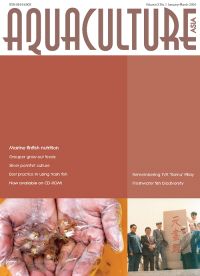
Aquaculture Asia Magazine, January-March 2005

In this issue:

Freshwater prawn culture in China and its market prospects. Demise of wastewater-fed duckweed-based aquaculture in Bangladesh. Freshwater finfish biodiversity - an Asian perspective. Her farm is destroyed, how can we help? Women oyster vendors in Eastern Thailand. Farm-level feeds and feeding practices for marine finfish. ACIAR grouper grow-out feeds and CSIRO research. Feed development and application for juvenile grouper. Grouper growout feeds. Silver pomfret culture technology.

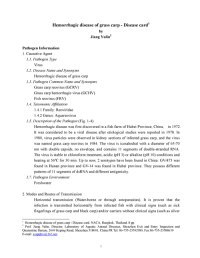
Haemorrhagic disease of grass carp: Disease card

Hemorrhagic disease of grass carp is a serious viral disease affecting grass carp fingerlings. The disease has the potential to spread and cause serious economic loss in countries of the region. This disease card is developed to raise awareness and support surveillance efforts of countries in the region.

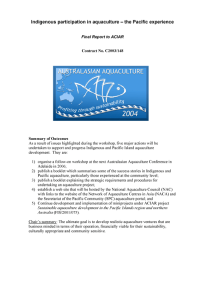
Report on indigenous participation in aquaculture - the Pacific experience, Sydney, Australia, 27-28 September 2004

The workshop Indigenous Participation in Aquaculture – the Pacific Experience was held as a day-and-a-half session in the Australasian Aquaculture 2004, Sydney, 27–28 September 2004. The workshop promoted exchange of information and experiences between researchers, government representatives and industry involved in aquaculture development in the Pacific. The workshop recognised the increasing interest in aquaculture as an industry that can provide benefits for indigenous communities in Australia as well as the Pacific Islands.

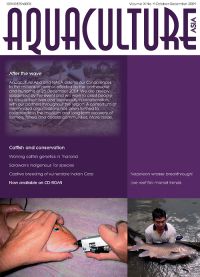
Aquaculture Asia Magazine, October-December 2004

In this issue:

Captive breeding of vulnerable Indian carp Cirrhinus reba for conservation. Conservation of the Asiatic catfish Clarias batrachus through artificial propagation. A perspective on breeding and genetics of walking catfish in Thailand. Decline of wastewater-fed aquaculture in Hanoi. Artificial propagation of indigenous Tor species in Malaysia. Aquaculture of spotted babylon Babylonia areolata. First successful hatchery production of Napoleon wrasse Cheilinus undulatus. Trade and market trends in the live reef fish trade.

Adopting a STREAM approach for inland fisheries management

This paper advocates strategies, processes and practices that enable: livelihoods approaches rather than resource-based approaches, ‘direct’ institutional and policy development, rather than ‘project demonstrations’, and support for regional, national and local communications. It was presented at the Symposium on Participatory approaches in reservoir fisheries management: Issues, challenges and policy, October 4-6th 2004 at the Culture Club Resort, Dambulla, Sri Lanka hosted by the National Aquaculture Development Authority in collaboration with FAO..
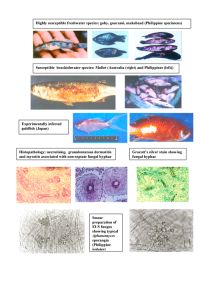
Epizootic ulcerative syndrome: Disease card

Epizootic ulcerative syndrome (EUS) is a seasonal epizootic condition of wild and farmed, fresh and brackishwater fish. Of complex infectious aetiology, it is characterised by the presence of invasive Aphanomyces infection and necrotising ulcerative lesions typically producing a granulomatous response. The disease is now endemic in South-east and south Asia, and has recently extended to West Asia. EUS is indistinguishable from red spot disease of eastern Australia and mycotic granulomatosis of Japan.

Infection with koi herpes virus: Disease card

Koi herpes virus (KHV) outbreaks in the region have significant trade implications for the high value ornamental koi carp industry, and the important food fish common carp. Active trade in ornamental fish poses a potential risk for spread of KHV. Recognising the significance, "infection with koi herpesvirus" has been listed under "diseases prevalent in the region" in the NACA/FAO/OIE regional quarterly aquatic animal disease (QAAD) list, effective for reporting from first quarter of 2004.

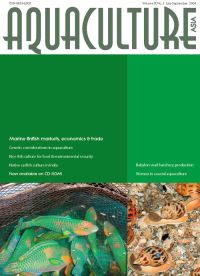
Aquaculture Asia Magazine, July-September 2004

In this issue:

Genetic considerations in fisheries and aquaculture with regards to biodiversity. Rice-fish culture for food and environmental security. Land-based aquaculture of spotted babylon Babylonia areolata in Thailand: Hatchery-based seedling operation. Shrimp health question and answer. Women in coastal aquaculture. Insights into live marine food fish markets in Asia. Farming practices, market chains and prices of marine finfish in Malaysia, Indonesia and Hong Kong.

Aquaculture Asia Magazine, April-June 2004

In this issue:

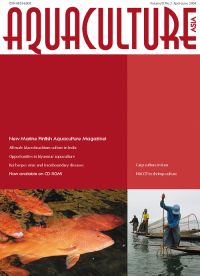
Genetic impacts of translocation on aquatic biodiversity in Asia. Carp culture in Iran. Opportunities and challenges in Myanmar aquaculture. Impacts of monosex Macrobrachium culture on seed availability in India. Use of new technology and skills for eco-friendly production of tiger shrimp Penaeus monodon. Larval rearing and spat production of the windowpane shell Placuna placenta. HACCP in shrimp farming. First breeding success of Napoleon wrasse Cheilinus undulatus and coral trout Plectropomus leopardus.

Report of the Emergency Disease Control Task Force on a Serious Disease of Koi and Common Carps in Indonesia, June 2002

An Emergency Disease Control Task Force on a Serious Disease of Koi and Common Carps in Indonesia was organised by NACA in June 2002. The Task Force conducted an emergency assessment of the disease situation in July through field and laboratory examinations of collected samples. The Task Force collected information about the disease occurrence. Koi herpes virus was detected from all case samples which indicates that it may have played a role in the observed mortalities.

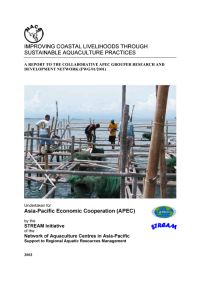
Improving coastal livelihoods through sustainable aquaculture practices: Full report

Wild-harvest fisheries for live reef fish are largely over-exploited or unsustainable. Sustainable aquaculture – such as that of groupers – is one option for meeting increasing demand for reef fish as well as potentially maintaining livelihoods of coastal communities. This report draws upon secondary literature, media sources and four diverse case studies from at-risk reef fisheries, to frame a strategy for encouraging sustainable aquaculture as an alternative to destructive fishing practices. It was commissioned by the APEC Secretariat.

Destructive fishing practices in south Sulawesi Island, East Indonesia, and the role of aquaculture as a potential alternative livelihood

Sulawesi has the largest coral reef area in Indonesia, at the epicenter of worldwide marine biodiversity, but is one of the areas most threatened in Southeast Asia by destructive fishing practices. This case study reviews the potential for aquaculture to provide alternative livelihoods for fishers within the context of an integrated, community-based coastal management plan with involvement of local communities empowered to control and steward their resources so that they can conserve and utilise them sustainably.

Carp production in seasonal water bodies in Eastern India

The feasibility of integrated aquaculture in seasonal water bodies in rainfed farming areas of Eastern India was assessed in on-farm trials. Fry of Indian major carps: Catla, mrigal, rohu, common carp, and silver barb, and advanced fingerlings of Indian major carps were raised to marketable size. Key factors for the success of aquaculture in seasonal water bodies are access to credit, production enhancing inputs and water bodies that hold water for more than 120 days of the year.