Livelihoods, gender and social issues

Aquaculture livelihoods and social issues in rural communities.

Creative Commons Attribution.

Related

Subject tags

A collection of subject tags relating to technical matters.

In this collection

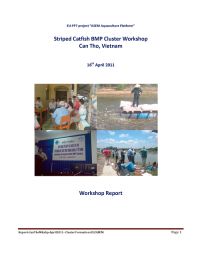
Report of the Striped Catfish BMP Cluster Management Workshop, Can Tho, Vietnam

The purpose of the workshop, held in Can Tho Vietnam on 16 April 2011, was to build capacity and awareness of prospective cluster farmers and their leaders on the adoption of better management practices through cluster based management. The workshop shared experiences in cluster formation from other Asian countries and developed a join work programme for implementation of the project.

Opportunities and challenges facing small-scale farmers in Asia

Miao Weimin presents on aquaculture certification opportunities and challenges for small scale farmers.

Cluster certification: Way forward for small-scale farmers

A cluster-based approach allows small-scale farmers to participate in aquaculture certification schemes.

National Training Workshop for Cluster Certification Trainers

International requirements on food safety, traceability, animal health and welfare and social responsibility are increasingly stringent. The burden of compliance and the cost of certification are particularly heavy for small scale farmers who are often excluded by the limited resources at their disposal. Working in groups can help small scale farmers attain economies of scale necessary to address compliance issues and participate in certification schemes, improving their competitive position.

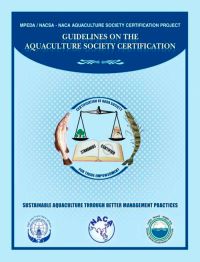
Guidelines on Aquaculture Society Certification

These guidelines prepare and enable aquaculture societies to seek group certification from independent third party certification programmes. The guidelines are independent of commodity and certification standards. They were developed as part of a collaborative MPEDA/NaCSA/NACA project on the certification of aquaculture societies. Draft guidelines developed by the project partners were discussed at the inception meeting on aquacutlure society certifiction held at Kakinada during 1-2 September 2009.

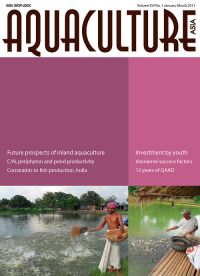
Aquaculture Asia Magazine, January-March 2011

In this issue:

Recent developments and future prospects of inland aquaculture in Asia. Factors influencing success of Penaeus vannamei culture. Freshwater prawn farming in a carbon-nitrogen controlled periphyton-based system: A sustainable approach to increase stagnant pond productivity. Constraints to fish production in community ponds in Orissa, India. Continued confidence in inland fisheries developmentg of a Sri Lankan youth begins to pay off. The Asia-Pacific Quarterly Aquatic Animal Disease Report: 12 years and beyond.

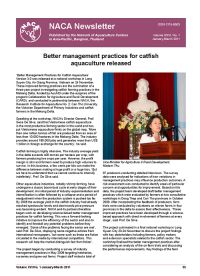
NACA Newsletter, Volume XXVI, No. 1, January-March 2011

In this issue:

Better management practices for catfish aquaculture released. 9th Meeting of the Asia Regional Advisory Group on Aquatic Animal Health. Trialling ocean temperature forecasts for fish farms. Global Conference on Aquaculture 2010: Publications. Capacity of small holder ASEAN aquaculture farmers for competitive and sustainable aquaculture strengthened.

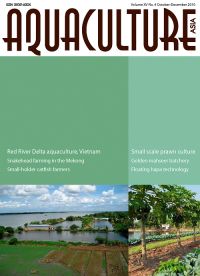
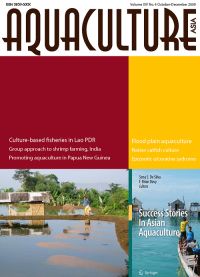
Aquaculture Asia Magazine, October-December 2010

In this issue:

Rapidly changing aquaculture scene in the Red River Delta, Vietnam. Current situation and challenges for the farming of snakeheads in the Mekong Delta. Is there a business case for small-holders in Vietnamese pangasius? Small scale prawn culture practices towards sustainable development in Chittagong region, Bangladesh. Gloating hapa technology for the mass production of tilapia Oreochromis niloticus in Bangladesh. Management in seed production of golden mahseer Tor putitora in hatchery condictions.

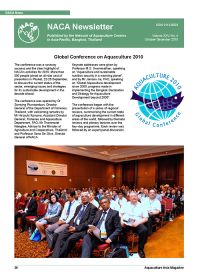
NACA Newsletter, Volume XXV, No. 4, October-December 2010

In this issue:

Global Conference on Aquaculture 2010. Reducing the dependence on trash fish as feed for marine finfish. 21st NACA Governing Council & 10th Technical Advisory Committee. Training course on application of business management principles in small-scale aquaculture. Sri Lanka Journal of Aquatic Sciences goes open access. Now we're on Facebook too.

Aquaculture and socio-economic growth and development: enabling policies and partnership for improved benefits

This presentation builds on countries’ recent experiences to review the role of aquaculture in countries’ socio-economic growth and development, and discusses how institutional arrangements can lead to aquaculture’s enhanced net benefits to society. Aquaculture growth has recently been slowing down, and the sector is facing various resource, environmental, economic, knowledge and institutional constraints. Population growth, economic expansion and increasing preference for healthy food are expected to sustain the demand for aquaculture products.

Enhancing the contribution of aquaculture to poverty alleviation, food security and rural development

We are passing through an era of increasing population, food shortages and unsustainable farming practices. We cannot think of food security unless issues connected with poverty and livelihoods are addressed. Since 75 percent of global aquaculture production comes from small-scale farms in developing countries we have to address a number of issues to ensure that the livelihoods and food security of all those involved in the sector are not threatened.

Protecting small-scale farmers: a reality within a globalised economy?

Between 70 and 80 percent of Asian farmers are estimated to be small-scale farmers. It is clear that increasing globalisation and the resultant trade liberalisation of aquaculture products is leading towards the marginalisation and exclusion of individual small-scale producers. There is a need for changing the management of both large- and small-scale producers to remain competitive. Recent experiences show that establishment of farmer societies are effective.

Alleviating poverty through aquaculture: how can we improve

Aquaculture as a household, community and agribusiness-based activity to supply human food and other products and contribute to the alleviation of poverty is explored in this overview. The multiple natures of poverty and the concepts of escaping from and slipping into poverty are explored with reference to aquaculture contexts. Aquaculture as a driver for development is reviewed and found to contribute to poverty alleviation in both transformative and incremental modes and at various scales.

Thematic session 6 summary and conclusions: Enhancing the contribution of aquaculture to poverty alleviation, food security and rural development

Presentation of the summary, conclusions and recommendations of Thematic Session 6 (Enhancing the contribution of aquaculture to poverty alleviation, food security and rural development).

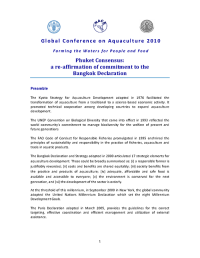
Phuket Consensus: A re-affirmation of commitment to the Bangkok Declaration

The Phuket Consensus is a declaration on aquaculture development endorsed by participants of the Global Conference on Aquaculture 2010, held in Phuket, Thailand, 22-25 September. The consensus builds on the Bangkok Declaration, which was formulated at the International Conference on Aquaculture in the Third Millennium, held in Bangkok, 20-25 February 2000. The consensus and declaration provide strategic guidance on sustainable development of aquaculture considering social, environmental, technical and economic issues.
NACA Newsletter, Volume XXV, No. 3, July-September 2010

In this issue:

Vietnamese catfish - better management practices update. Is this the perfect prawn? Fish Oil Replacement and Alternative Lipid Sources in Aquaculture Feeds. Multilingual CD-ROM of FAO cultured aquatic species fact sheets. Aquaclimate Annual Progress Report 2010. Training course on application of business management principles in small-scale aquaculture.

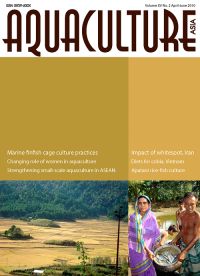
Aquaculture Asia Magazine, April-June 2010

In this issue:

The Dedanaw Project, Myanmar. The changing face of women for small-scale aquaculture in Bangladesh. Strengthening capacity of small holders in ASEAN. Carp seed production in Orissa, India. Sustainable mountain paddy-fish farming of the Apatani tribes. The economic impacts of whitespot virus on shrimp production in Iran. Current practices of marine finfish cage culture in China, Indonesia, Thailand and Vietnam. Effects of trash fish on growth and body composition of cobia.

Inland fishery resource enhancement and conservation in Thailand

The production from inland capture fisheries in Thailand is about 1 million tonnes per annum. Engineering the environment and fish stocking are the two major practices adopted, and closed-season fishing as well as control of fishing gears are used for conservation purposes. Fish stocking programs date back to the 1950s have been continuously conducted. This presentation provides a historical perspective on stock enhancement practices in Thailand since the 1950s.

Aquaculture Asia Magazine, October-December 2009

In this issue:

Mussel farming initiatives in North Kerala, India. Selective study on availability of indigenous fish with ornamental value in West Bengal. Aquaculture livelihoods centre in Aceh, Indonesia. e-Sagu Aqua - an innovative information and communication technology model for transfer of technology for aquaculture. Freshwater pearl crop: An emerging enterprise in the Indian subcontinent. Preliminary risk assessment of Pacific white shrimp (P. vannamei) introduced to Thailand for aquaculture. Black gill disease of lobster and more.

The changes of mangrove ecosystem in Mahakam Delta, Indonesia: A complex social-environmental patter on linkages in resources utilisation

The vegetation in Mahakam Delta is predominantly mangrove forest that consists of a pedada zone, Rizophora zone, transition zone, Nipa zone and nibung zone. Prior to 1980, mangrove vegetation in Mahakam Delta was pristine. Considerable changes in the extent of mangrove ecosystem occurred between 1990-2002 until 2001 when about 63% mangrove areas was deforested mainly due to conversion for shrimp ponds. Since 2002, partial efforts for restoration had been taken in mangrove replanting at some sites.