The purpose of this workshop was to build shared understandings of participatory livelihoods concepts and approaches, with emphases on the approaches as ways of thinking and working, and on learning from concrete examples from the experiences of STREAM in Cambodia and Vietnam, and SPARK in the Philippines. One outcome from the first workshop, was that between the two workshops participants would carry out follow-up tasks appropriate to their context.
3 February 2004 | Matthew Briggs | 6807 Downloads | .pdf | 582.74 KB
Sulawesi has the largest coral reef area in Indonesia, at the epicenter of worldwide marine biodiversity, but is one of the areas most threatened in Southeast Asia by destructive fishing practices. This case study reviews the potential for aquaculture to provide alternative livelihoods for fishers within the context of an integrated, community-based coastal management plan with involvement of local communities empowered to control and steward their resources so that they can conserve and utilise them sustainably.
The Nature Conservancy has been working in Komodo National Park since 1995 to establish a marine reserve that 1) ensures long-term protection of the natural community structure, habitat and species and protects a portion of the exploited reef fish stock to enhance fisheries in the traditional use zones inside the Park and in the waters surrounding the Park. This case study illustrates mariculture activities that could contribute to conservation purposes and more sustainable use of natural resources.
3 February 2004 | IUCN Vietnam Program | 1868 Downloads | .pdf | 376.38 KB
This case study describes the present status and trends, and provides recommendations for the improvement of aquatic resources management within Hon Mun Marine Protected Area (MPA), Nha Trang Bay, Khanh Hoa Province, Vietnam. The case study also evaluates options for improving the livelihoods of local villagers through the development of ecologically sustainable aquaculture and fisheries, which include diversification following careful selection and trial of appropriate culture species, and application of “best practice” culture methods.
3 February 2004 | Ronet Santos, Erwin Pador and Meddy De La Torre | 6218 Downloads | .pdf | 761.14 KB
This study characterised the coral reef fisheries in Tubigon, Bohol, Philippines, and sought to derive lessons from the management interventions to eliminate unsustainable fishing practices and improve coastal livelihoods employed by various groups in Tubigon. The study investigated whether recent advances in aquaculture of grouper and reef fisheries had helped improve coastal community livelihoods and prevent unsustainable and destructive practices, and whether there was a role for the private sector in eliminating unsustainable fishing practices and improving coastal livelihoods.
30 January 2004 | Graham Haylor, William Savage and S.D. Tripathi | 1336 Downloads | .pdf | 382.99 KB
The visit was to plan the proposed case studies, the State-level Workshops and the consensus-building process of the DFID NRSP Research Project R8100 entitled “Investigating Improved Policy on Aquaculture Service Provision to Poor People”. Meetings were held with GVT staff, jankars and farmers from communities in villages in Orissa, Jharkhand and West Bengal, and officials of Departments of Fisheries in Orissa, West Bengal and Jharkhand. Meetings were also held with GVT, ICAR and the Fisheries Commission.
30 January 2004 | S. Ayyappan, P. Bueno and G. Haylor | 1292 Downloads | .pdf | 97.9 KB
To organise, to form a union, to become an alliance, is a fundamental of human social behaviour. Farming is one of the earliest examples of sustained collective livelihood. This missive relates some early exciting experiences of associations of farmers that are emerging from amongst tribal communities, which constitute some of the most disadvantaged in India, and the work that these organisations and other partners have made towards poverty alleviation through support for aquaculture.
30 January 2004 | Graham Haylor, William Savage and | 1579 Downloads | .pdf | 320.32 KB
The three State-level Workshops were held in West Bengal, Jharkhand and Orissa in October 2002. The aim and objectives of the workshops were to contribute to “giving people a voice” in policy-making processes that have an impact on their livelihoods, to understand a process for transacting institutional and policy change, to provide feedback on case studies and to review emerging “indicators of change” and provide input into the subsequent Stakeholders Workshop.
30 January 2004 | Graham Haylor and William Savage | 1254 Downloads | .pdf | 103.51 KB
This paper is about a process and practice which is bringing representatives of tribal communities in three Indian states together with district, state and national government officials, around the issue of aquaculture services provision. The project comprises a series of visits, fieldwork, workshops, case studies, a consensus-building process, literature research and documentation. Among its aims are building shared understandings of government services provision among recipients, implementers and policy-makers, and facilitating an equitable dialogue towards policy change.
30 January 2004 | Graham Haylor, William Savage and S.D. Tripathi | 1453 Downloads | .pdf | 405.61 KB
The workshop objectives were to understand a process for transacting institutional and policy change, provide feedback to “finalise” six case studies which document experiences of rural aquaculture services provision from the perspectives of representative recipient and provider groups, to review emerging “indicators of progress” to feed into a consensus-building process and to provide input into a subsequent Policy Review Workshop. It contributed to giving people a voice in policy-making processes that have an impact on their livelihoods.
30 January 2004 | Graham Haylor, Ashish Kumar, Rubu Mukherjee and William Savage | 1372 Downloads | .pdf | 354.15 KB
There are many “stakeholders” involved in the development of schemes to support tribal people to undertake aquaculture. These should include tribal people, researchers, policy-makers and others. Stakeholders often face a situation in which different people have conflicting views. Such differences can be over the appropriate goals of a scheme, the types of outcomes, who should be helped and in what way, or the merit and worth of particular activities.
30 January 2004 | Ashish Kumar, B.K. Sahay, K.P. Singh, S.D. Tripathi, Gautam Dutta, Jhinuk Ray, Graham Haylor and William Savage | 2334 Downloads | .pdf | 588.45 KB
The six case studies published here grew in concept and content throughout the Project period. To follow the progress of the Case Studies, excerpts have been taken from previous Project documents, and adapted for the purpose of showing how they changed from an initial idea to the form in which they appear here and were presented finally at the Policy Review Workshop in Noida, Delhi, in April 2003. Each of the studies is different in focus and format.
30 January 2004 | Graham Haylor, William Savage and S.D. Tripathi | 1352 Downloads | .pdf | 494.22 KB
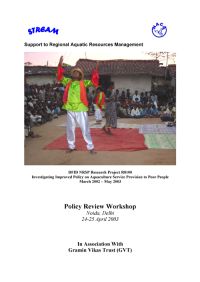
The aim of the Policy Review Workshop, as with all project activities, was “contributing to ‘giving people a voice’ in policy-making processes that have an impact on their livelihoods”. The workshop objectives included: Through six case studies, stakeholder statements and a street-play, understand the experiences of rural aquaculture services provision from the perspectives of recipients and providers; review the process for transacting policy change and lessons learnt; and make recommendations for policy change based on project outcomes.
30 January 2004 | Graham Haylor and William Savage | 1519 Downloads | .pdf | 447.15 KB
This report, at the request of NRSP, highlights “research learning and new thinking” arising from project R8100. It considers the project’s process from a strategic viewpoint, which is summarised in a conceptual matrix. The main features of the process’s overall strategy considered in more detail are a strategy for bringing through the voices of poor people – described as facilitated advocacy, with the role played by the project being one of “making it easier for people to speak for themselves”.
30 January 2004 | Graham Haylor, William Savage and S.D. Tripathi | 1376 Downloads | .pdf | 399.6 KB
The meetings and this document discuss the lessons learnt by project R8100 and consider how the follow on project might take these forward. This document combines the minutes of the Delhi meetings and the Stakeholder meeting in Ranchi, and captures as stories the summary of project R8100 and the visit to Jabarrah. The objectives of R8334 are presented, with comments on these recorded, and the project flow chart and proposed revisions to it are included.
30 January 2004 | Graham Haylor, William Savage and S.D. Tripathi | 1728 Downloads | .pdf | 267.98 KB
Three consecutive State-level Communications Strategy Workshops were held in the capitals of Jharkhand, Orissa and West Bengal states. The aim of the workshops, as with all project activities, was to “contribute to ‘giving people a voice’ in policy-making processes that have an impact on their livelihoods.” The specific objectives were to review and orient participants to the project’s four outputs and to draft a state-level communications strategy, including ideas for a monitoring and evaluation process.
30 January 2004 | Paul Bulcock, Graham Haylor and William Savage | 1630 Downloads | .pdf | 516.56 KB
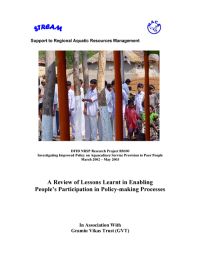
Development approaches are constantly evolving, acting on and utilising lessons learnt from past experiences. As a result, “good governance” approaches are currently topical, an intrinsic component of which is how rural poor people can participate in policy-making processes. By reviewing lessons learnt, and considering these with examples from within and outside India, an indication can be given of the most appropriate ways to begin to affect policy, although a specific blueprint will not be suggested.
This Learning Workshop on Livelihoods Analysis was held in Long An Province, Vietnam from 19-20 November 2002. It was part of an ongoing series of activities that will inform the implementation of the Ministry of Fisheries Strategy on Sustainable Aquaculture for Poverty Alleviation under the Vietnamese Government’s Hunger Eradication and Poverty Reduction (HEPR) Program. The recruitment in October of Nguyen Song Ha, STREAM Vietnam Communications Hub Manager, improved preparations within the Vietnamese national context.
A scoping Meeting on “Sustainable Aquaculture for Poverty Alleviation” was held in Hanoi , 23-25 May 2000. The meeting was held to review the role of aquaculture development (freshwater, brackish water and marine environments) in poverty alleviation and hunger eradication in Vietnam, to identify strategies for the more effective application of aquaculture and aquatic resources management to poverty alleviation, to review a draft framework for a programme on sustainable aquaculture for poverty alleviation and to prepare an appropriate action plan.
This System Requirement Report describes national level requirements for data collection and sharing mechanisms for fisheries co-management in the Philippines. It also provides a broad picture of the following for the national fisheries management level in the Philippines.