7 May 2006 | Wilfredo G. Yap, Simon Funge-Smith, M. Rimmer, M.J. Phillips, Sih Yang Sim, H. Kongkeo and Pedro B. Bueno | 1674 Downloads | .pdf | 196.38 KB
This paper provides an overview of seafood consumption production in southeast Asia circa 2006. It forecasts a need for aquaculture to expand area under culture and intensity; highlights the potential for fishmeal to constrain growth, and identifies a trend towards cultivation of high-value species. Sources for the review included a regional synthesis of aquaculture developed for a regional workshop in 2005, a review of marine finfish hatchery development and a regional survey of cage fish culture.
20 April 2006 | Gonzales, E., Maung Soe, K., Mukherjee, R., Nguyen, S.H., Suspita, A., Wattoo, J.M. and Bulcock, P. | 3007 Downloads | .pdf | 287.29 KB
This report examines the role mariculture could play in reducing poverty and providing alternative livelihood opportunities for people living in coastal areas. This includes a review of the current status of coastal poverty, coastal livelihoods and vulnerabilities within the Asia-Pacific region and the experiences and examples of sustainable economic development through mariculture. This review then identifies key follow-up actions and recommends strategies for future pro-poor mariculture development.
High-health postlarvae a prerequisite for sustainability of the Indian shrimp industry. Broodstock and all-female scampi grow out ponds in south India. Genetically modified fish and potential applications. Rainbow trout farming in hill terraces of Nepal. Sugar industry by-products as plankton boosters and yield enhancers in carp culture. Growth and production of Penaeus monodon in low saline culture systems. Poor households raise prawns for export. Marine fish marketing in Bangladesh.
NACA Governing Council endorses new work programme, elects Sena De Silva as next Director General. RapiDot Kit - Farmer friendly kit for WSSV detection. Regional mariculture program strengthened. Economics and marketing analysis of the live reef fish food trade in the Asia-Pacific. Workshop on molecular techniques in aquaculture and seafood safety, Mangalore, India. Better-practice approaches for culture-based fisheries development in Asia. High-level Bahrain fisheries deletation visits Iran. First monthly meeting of fish farmers at One-stop Aqua Shop in Punjab Pakistan. Fish breeding training program for farmers of OAS, Kaipara. Provincial workshops on National Fisheries Policy and Strategy Framework held in Punjab and Sindh, Pakistan. Monitoring and evaluating the impacts of aquaculture on the agency and well-being of women. STREAM welcomes AYAD volunteer. Workshop to strengthen aquatic animal health capacity and biosecurity in ASEAN. Asian Federation for Information Technology in Agriculture (AFITA) 2006 in Bangalore. Aquaculture rehabilitation project launched by Indonesian Minister of Marine Affairs and Fisheries.
16 January 2006 | Gonzales, E. and Savaris, J. | 7077 Downloads | .pdf | 1.69 MB
This report provides insight into the status of the marine ornamental fish trade in the Philippines, including policy environment, collection, distribution channels, markets and constraints. The report also reviews the livelihoods of poor stakeholders in market chains including economic and financial aspects, natural and physical resources, livelihood patterns, social structures. The report provides recommendations for policy makers and stakeholders in improving the livelihoods of poor stakeholders in marine ornamental fish collection and market chains and resource management.
This is the annual report (2003-2004) of the Reef Fish Aquaculture R&D Project, based at the Northern Fisheries Centre, Cairns. The project provides a core platform for a suite of R&D projects addressing the feasibility of aquaculture technologies for high-value marine finfish species. This report outlines progress on the three core components of the programme, namely broodstock management and spawning, live prey production, and larval rearing and grow-out.
Nursery rearing of silver barb Puntius goniotus. Artemia enrichment and biomasss production for larviculture. Seed production of mud crab Scylla serrata in India. Macrobrachium on the southwest coast of India. Fish wastes in urban and suburban markets of Kolkata: Problems and solutions. Groups of poor women farming carps in leased ponds, Bangladesh. Lymphocystis disease and diagnostic methods in China. Mesocosm technology advances grouper aquaculture in northern Australia.
The Asia Regional Advisory Group on Aquatic Animal Health meets annually to discuss regional health issues including emerging disease threats. This report includes a review of regional disease status circa 2005, global and regional disease reporting arrangements, global issues and standards, progress in implementation of the the Regional Technical Guidelines on Health management for the Responsible Movement of Live Aquatic Animals, identification and designation of regional aquatic animal health resources and regional and international cooperation.
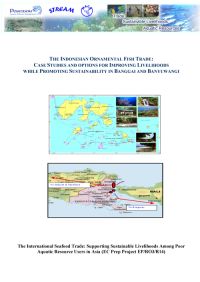
This report provides insight into the status of the marine ornamental fish trade in Indonesia, including policy environment, collection, chain of custody, distribution channels, markets and constraints. The report also reviews the livelihoods of poor stakeholders in market chains including economic and financial aspects, natural and physical resources, livelihood patterns, social structures. The report provides recommendations for policy makers and stakeholders in improving the livelihoods of poor stakeholders in marine ornamental fish collection and market chains.
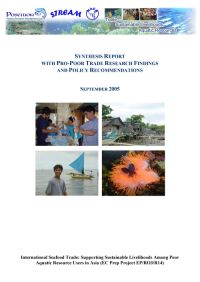
30 November 2005 | Macfadyen, G., Banks, R., Phillips, M. and Haylor, G. | 2844 Downloads | .pdf | 605.71 KB
The purpose of the project was to investigate international trade in fisheries products and its relationship to poverty alleviation and livelihoods of poor aquatic resource users in developing countries in Asia, and to identify options to improve the effectiveness of poverty reduction through international seafood trade. The project directly addressed the EC-PREP priority area of trade and development, and indirectly provided valuable insight to two other priority areas: food security and sustainable rural development; and institutional capacity building.
This is a historical report describing the establishment of a marine finfish and shrimp aquaculture research programme by the SEAFDEC Aquaculture Department at its Tigbauan station. The report describes the facilities that were established, with diagrammes of the facility layout and list of personnel. It also summaries research findings and makes recommendations on future research directions, including on broodstock manturation, development of larval and compound feeds, health and extension of technology.
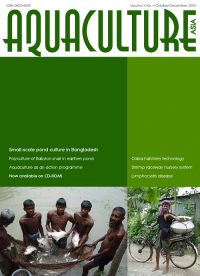
Small-scale pond culture in Bangladesh. Issues and challenges in community-based aquaculture. Aquaculture as an action programme building confidence and self-worth. Transforming policy recommendations into pro-poor service provision. Grow out of spotted Babylon to marketable size in polyculture with seabass. Influence of economic conditions and global shocks on grouper markets. Status of cobia hatchery technology in Vietnam. Organic shrimp raceway system. Macrobrachium rosenbergii in Vembanad Lake. Management of monogenean parasites.
A study tour of seafood markets in southern China (Guangdong Province and Hong Kong SAR) was conducted in 2005. The programme provided participants with exposure to some of China's larges live marine seafood markets, provided insight on marine farming systems and management including major species and technologies, and provided participants with the opportunity to develop valuable business and scientific contacts with farmers, buyers, traders, industry groups and scientists.
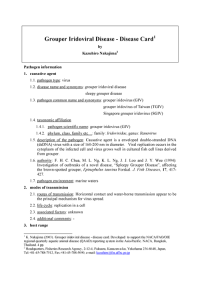
Recognising the importance of iridoviral disease, in terms of its potential to spread and cause economic loss, grouper iridoviral disease was included for listing in the quarterly aquatic animal disease (QAAD) list under any other diseases of importance effective for reporting from first quarter of 2003. This disease card is developed to provide information to national authorities and support the regional NACA/FAO/OIE QAAD reporting system.
31 July 2005 | Sih Yang Sim | 2186 Downloads | .pdf | 1.75 MB
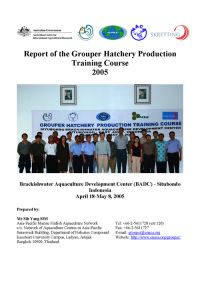
This is the report of the 3rd Regional Grouper Hatchery Production Training Course, which was conducted at the Brackishwater Aquaculture Development Center, Situbondo, East Java, Indonesia from April 18-May 8, 2005. There were a total of 17 participants coming from Australia, Brunei Darussalam, Indonesia, Malaysia, Maldives, Marshall Islands, Singapore, and Vietnam. The training consisted of a mixture of theory, practical and field trips for the participants.
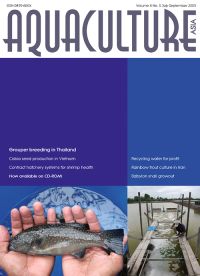
Asian Development Bank study on aquaculture and poverty. The consequences of converting to organic shrimp farming. Recycling water and making money with Artemia. Advances in the seed production of cobia Rachycentron canadum in Vietnam. Australian success with barramundi cod Cromileptes altivelis. Recent grouper breeding developments in Thailand. Application of probiotics in rotifer production systems. Contract hatchery systems. Rainbow trout culture in Iran. Spotted babylon Babylonia areolata growout in earthern ponds.
1 June 2005 | Sih-Yang Sim, Michael A. Rimmer, Kevin Williams, Joebert D. Toledo, Ketut Sugama, Inneke Rumengan and Michael J. Phillips | 2295 Downloads | .pdf | 1 MB
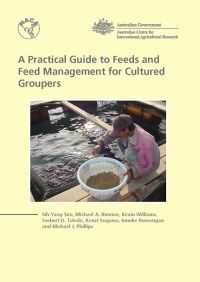
Most marine fish farms in Asia still rely on what is commonly termed "trash fish". Despite it's apparent abundance and availability, there are some issues and problems related to its use in fish farming. This guide explores new and better farming practices making use of formulated feeds, as well as technical aspects of feed storage and quality control, management of feeding including weaning of groupers onto formulated feeds and economic considerations.
1 June 2005 | Sih-Yang Sim, Michael A. Rimmer, Joebert D. Toledo, Ketut Sugama, Inneke Rumengan, Kevin Williams and Michael J. Phillips | 2026 Downloads | .pdf | 1.06 MB
Recent improvements in hatchery production technology for high-value marine finfish species such as groupers have led to an increased interest in setting up hatcheries to produce fingerlings for aquaculture. Small-scale hatcheries make this technology available to poor people in developing countries. This guide provides an outline of the requirements to establish a small-scale marine finfish hatchery, particularly the economic aspects.
31 May 2005 | Melba G. Bondad-Reantaso, Sharon E. McGladdery, Iain East and Rohana Subasinghe (eds.) | 2489 Downloads | .pdf | 3.37 MB
The Asia Diagnostic Guide to Aquatic Animal Diseases or ‘Asia Diagnostic Guide’ is a comprehensive diagnostic guide in support of the implementation of the Asia Regional Technical Guidelines on Health Management for the Responsible Movement of Live Aquatic Animals. It was developed from technical contributions of members of the Regional Working Group and Technical Support Services and other aquatic animal health scientists in the region and outside who supported the Asia-Pacific Regional Aquatic Animal Health Management Programme.
The Asia Regional Advisory Group on Aquatic Animal Health meets annually to discuss regional health issues including emerging disease threats. This report includes a review of regional disease status circa 2004, global and regional disease reporting arrangements, global issues and standards, progress in implementation of the the Regional Technical Guidelines on Health management for the Responsible Movement of Live Aquatic Animals, identification and designation of regional aquatic animal health resources and regional and international cooperation.