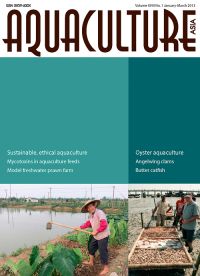
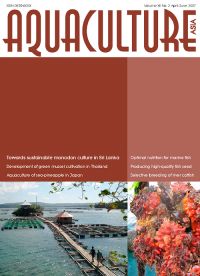
Health issues are not going away. Sustainable and Ethical Aquaculture Trade project in China. Oyster aquaculture for coastal defense and food production in Bangladesh. Importance of mycotoxins in aquaculture feeds. A model modular farm for size grading and monosex culture of freshwater prawn. Angelwing clam (Pholas orientalis) future assured after Thai DOF's breeding success. Ompok bimaculatus, an emerging species for diversification of aquaculture in Tripura, North-eastern India.
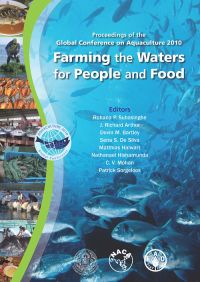
27 May 2012 | Rohana P. Subasinghe, J. Richard Arthur, Devin M. Bartley, Sena S. De Silva, Matthias Halwart, Nathanael Hishamunda, C.V. Mohan and Patrick Sorgeloos (Eds.) | 3804 Downloads | .pdf | 12 MB
The Global Conference on Aquaculture 2010 reviewed the present status and trends in aquaculture development, addressed emerging issues relevant to aquaculture development, assessed opportunities and challenges for future aquaculture development and built consensus on advancing aquaculture as a global, sustainable and competitive food production sector. This volume provides information on how aquaculture could be mobilized to alleviate global poverty and improve food and nutrition security in the coming decades.
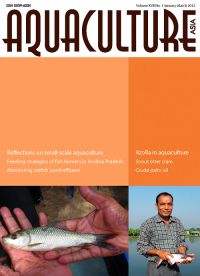
Reflections on small-scale aquaculture. Azolla - an aquatic fern of significance to small-scale aquaculture. Monitoring quantity and quality of striped catfish pond effluent. Feeding strategies adopted by fish farmers in Andhra Pradesh, India. Hatchery techniques applied for the artificiant production of snout otter clam (Lutraria rhynchaeria) in small scale farms in Nha Trang City, Vietnam. Crude palm oil is a sustainable alternative to the growing fish oil scarcity, particularly for the aquaculture of warm freshwater fish species.
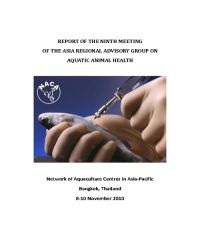
The Asia Regional Advisory Group on Aquatic Animal Health meets annually to discuss regional health issues including emerging disease threats. This report includes a review of regional disease status circa 2010, global and regional disease reporting arrangements, global issues and standards, progress in implementation of the the Regional Technical Guidelines on Health management for the Responsible Movement of Live Aquatic Animals, identification and designation of regional aquatic animal health resources and regional and international cooperation.
4 February 2011 | Miao Weimin, Sena De Silva and Brian Davy (eds.) | 6374 Downloads | .pdf | 1.16 MB
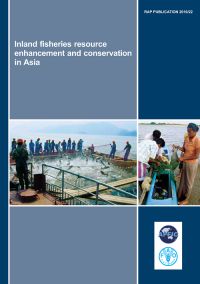
This regional review study is an effort to promote improved inland fisheries management under the Code of Conduct for Responsible Fisheries. It covers ten Asian countries with significant inland capture fisheries, namely Bangladesh, China, India, Indonesia, the Republic of Korea, Myanmar, Nepal, Sri Lanka, Thailand and Viet Nam. The papers were presented and discussed at a regional workshop held from 8-11 February 2010 in Pattaya, Thailand. Audio recordings of the presentations are also available for download.
The Phuket Consensus is a declaration on aquaculture development endorsed by participants of the Global Conference on Aquaculture 2010, held in Phuket, Thailand, 22-25 September. The consensus builds on the Bangkok Declaration, which was formulated at the International Conference on Aquaculture in the Third Millennium, held in Bangkok, 20-25 February 2000. The consensus and declaration provide strategic guidance on sustainable development of aquaculture considering social, environmental, technical and economic issues.
The Asia Regional Advisory Group on Aquatic Animal Health meets annually to discuss regional health issues including emerging disease threats. This report includes a review of regional disease status circa 2009, global and regional disease reporting arrangements, global issues and standards, progress in implementation of the the Regional Technical Guidelines on Health management for the Responsible Movement of Live Aquatic Animals, identification and designation of regional aquatic animal health resources and regional and international cooperation.
Mussel farming initiatives in North Kerala, India. Selective study on availability of indigenous fish with ornamental value in West Bengal. Aquaculture livelihoods centre in Aceh, Indonesia. e-Sagu Aqua - an innovative information and communication technology model for transfer of technology for aquaculture. Freshwater pearl crop: An emerging enterprise in the Indian subcontinent. Preliminary risk assessment of Pacific white shrimp (P. vannamei) introduced to Thailand for aquaculture. Black gill disease of lobster and more.
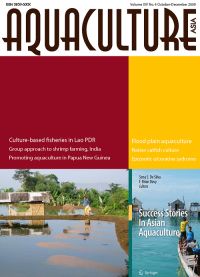
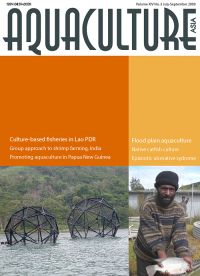
Community management and revenue sharing practices of culture-based fisheries in Lao PDR. Floodplain aquaculture in Bangladesh. Promoting small-scale inland aquaculture in Papua New Guinea. Group approaches to shrimp farming: The key to sustainability. Native catfish culture - a technology package for farmers. Influence of salinity in the growth of the black clam Villorita cyprinoides. EUS in Asia and Africa. Offshore opportunities for artisinal aquaculture. Grouper aquaculture in Brazil. NACA Newsletter.
Acute viral necrosis in scallops was included in the list of Qquarterly Aquatic Animal Disease (QAAD) reporting list for the year 2008. The disease card developed by regional resource experts from China in support of QAAD reporting system in Asia-Pacific provides information on pathogen, hosts, and confirmatory diagnostic methods. This is an emerging disease in the region and has caused significant losses to scallop culture industry in China.
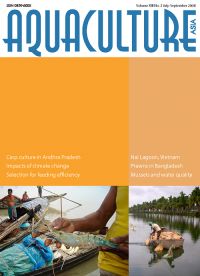
Possible improvements to carp culture in Andhra Pradesh. Aquaculture and environmental issues in the region of Nai Lagoon, Vietnam. Selection potential for feed efficiency in farmed salmonids. Freshwater prawn broodstock concern in Bangladhesh hatcheries. Production of Cirrhinus molitorella and Labeo chrysophekadion for culture-based fisheries in Lao PDR: Nursery and grow-out. Mussel farming: Alternate water monitoring practice. Use of poultry by-product meals in pelleted feed for humpback grouper Cromileptes altivelis.
The Asia Regional Advisory Group on Aquatic Animal Health meets annually to discuss regional health issues including emerging disease threats. This report includes a review of regional disease status circa 2007, global and regional disease reporting arrangements, global issues and standards, progress in implementation of the the Regional Technical Guidelines on Health management for the Responsible Movement of Live Aquatic Animals, identification and designation of regional aquatic animal health resources and regional and international cooperation.
Sustainable black tiger shrimp farming in Sri Lanka. An economic analysis of Persian sturgeon stock enhancement. Aquaculture and environmental sustainability in Thailand: Food or financial security? Cage fish culture - successful income generation in manmade reservoir Kulekhani, Nepal. Diversification of rice farming alleviates poverty in a Bangladesh village. Sea-pineapple aquaculture in Japan. Green mussel cultivation in Thailand. Selective breeding for growh and fillet yield in Vietnamese catfish. Producing quality fish seed in rural Asia.
The Asia Regional Advisory Group on Aquatic Animal Health meets annually to discuss regional health issues including emerging disease threats. This report includes a review of regional disease status circa 2006, global and regional disease reporting arrangements, global issues and standards, progress in implementation of the the Regional Technical Guidelines on Health management for the Responsible Movement of Live Aquatic Animals, identification and designation of regional aquatic animal health resources and regional and international cooperation.
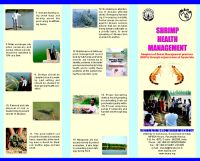
Shrimp Health Management brochures provide better management practices in a reader friendly format. These brochures were prepared as extension materials through the village based demonstration programme by the Marine Products Export Development Authority of India and NACA. The programme continues building success and involved a total of 29 villages and 29 Aquaclubs in five Indian states (Andhra Pradesh, Tamilnadu, Orissa, Gujarat, and Karnataka) in 2006.
7 May 2006 | Wilfredo G. Yap, Simon Funge-Smith, M. Rimmer, M.J. Phillips, Sih Yang Sim, H. Kongkeo and Pedro B. Bueno | 1675 Downloads | .pdf | 196.38 KB
This paper provides an overview of seafood consumption production in southeast Asia circa 2006. It forecasts a need for aquaculture to expand area under culture and intensity; highlights the potential for fishmeal to constrain growth, and identifies a trend towards cultivation of high-value species. Sources for the review included a regional synthesis of aquaculture developed for a regional workshop in 2005, a review of marine finfish hatchery development and a regional survey of cage fish culture.
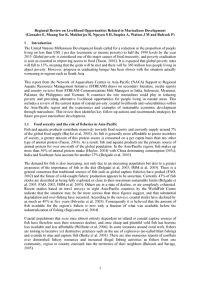
20 April 2006 | Gonzales, E., Maung Soe, K., Mukherjee, R., Nguyen, S.H., Suspita, A., Wattoo, J.M. and Bulcock, P. | 3008 Downloads | .pdf | 287.29 KB
This report examines the role mariculture could play in reducing poverty and providing alternative livelihood opportunities for people living in coastal areas. This includes a review of the current status of coastal poverty, coastal livelihoods and vulnerabilities within the Asia-Pacific region and the experiences and examples of sustainable economic development through mariculture. This review then identifies key follow-up actions and recommends strategies for future pro-poor mariculture development.
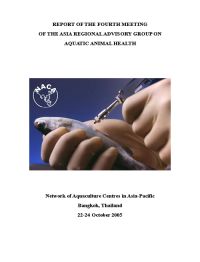
The Asia Regional Advisory Group on Aquatic Animal Health meets annually to discuss regional health issues including emerging disease threats. This report includes a review of regional disease status circa 2005, global and regional disease reporting arrangements, global issues and standards, progress in implementation of the the Regional Technical Guidelines on Health management for the Responsible Movement of Live Aquatic Animals, identification and designation of regional aquatic animal health resources and regional and international cooperation.
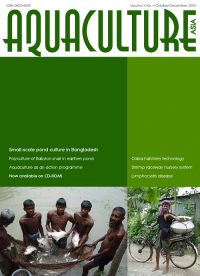
Small-scale pond culture in Bangladesh. Issues and challenges in community-based aquaculture. Aquaculture as an action programme building confidence and self-worth. Transforming policy recommendations into pro-poor service provision. Grow out of spotted Babylon to marketable size in polyculture with seabass. Influence of economic conditions and global shocks on grouper markets. Status of cobia hatchery technology in Vietnam. Organic shrimp raceway system. Macrobrachium rosenbergii in Vembanad Lake. Management of monogenean parasites.
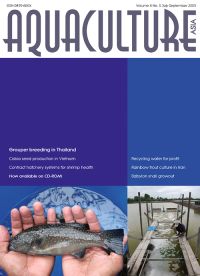
Asian Development Bank study on aquaculture and poverty. The consequences of converting to organic shrimp farming. Recycling water and making money with Artemia. Advances in the seed production of cobia Rachycentron canadum in Vietnam. Australian success with barramundi cod Cromileptes altivelis. Recent grouper breeding developments in Thailand. Application of probiotics in rotifer production systems. Contract hatchery systems. Rainbow trout culture in Iran. Spotted babylon Babylonia areolata growout in earthern ponds.