The Education and Training Programme assists capacity building among NACA members through the exchange and sharing of knowledge and skills between members. Activities may take the form of training courses, study visits and personnel exchange. The programme also supports the training components of the other thematic programmes and serves as an outreach arm of NACA. Regular training activities include three to four courses each year on various topics of regional priority in aquaculture development, such as:
Broodstock management in aquaculture.
Aquaculture business management.
Marine finfish seed production.
Aquaculture governance and planning.
Management for sustainable aquaculture development.
Key activities
Key activities of the programme include:
Identifying training needs for aquaculture development in NACA members.
Identifying and organising relevant expertise and capacities to meet the training needs.
Developing training modules and materials.
Facilitating routine education and training activities of NACA.
Facilitating and coordinating exchange programmes among members and with other regions.
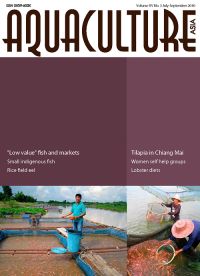
Seaweed farming in Sulawesi, Indonesia. Scaling up better management practices: Empowering small scale farmers. Animal welfare for farmed fish...is Asia-Pacific ready? Aquaculture field schools as an extension methodology. Successful seed production of cobia, Rachycentron canadum in India. 22nd Governing Council Meeting and a new Director General. NACA receives the Magarita Lizárraga Medal. NACA receives Gold Medal Award from the Asian Fisheries Society. Striped catfish farming in the Mekong Delta and more.
The workshop was held in Chennai, India from 16-18 May 2011, at the Central Institute for Brackishwater Aquaculture. It was convened as an activity of the ASEM Aquaculture Platform, funded by the European Commission’s 7th Framework Programme. The main purpose of the national workshop was to develop practical scaling up strategies at the national level and build consensus for an implementation plan for wider adoption of shrimp BMPs through a cluster management approach.
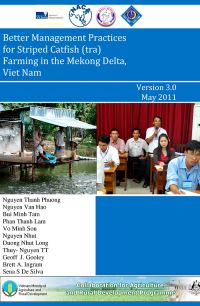
23 May 2011 | Nguyen Thanh Phuong, Nguyen Van Hao, Bui Minh Tam, Phan Thanh Lam, Vo Minh Son, Nguyen Nhut, Duong Nhut Long, Thuy Nguyen T.T., Geoff J. Gooley, Brett A. Ingram and Sena S De Silva | 10324 Downloads | .pdf | 4.11 MB
Tài liệu này là phiên bản thứ 3.0 về “Thực hành quy phạm thực hành quản lý tốt hơn (BMP) cho nghề nuôi cá tra vùng Đồng bằng Sông Cửu Long, Việt Nam”. Phiên bản này được chỉnh sửa từ phiên bản 2.0 dựa trên kết quả thí nghiệm ở 11 điểm trình diễn tự nguyện thực hiện theo BMP phiên bản 2.0 và ý kiến phản hồi của các hộ tham gia trình diễn và các nhóm liên quan khác trong các đợt hội thảo. Cùng với tài liệu này, nông dân cũng được dự án cung cấp một bản hướng dẫn BMP đơn giản hơn bằng tiếng Việt (chỉ bao gồm các bước thực hiện BMP) và sổ ghi chép các hoạt động hằng ngày. “Gói tài liệu” này được phổ biến đến người nuôi nhằm thúc đẩy quá trình ứng dụng BMP vào nghề nuôi cá tra ở Việt Nam.
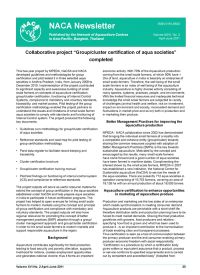
International requirements on food safety, traceability, animal health and welfare and social responsibility are increasingly stringent. The burden of compliance and the cost of certification are particularly heavy for small scale farmers who are often excluded by the limited resources at their disposal. Working in groups can help small scale farmers attain economies of scale necessary to address compliance issues and participate in certification schemes, improving their competitive position.
International requirements on food safety, traceability, animal health and welfare and social responsibility are increasingly stringent. The burden of compliance and the cost of certification are particularly heavy for small scale farmers who are often excluded by the limited resources at their disposal. Working in groups can help small scale farmers attain economies of scale necessary to address compliance issues and participate in certification schemes, improving their competitive position.
Collaborative project "Grouper/cluster certification of aqua societies" completed. Report of the Advisory Group on Aquatic Animal Health available. Guidelines on Aquaculture Society Certification released. Listen to us online. Workshop on ecosystem approach to inland fisheries: Data needs and implementation strategies. Disease advisory: Infectious myonecrosis (IMN) status and threat. 7th Regional Grouper Hatchery Production Training Course, 25 September - 15 October, Situbondo, Indonesia.
23 February 2011 | Nguyen Thanh Phuong, Nguyen Van Hao, Bui Minh Tam, Phan Thanh Lam, Vo Minh Son, Nguyen Nhut, Duong Nhut Long, Thuy Nguyen T.T., Geoff J. Gooley, Brett A. Ingram and Sena S De Silva | 2647 Downloads | .pdf | 3.3 MB
This document is Version 3.0 of “Better Management Practices for Catfish Aquaculture in the Mekong Delta, Vietnam”. It incorporates revisions of previous versions and experiences from demonstration farms, as well as feedback from a National CatFish BMP Workshop, held 23-24 November 2010 in Long Xuyen City, An Giang Province, involving all stakeholders of the tra/striped catfish (Pangasianodon hypophthalmus) farming sector of the Lower Mekong Delta. A Vietnamese translation is available.
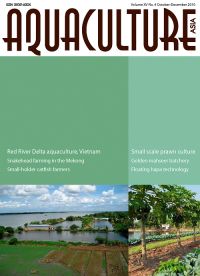
Rapidly changing aquaculture scene in the Red River Delta, Vietnam. Current situation and challenges for the farming of snakeheads in the Mekong Delta. Is there a business case for small-holders in Vietnamese pangasius? Small scale prawn culture practices towards sustainable development in Chittagong region, Bangladesh. Gloating hapa technology for the mass production of tilapia Oreochromis niloticus in Bangladesh. Management in seed production of golden mahseer Tor putitora in hatchery condictions.
25 September 2010 | Gary Jensen | 2614 views | .mp3 | 9.51 MB
Aquaculture has transitioned rapidly over the past decade to reach global status as a critical source of nutritious and safe food. Research, extension, policy and information systems are powerful mechanisms that must address several dimensions of food security at once. Intuition-based aquaculture is being systematically replaced by science-based practices and improved technologies from world-class research institutions and new innovations by entrepreneurial farmers and private companies.
25 September 2010 | Brian Davy | 2648 views | .mp3 | 14.19 MB
Looking back to Kyoto (June 1976) and the last global conference, the Millennium Conference (February 2000), there was a clear recognition of the importance of networking and related forms of knowledge sharing and learning. This panel reviews examples of knowledge sharing networks using knowledge platforms and different knowledge management activities. It is expected that such networking and wider knowledge sharing activities will intensify and we suggest a number of new future directions drawn from other sectors.
How do we ensure that the benefits from aquaculture growth are pro-poor and gender equitable? In science, some gender-disaggregated statistics are collected by the Agricultural Science and Technology Indicators programme. Akin to farming and fishing, aquaculture is usually assumed to be largely the domain of men. Minimal progress has been made in addressing gender issues in aquaculture, even though some researchers, activists and development agencies are recognising and raising the profile of the issues.
It has been recognised that farmers’ innovations are crucial in order to achieve cumulative growth, both economically and socially. However, several social, political, economical and environmental factors have hampered farmers’ innovation, such as lack of information on aquaculture, inadequate science and technology policies and lack of governmental support. The panel will assess crucial factors needed to promote, encourage and support farmers’ innovative processesand transform developing countries to innovatoin-driven economies.
25 September 2010 | Gary Jensen | 2764 views | .mp3 | 7.1 MB
Presentation of the summary, conclusions and recommendations of Thematic Session 5 (Improving knowledge, information, research, extension and communication on aquaculture).
The Phuket Consensus is a declaration on aquaculture development endorsed by participants of the Global Conference on Aquaculture 2010, held in Phuket, Thailand, 22-25 September. The consensus builds on the Bangkok Declaration, which was formulated at the International Conference on Aquaculture in the Third Millennium, held in Bangkok, 20-25 February 2000. The consensus and declaration provide strategic guidance on sustainable development of aquaculture considering social, environmental, technical and economic issues.
Relative efficacies of lobsters Panulirus ornatus and P. homarus cultured using pellet feeds and trash fish, Vietnam. Tilapia in Chiang Mai, Thailand. Marketing low-value cultured fish in Bangladesh: An evaluation of value chain. Current practices of rice field eel Monopterus albus culture in Vietnam. Self-help group makes fisherwomen self-relian: A story of success. Small indigenous freshwater fish species of India: Significance, conservation and utilisation.
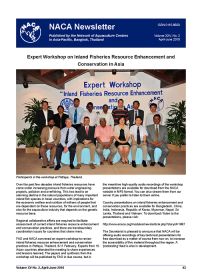
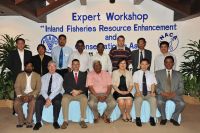
Expert Workshop on Inland Fisheries Resource Enhancement and Conservation in Asia. Reviews in Aquaculture: Special issue on the Use and Exchange of Aquatic Genetic Resources. Dr Ayyappan becomes the Director General of ICAR. CIBA training course - capacity building on entrepreneurship development in coastal aquaculture. Success Stories in Asian Aquaculture - now available for free download! Giant Prawn 2011. Peer reviewed publications. Meetings address climate change impacts on small scale milkfish farmers in the Philippines.
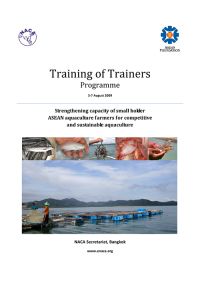
This is the manual for the "train the trainers" course aiming to increase the capacity of small-scale farmers in ASEAN countries. The manual focusses on five countries and commodities: Snakehead (Cambodia), Tilapia (Thailand), seaweed (Philippines), marine fish (Indonesia) and shrimp (Vietnam). In this volume, lectures presented by experts are included. The training program included technical aspects related to the culture of commodities, marketing, access to information, organization of farmer groups, gender and good culture practices.
Over the past few decades inland fisheries resources have come under increasing pressure from water engineering projects, pollution and overfishing. FAO and NACA convened an expert workshop to review inland fisheries resource enhancement and conservation practices in Pattaya, Thailand, 8-11 February. Experts from 10 Asian countries attended the meeting to share experiences and lessons learned. Regional collaborative efforts are required to facilitate assessment of current inland fisheries resource enhancement and conservation practices.
7 February 2010 | Tuantong Jutagate and Achara Rattanachai | 4252 views | .mp3 | 6.73 MB
The production from inland capture fisheries in Thailand is about 1 million tonnes per annum. Engineering the environment and fish stocking are the two major practices adopted, and closed-season fishing as well as control of fishing gears are used for conservation purposes. Fish stocking programs date back to the 1950s have been continuously conducted. This presentation provides a historical perspective on stock enhancement practices in Thailand since the 1950s.