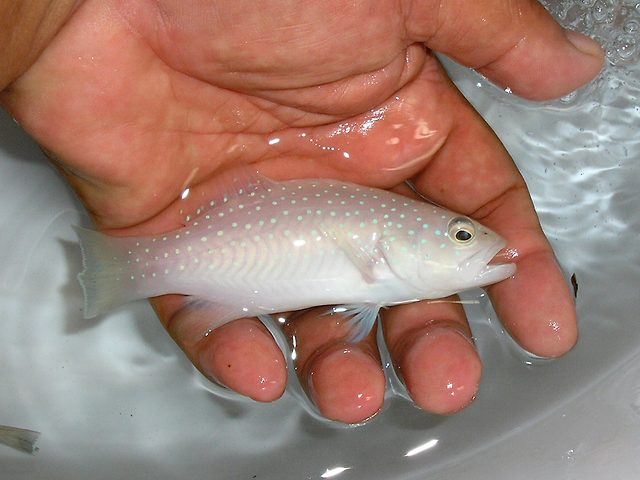
NACA-ACIAR projects developed hatchery technology for tropical groupers and other marine finfish.
NACA implements collaborative development assistance projects, addressing issues of common or regional interest. Individual projects draw heavily on the personnel and facilities of participating centres in member states. Projects are essentially implemented by the centres with the Secretariat acting as a coordinating body.
NACA supports technical exchange, capacity building, institutional strengthening and policies for sustainable aquaculture development and aquatic resource management. Network partners include research centres, member governments, farmer associations, development agencies and the Food and Agriculture Organization of the United Nations. Projects currently or recently implemented by the network are listed below.
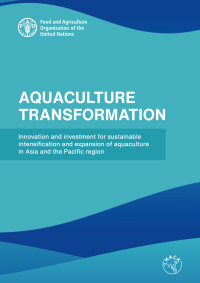
The document provides an overall vision and framework intended to accelerate aquaculture transformation in Asia and the Pacific region through innovations and investment, and to provide guidance to partners from the public, private and development communities to actively engage with the region in transforming aquaculture to more efficient, inclusive, resilient and sustainable food systems. The document served as background information for discussion in the High-Level Meeting on Aquaculture Transformation in Asia and the Pacific Region, 22–23 November 2022, organised by the FAO Regional Office for Asia and the Pacific and the Network of Aquaculture Centres in Asia-Pacific. The document is broadly aligned with FAO’s Blue Transformation Roadmap, paying specific attention to the context and needs of aquaculture within Asia and the Pacific region. The Paper translates the Roadmap into a vision and priority actions for aquaculture transformation in the region by 2030.
This project contributes to NACA's recent work with the FAO on aquaculture transformation. The aim is to create more efficient, inclusive, resilient, and sustainable food systems through innovation, investment, and partnerships. NACA is developing an Aquaculture Innovation and Investment Hub (AIIH) to help realise this vision in the region, providing a facility that will bring together innovators, startups, and investors to accelerate transformation. The project will contribute to developing National Innovation and Investment Plans for Thailand, The Philippines, and Fiji, which will address issues including climate change, disease prevention and management, environmental sustainability, gender equality and social inclusion, and resource utilisation and management. The project is part of a wider AQUADAPT initiative, a four-year partnership running from 2023-2027, funded by Canada's International Development Research Centre.
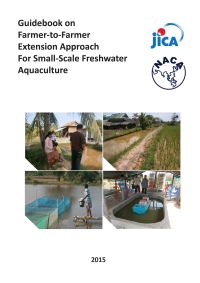
The objectives of this project were to i) develop a guidebook in English on "Farmer-to-farmer extension approaches for small-scale aquaculture" and ii) to translate the developed guidebook into selected local dialects in Asia-Pacific and other regions (e.g. Africa). The project made use of the significant results from the JICA projects in Cambodia, Benin and other countries on farmer-to-farmer extension approaches on technology extension for small-scale farmers. The book is available in eleven languages (English, Arabic, Bahasa Indonesia, Burmese, French, Khmer, Loatian, Malay, Nepali, Thai and Vietnamese.
Culture-based fisheries (CBF) are a useful development strategy for improving the income and food security of rural communities. CBF requires minimal capital outlay, mobilising farming communities to make use of existing small dams and reservoirs for the secondary purpose of foodfish production. The objective of this project is to introduce community-based CBF to Cambodia, and to consolidate the gains of communities that have adopted CBF in Lao PDR.
The objective of this project was to develop an agreed code of practice for the transboundary movement of aquatic organisms that feeds into the fisheries management strategy for the lower Mekong basin. The code of practice provides guidance on risk management and mitigation measures be taken into account for live aquatic animal imports or other transfers that are part of the established commercial practice, or those related to scientific study at research facilities.