NACA member governments are: Australia, Bangladesh, Cambodia, China, Hong Kong SAR, India, Indonesia, I.R. Iran, Kingdom of Saudi Arabia, Korea (DPR), Lao PDR, Malaysia, Maldives, Myanmar, Nepal, Pakistan, Philippines, Sri Lanka, Thailand and Vietnam.
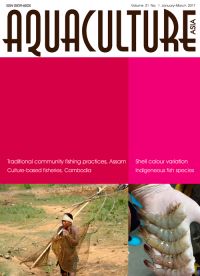
Anti-microbial resistance in aquaculture; participatory market chain approaches to boost fish nurseries; traditional community fishing practices of rural Assam; practical significance of restricted feeding regimes in aquaculture; Bangana dero: A potential indigenous fish species for diversification of carp culture; shell colour variation in farmed Litopenaeus vannamei: Comparison of white- and brown-shelled shrimp; culture-based fisheries: A low-tech, greenhouse friendly approach to improving food and income for Cambodian families.
The 15th meeting of the Asia Regional Advisory Group on Aquatic Animal Health; a regional consultation on responsible production and use of feed in aquaculture; a report on the Giant Prawn 2017 conference; a preview of the new NACA website; and new initiatives on a very serious emerging issue - reducing the human and animal health risks from development of anti-microbial resistance in the aquaculture industry.
The development of resistant strains of disease-causing microorganisms is an important health issue of global concern. When microbes such as bacteria, fungi, parasites, and viruses become resistant to antimicrobial substances, the diseases they may cause become more difficult or impossible to treat. Resistance is developed by the indiscriminate use of antimicrobials and places human health at risk. The discovery of antibiotics revolutionised medicine, creating a belief that a 'magic bullet' had finally been found to control bacterial diseases. Antibiotics, a class of antimicrobial agents, kill or inhibit the growth of bacteria, but they have no significant effect on other types of microorganisms such as viruses.
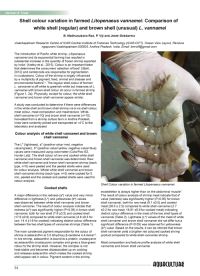
The regular shell colour of farmed Litopenaeus vannamei is off-white to greenish-white but instances of L. vannamei with brown-shell colour do occur in farmed shrimp. A study was conducted to determine if there were differences vis-à-vis shell colour, meat colour, meat composition and meat texture. White-shelled vannamei was determined to be better in terms of meat composition and texture profile but brown-shelled vannamei yielded a more brightly red-coloured cooked product.
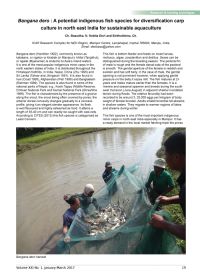
Bangana dero is one of the most popular indigenous minor carps in the north eastern states of India, fetching triple the market prices of Indian major carps. B. dero is a bottom feeder and feeds on insect larvae, molluscs, algae, zooplankton and detritus. Over the last two decades the occurrence of wild juveniles of this fish in Indian rivers has fallen drastically. A protocol for induced breeding, larviculture, nursery rearing and growout including polyculture of B. dero is described.
Feed is the most expensive component of an aquaculture enterprise. Successful cultured fish production requires optimisation of feeding practices to ensure the most economically effective growth rates. Reducing feed costs for culture practices can be achieved by taking the advantage of restricted feeding strategies. Under a restricted feeding regime fish convert a greater portion of feed to body weight. Case studies of restricted feeding are presented for several species and the costs savings and other benefits are briefly discussed.
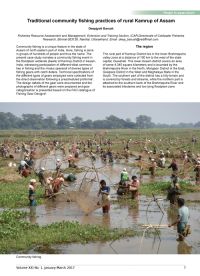
Community fishing is a unique feature in the state of Assam, India. The present case study narrates a community fishing event in the floodplain wetlands (beels) of Kamrup District in Assam, India, witnessing participation of different tribal communities in fishing and the modus operandi of diverse types of fishing gears with catch details. The design details of the gear were documented. The communal fishing practices of local communities are described along with the respective roles of men and women.
About 0.75 million tonnes of shrimp feed was produced during 2016, with roughly equal quantities of freshwater fish feed produced. Although shrimp farming is fully dependent on formulated feeds, freshwater finfish farming is still transitioning to use of pelleted feeds. High value coastal carnivorous fin fish continues to be produced via a combination of trash fish and formulated feeds. Fishmeal inclusion in shrimp feed formulations has fallen substantially. The availability of feed ingredients in India is discussed.
The Asia Regional Advisory Group on Aquatic Animal Health meets annually to discuss regional health issues including emerging disease threats. This report includes a review of regional disease status circa 2016, global and regional disease reporting arrangements, global issues and standards, progress in implementation of the the Regional Technical Guidelines on Health management for the Responsible Movement of Live Aquatic Animals, identification and designation of regional aquatic animal health resources and regional and international cooperation.
The 15th meeting was held from 21-23 November 2016, in Bangkok, Thailand. A special session was held on addressing the use of anti-microbial substances in aquaculture and the development of anti-microbial resistance. This is an issue of global concern for both human and animal health, and it had been addressed by a resolution at FAO’s Thirty-ninth Conference in June 2015. The meeting reviewed in detail the status of aquatic animal disease in the region.
The 72nd edition of the Quarterly Aquatic Animal Disease Report contains information from 12 governments. The foreword provides information about the 15th Meeting of the Asia Regional Advisory Group on Aquatic Animal Health.
The 71st edition of the Quarterly Aquatic Animal Disease Report contains information from 15 governments. The foreword provides information about the 10th Symposium on Diseases in Asian Aquaculture.
The Asia Regional Advisory Group on Aquatic Animal Health meets annually to discuss regional health issues including emerging disease threats. This report includes a review of regional disease status circa 2015, global and regional disease reporting arrangements, global issues and standards, progress in implementation of the the Regional Technical Guidelines on Health management for the Responsible Movement of Live Aquatic Animals, identification and designation of regional aquatic animal health resources and regional and international cooperation.
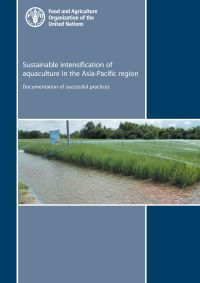
This publication is the major output of a regional programme jointly implemented by FAO and NACA in 2015 to document and disseminate successful practices that contribute to the sustainable intensification of aquaculture in the Asia-Pacific region. Twelve practices are described that contribute to at least one of the following: Improved production and resource use efficiency (land, water, feed, energy); improved environmental benefits; strengthened economic viability and farmers' resilience; and improved social acceptance and equity.
This report, the 71st in the series, contains information about the aquatic animal health status of sixteen states in the Asia-Pacific region. The foreword discusses changes to the Quarterly Aquatic Animal Disease Report, including a move to electronic-only distribution.
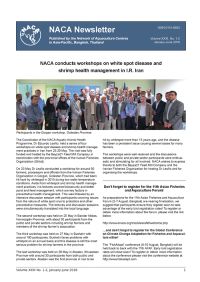
NACA conducts workshops on white spot disease and shrimp health management in I.R. Iran. Don’t forget to register for the 11th Asian Fisheries and Aquaculture Forum! NACA pays tribute to Professor H.P.C. Shetty – Patron of the Pillay Aquaculture Foundation. EHP: Shrimp industry survey. 3rd International Conference on Fisheries and Aquaculture, 24-25 August, Negombo, Sri Lanka. Special Session on the Status of Aquatic Genetic Resources for Food and Agriculture. Second International Technical Workshop on Acute Hepatopancreatic Necrosis Disease (AHPND). Guidebook on Farmer-to-Farmer Extension Approach for Small-Scale Freshwater Aquaculture. Sustainable intensification of aquaculture in the Asia-Pacific region.
Professor H. P. C. Shetty (17 May 1930 - 11 November 2015) was the first Director of Instruction of the College of Fisheries Mangalore, established in 1969, the first such College in India, thereby laying the foundation for fisheries education. He was responsible for setting the syllabus and developing the campus of the College in Mangalore. He was involved in replicating the Mangalore Fisheries College model elsewhere in India and even abroad.
This report, the 70th in the series, contains information about the aquatic animal health status of nine states in the Asia-Pacific region. The foreword discusses tilapia lake virus, a new viral disease of farmed tilapia.
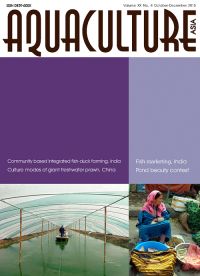
Aquaculture feed supply chain attracting scrutiny. Pond beauty contest, Ram Kumar and social development. Culture modes of giant freshwater prawn in Yangtze River Delta for early harvest. Fish marketing in Kashmir, India - a case study of Srinagar. Community-based integrated fish-duck farming: A boon for rural development in agro-climatic conditions of Assam, India. Gastropod and bivalve fishery of Kakinada Bay, Andhra Pradesh, India: Management and conservation issues.