NACA member governments are: Australia, Bangladesh, Cambodia, China, Hong Kong SAR, India, Indonesia, I.R. Iran, Kingdom of Saudi Arabia, Korea (DPR), Lao PDR, Malaysia, Maldives, Myanmar, Nepal, Pakistan, Philippines, Sri Lanka, Thailand and Vietnam.
It is best to stock advanced fingerlings in large ponds, tanks, and in both small and large reservoirs, since they can better escape predators and competitors. Seasonal ponds, often 0.10-0.15 ha and 1.5-1.8 m deep can be used as rearing ponds for raising advanced fingerlings. Low water levels at the end of the season will make netting and harvesting easy.
Everyone wants advanced fingerlings as early after the rains as possible. They fetch a good price and make marketable fish production possible in seasonal ponds. One way to produce early season advanced fingerlings is to grow them in perennial ponds and store them at high density with minimal feeding for the coming year. Whe such "stunted" fingerlings are stocked into ponds with good feed they grow fast and can be marketed in about 6-8 months.
Common carp is a foreign fish and there are several varieties. The variety used in Western Orissa is the fully scaled carp, which suits the tropical climate. Common carp lives and feeds near the pond bottom and can be grown with the Indian major carps, catla, rohu and mrigal as a 'polyculture' (which means growing many different types of fish together). It can also be grown alone, as a 'monoculture' in rice fields with high dykes that retain water.
In this issue: Policy development as a theme and policy briefs as a genre. Decriminalising Cambodian family-scale fishers through a livelihoods approach to law reform. Longer pond leases in Orissa. One-stop Aqua Shop - a "one-window delivery" service center for aqua-farmers and fishers. Fisheries and aquaculture policy formulation process in Pakistan. Improving the international marine ornamental fish trade to sustain and improve the livelihoods of poor people involved in the trade. About the STREAM Journal. About STREAM.
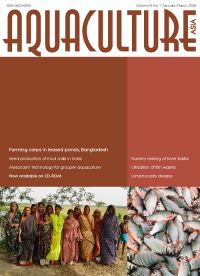
Nursery rearing of silver barb Puntius goniotus. Artemia enrichment and biomasss production for larviculture. Seed production of mud crab Scylla serrata in India. Macrobrachium on the southwest coast of India. Fish wastes in urban and suburban markets of Kolkata: Problems and solutions. Groups of poor women farming carps in leased ponds, Bangladesh. Lymphocystis disease and diagnostic methods in China. Mesocosm technology advances grouper aquaculture in northern Australia.
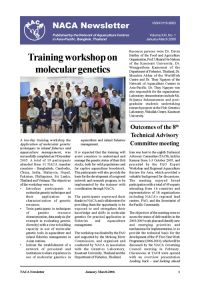
Training workshop on molecular genetics. Outcomes of the 8th Technical Advisory Committee Meeting. Taking the 'grey' out of 'grey literature'. An introduction to the South Iran Aquaculture Research Center. Aquaclubs in India achieve good crops this year, with further challenges ahead. Rebuilding resilience of coastal populations and aquatic resources. Recent activities in STREAM. First international PCR training workshop completed. AusAID funds two aquatic animal health projects. Asia Regional Advisory Group continues to support aquatic animal disease management in the region. Indonesia accedes to the NACA Agreement. Governing Council 17 to set NACA Work Programme 2006-2010. Marine fish culture manuals now available in Thai. Aquaculture Rehabilitation Guide in Aceh, Indonesia. Boat building in the tsunami affected areas of NAD: Fishing vessel quality issues. Australasian Aquaculture 2006, 27 - 30 August, Adelaide. East Asian Seas Congress, 12-16 December 2006, China. Aquafeed Production Workshop, 8 March 2006, Thailand.
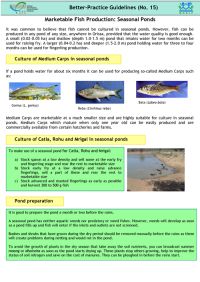
It was common to believe that fish cannot be cultured in seasonal ponds. However, fish can be produced in any pond of any size, anywhere in Orissa, provided that the water quality is good enough. A small and shallow pond that retains water for two months can be used for raising fry. A larger and deeper pond holding water for three to four months can be used for fingerling production.
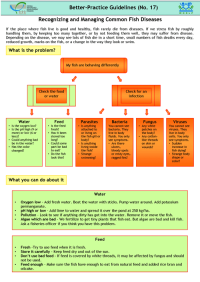
If the place where fish live is good and healthy, fish rarely die from diseases. If we stress fish by roughly handling them, by keeping too many together, or by not feeding them well, they may suffer from disease. Depending on the disease, we may see lots of fish die in a short time, small numbers of fish deaths every day, reduced growth, marks on the fish, or a change in the way they look or swim.
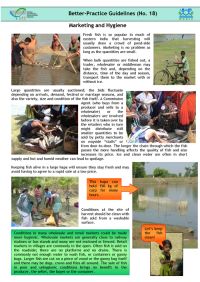
Fresh fish is so popular in much of eastern India that harvesting will usually draw a crowd of pond side customers. Marketing is no problem so long as the quantities are small. When bulk quantities are fished out a trader, wholesaler or a middleman may take the fish and depending on the distance, time of the day and season, transport them to the market with or without ice.
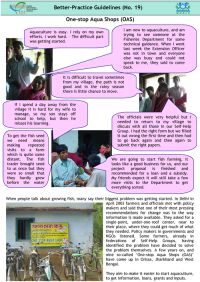
When people talk about growing fish, many say their biggest problem was getting started. In Delhi in April 2003 farmers and officials met with policy makers and said that one of their most pressing recommendations for change was to the way information is made available. They asked for a single-point, under-one-roof center, near to their place, where they could get much of what they needed.
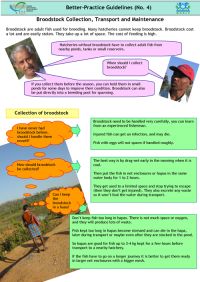
These guidelines illustrate good practice for broodstock handling and management using practices that are suitable for small-scale operations. This document is also available in Oriya.
A bold bid by women in Kandhkelgaon Village, West Bengal, to break out of their poverty trap. This story describes how women who could no longer make a living from weaving turned to aquaculture. Success came, not just through income generation but by reducing the cost of being poor. The story highlights the influences that constrain and enhance development, including the sheer bravery and entrepreneurial spirit of people who are poor.
A closer look at the benefits of working together, the evolution of a federation of aquaculture self-help groups and a one-stop aqua shop in rural West Bengal. India has the largest concentration of tribal population in the world. For a long time now, voices have been raised in support of disadvantaged social groups that are trying to derive a livelihood from limited resources in remote rural areas in India.
A closer look at the evolution of successful aquaculture self-help groups in rural West Bengal, the discovery of new uses for local resource systems and the energising effect of flexible rural credit.
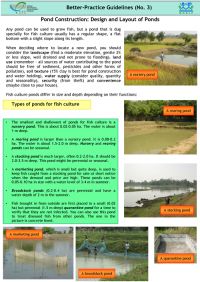
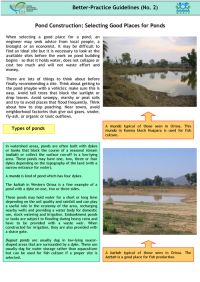
Any pond can be used to grow fish, but a pond that is dug specially for fish culture usually has a regular shape, a flat bottom with a slight slope along its length. When deciding where to locate a new pond, you should consider the landscape, land use, soil texture (15% clay is best for pond construction and water holding), water supply (consider quality, quantity and seasonality), security (from theft) and convenience (maybe close to your house).
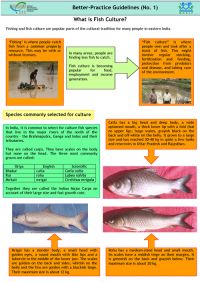
Fish culture is where people own and look after a stock of fish. This might involve regular stocking, fertilisation and feeding, protection from predators and disease and taking care of the environment.
When selecting a good place for a pond, an engineer may seek advice from local people, a biologist or an economist. It may be difficult to find an ideal site but it is necessary to look at the available sites before the work on pond building begins – so that it holds water, does not collapse or cost too much and will not waste effort and money. There are lots of things to think about before finally recommending a site.
In this issue: Seaweed culture and farmer incomes in Bekasi, Indonesia. Significant change for a self-help group. Conflict over fishing in Jharkhand. Critical steps in preparing coastal communities for effective policy changes. New guidelines on data collection and information sharing for co-management. About the STREAM Journal. About STREAM. This edition is also available in Ilonggo.
This report, the 30th in the series, contains information about the aquatic animal health status of sixteen states in the Asia-Pacific region. The foreword discusses capacity building and harmonisation in aquatic animal health within ASEAN.