NACA member governments are: Australia, Bangladesh, Cambodia, China, Hong Kong SAR, India, Indonesia, I.R. Iran, Kingdom of Saudi Arabia, Korea (DPR), Lao PDR, Malaysia, Maldives, Myanmar, Nepal, Pakistan, Philippines, Sri Lanka, Thailand and Vietnam.
This report, the 64th in the series, contains information about the aquatic animal health status of fourteen states in the Asia-Pacific region. The foreword discusses the 9th Symposium on Diseases in Asian Aquaculture.
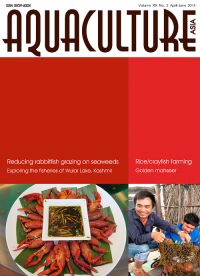
Integrated rice/crayfish farming in Hubei Province, China. Improvement of seaweed Kappaphycus alvarezii culture production by reducing grazing by rabbit fish (Siganus spp.). Exploring the fisheries of Wular Lake, Kashmir, India. Golden mahseer Tor putitora - a possible candidate species for hill aquaculture. Free primers for specific detection of bacterial isolates that cause acute hepatopancreatic necrosis disease. Special session on regional cooperation for improved biosecurity. AHPND detection discussion group established.
25th NACA Governing Council held in Vientiane, Lao PDR. Dr Cherdsak Viripat elected as next Director General of NACA. 9th Symposium on Diseases in Asian Aquaculture 24-28 November 2014, Vietnam. NACA to convene the 11th AFS Asian Fisheries and Aquaculture Forum. Free primers for specific detection of bacterial isolates that cause acute hepatopancreatic necrosis disease. World Aquaculture Adelaide 2014: Special session on regional cooperation for improved biosecurity. AHPND detection discussion group established. OIE Regional Workshop on Emerging Aquatic Animal Disease Response, in collaboration with NACA, Bali, Indonesia. United Kingdom - Southeast Asia Workshop on Sustainable Aquaculture.
The symposium provided a venue for information sharing on extension of small-scale aquaculture targeted to those individuals and relevant organisations involved in various aquaculture development projects. The symposium also assessed and presented the effectiveness of “farmer-to-farmer extension” approaches in the implementation of relevant aquaculture development projects in the region. The symposium was organised by the Japan International Cooperation Agency (JICA), NACA and the Thai Department of Fisheries.
This report, the 63rd in the series, contains information about the aquatic animal health status of fifteen states in the Asia-Pacific region. The foreword provides an update on acute hepatopancreatic necrosis disease of cultured shrimp, including a description of an improved PCR method for detection of AHPND bacteria.
4 December 2013 | V. Tammajedy | 4709 views | .mp4 | 49.6 MB
The Lao government has set a target to increase fish supply to 24 kg/year/person by 2020. In most cases of aquaculture extension, exotic species have been used as target species. In view of biodiversity, establishment of habitat and hybridizations with indigenous species in the natural water body, this practice may cause deterioration of the natural biodiversity. Therefore, to protect the diversifications, aquaculture extension using indigenous species should be promoted.
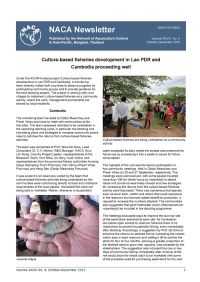
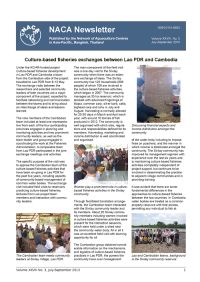
Under the ACIAR-funded project Culture-based fisheries development in Lao PDR and Cambodia, a monitoring team recently visited both countries to observe progress by participating community groups and to provide guidance for the next stocking season. The project is working with rural villages to implement culture-based fisheries as a community activity, where the work, management and benefits are shared by local residents.
This report, the 62nd in the series, contains information about the aquatic animal health status of sixteen states in the Asia-Pacific region. The foreword discusses the outcomes of the 12th meeting of the Asia Regional Advisory Group on Aquatic Animal Health.
This report, the 61st in the series, contains information about the aquatic animal health status of fifteen states in the Asia-Pacific region. The foreword discusses the OIE tool for evaluation of performance of aquatic veterinary services.
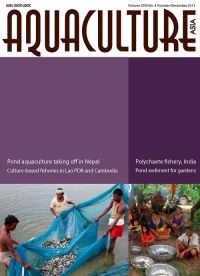
Special session on regional cooperation for improved biosecurity. Pond aquaculture taking off in Nepal. Introduction of culture-based fishery practices in small water bodies in Cambodia: Issues and strategies. A case study on polychaete fishery by the Irular tribal fishing community on the Tamil Nadu coast. Use of pangasius pond sediment for rooftop bag gardening: Potential for rural-urban integrated agriculture-horticulture. Culture-based fisheries exchanges between Lao PDR and Cambodia.
Culture-based fisheries development in Lao PDR and Cambodia proceeding well. National aquatic animal disease surveillance programme launched in India. Report on early mortality syndrome / acute hepatopancreatic necrosis syndrome of shrimp. International Symposium on Small-scale Freshwater Aquaculture Extension, 2-5 December, Bangkok. 'Perfect' food for 'perfect' prawns. Aquaculture without Frontiers Special Session. We asked CSIRO: Gold Coast Tiger Prawns. Understanding the sex of salmon. Overcoming smallholder challenges with biotechnology. Coordinated efforts in aquaculture needed to meet global demand. FAO e-book collection for tablets and e-readers.
Under the ACIAR-funded project Culture-based fisheries development in Lao PDR and Cambodia a team from the Cambodian side of the project travelled to Lao PDR from 8-12 May. The exchange visits between the researchers and selected community leaders of both countries are a major component of the project, expected to facilitate networking and communication between the teams and to bring about an interchange of ideas and lessons learned.
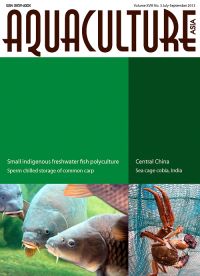
A second trip to Hubei Province, central China. Sea cage growout of cobia Rachycentron canadum in the Gulf of Mannar. Culture of small indigenous fish species in polyculture with Indian major carps and high value crops along pond dykes. Study on sperm chilled storage of common carp Cyprinus carpio in Vietnam. Culture-based fisheries exchanges between Lao PDR and Cambodia. Culprit behind massive shrimp die-offs in Asia unmasked.
Culture-based fisheries exchanges between Lao PDR and Cambodia. Culprit behind massive shrimp die-offs in Asia unmasked. Presentations from the final technical consultation on EMS/AHPNS of shrimp available for download. Aquaculture certification workshop held in Viet Nam. Aquaculture in a genetic plunge towards extinction? NACA implements World Bank training program on Good Aquaculture Practices. Study tour on aquaculture and wetland management for delegation from Assam, India. Koh Yao Noi Tree Bank and mangrove replanting continues. Consistent fish names key to consumer confidence. We are hiring! Request for contributions: Global Advances in Ecology and Management of Golden Apple Snails (2nd edition).
This report, the 60th in the series, contains information about the aquatic animal health status of fifteen states in the Asia-Pacific region. The foreword discusses response to aquatic animal disease emergencies.
This report, the 58th in the series, contains information about the aquatic animal health status of fifteen states in the Asia-Pacific region. The foreword contains a disease advisory notice on acute hepatopancreatic necrosis syndrome (AHPNS) of cultured shrimp.
This report, the 57th in the series, contains information about the aquatic animal health status of thirteen states in the Asia-Pacific region. The foreword discusses the outcomes of the 11th meeting of the Asia Regional Advisory Group on Aquatic Animal Health.
This report, the 56th in the series, contains information about the aquatic animal health status of fifteen states in the Asia-Pacific region. The foreword discusses a case definition for acute hepatopancreatic necrosis syndrome ("early mortality syndrome") in cultured shrimp in Asia.
This report, the 54th in the series, contains information about the aquatic animal health status of fourteen states in the Asia-Pacific region. The foreword discusses emerging aquatic animal diseases in the region, including acute hepatopancreatic necrosis disease and scale-drop syndrome.
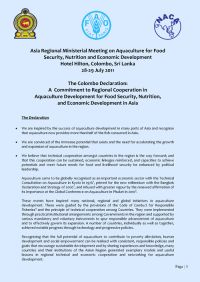
The Colombo Declaration is a commitment to regional cooperation in aquaculture development for food security, nutrition and economic development in Asia. It was developed and agreed on by delegations from 18 states at a ministerial-level meeting held in Colombo, Sri Lanka, 28-29 July 2011.