NACA member governments are: Australia, Bangladesh, Cambodia, China, Hong Kong SAR, India, Indonesia, I.R. Iran, Kingdom of Saudi Arabia, Korea (DPR), Lao PDR, Malaysia, Maldives, Myanmar, Nepal, Pakistan, Philippines, Sri Lanka, Thailand and Vietnam.
22 March 2018 | Network of Aquaculture Centres in Asia-Pacific | 3161 Downloads | .pdf | 3.45 MB
This report summarises the proceedings of the 16th meeting of the Advisory Group, held 26-27 August 2017 in Bali, Indonesia. The group's role includes reviewing disease trends and emerging threats in the region, identifying developments in global aquatic disease issues and standards, evaluating the Quarterly Aquatic Animal Disease Reporting Programme and providing guidance on regional strategies to improve aquatic animal health management. The meeting included discussion on Tilapia Lake Virus (TiLV) and developments in antimicrobial resistance.
This collection contains video recordings of the lectures from the Regional Training Course on Culture-based Fisheries in Inland Waters, held at Nha Trang University, Vietnam. The objective of the course was to provide participants with the skills to assist local communities to plan and manage culture-based fisheries; a relatively simple and low cost technology that can deliver nutritional and economic benefits to rural communities with few livelihood options. The course was sponsored by the United Nations University Fisheries Training Programme.
The first ever Regional Training Course on Culture-based Fisheries in Inland Waters was held at Nha Trang University from 30 October to 8 November. The objective of the course was to provide participants with the skills to assist local communities to plan and manage culture-based fisheries. These practices are an example of a relatively simple and low cost technology that can deliver nutritional and economic benefits to rural communities, which often have few livelihood options.
A regional consultation on aquaculture feed production and use in Asia-Pacific was held from 7-9 March 2017. The consultation reviewed the current situation of aquaculture feed production and use, sourcing of ingredients, policy and research needs. This collection contains audio recordings of the technical presentations made by experts, international organisations, the private sector and governments in the region. The report of the consultation is in press and will be made available for download in due course.
20 May 2017 | H.T. Dong, T. Rattanarojpong and S. Senapin | 5088 Downloads | .pdf | 375.4 KB
Recently, we released a warning of TiLV in Thailand and an improved RT-PCR detection methodology. The Fish Health Platform in Centex, BIOTEC/Mahidol University has also obtained positive test results for TiLV in other Asian countries where it has not yet been reported. Many countries have been translocating tilapia fry/fingerlings prior to and even after the description of TiLV. We have prepared a map listing countries with confirmed reports of TiLV infections and 43 other countries that we believe have imported infected fish.
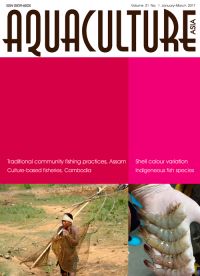
Anti-microbial resistance in aquaculture; participatory market chain approaches to boost fish nurseries; traditional community fishing practices of rural Assam; practical significance of restricted feeding regimes in aquaculture; Bangana dero: A potential indigenous fish species for diversification of carp culture; shell colour variation in farmed Litopenaeus vannamei: Comparison of white- and brown-shelled shrimp; culture-based fisheries: A low-tech, greenhouse friendly approach to improving food and income for Cambodian families.
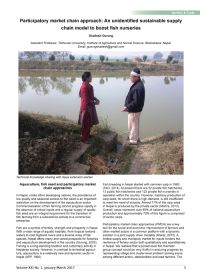
In Nepal, low quality and seasonal access to fish seed is an important restriction on the development of the aquaculture sector. Commercialisation of fish farming cannot progress rapidly in the absence of critical inputs and a regular supply of quality fish seed is an integral requirement for the transition of fish farming from a subsistence activity to a commercial enterprise. Participatory market chain approaches are a key tool for the social and economic improvement of farmers and market participants.
In mountain and hilly regions rainbow trout is the main fish species cultivated whereas carps, tilapia and pangasius are cultivated in the inner terai and terai region. Around 12,000 tonnes of pellet feed is used in aquaculture, of which about one third is imported from India. Around 60% of carps are fed with pellets or homemade feed. Around 40% of carp farmers, mainly small-scale, do not use any types of artificial feed but rely upon natural productivity of ponds.
1 January 2016 | Miao, W. and Lal, K.K. (Eds.) | 7177 Downloads | .pdf | 1.5 MB
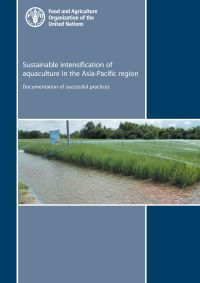
This publication is the major output of a regional programme jointly implemented by FAO and NACA in 2015 to document and disseminate successful practices that contribute to the sustainable intensification of aquaculture in the Asia-Pacific region. Twelve practices are described that contribute to at least one of the following: Improved production and resource use efficiency (land, water, feed, energy); improved environmental benefits; strengthened economic viability and farmers' resilience; and improved social acceptance and equity.
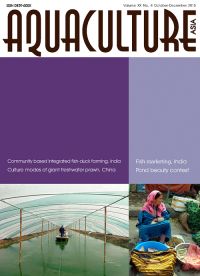
Aquaculture feed supply chain attracting scrutiny. Pond beauty contest, Ram Kumar and social development. Culture modes of giant freshwater prawn in Yangtze River Delta for early harvest. Fish marketing in Kashmir, India - a case study of Srinagar. Community-based integrated fish-duck farming: A boon for rural development in agro-climatic conditions of Assam, India. Gastropod and bivalve fishery of Kakinada Bay, Andhra Pradesh, India: Management and conservation issues.
Due to the world’s rapidly growing population, which is expected to peak somewhere around 9.5 billion, food production will need to be massively increased over the next few decades. This increase must be achieved without further degrading the environment. The unit environmental footprint of food production must be significantly reduced from where it is today. This concept, termed sustainable intensification, applies as much to aquaculture as it does to other agricultural sectors.
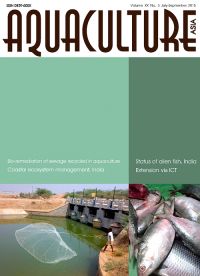
Changes to the magazine and website. Status of alien fish species farming and it's implications for Andhra Pradesh, India. Bridging the research-extension-farmer-input and market linkage gap in coastal aquaculture through application of ICT. Bio-remediation of domestic sewerage recycled in aquaculture: A Central Institute of Freshwater Aquaculture model. Role of family farming in marine and coastal ecosystem management in India. Conservation of fish genetic resources: An introduction to the state fishes of India.
This report, the 65th in the series, contains information about the aquatic animal health status of thirteen states in the Asia-Pacific region. The foreword discusses the outcomes of the 13th meeting of the Asia Regional Advisory Group on Aquatic Animal Health.
This report, the 64th in the series, contains information about the aquatic animal health status of fourteen states in the Asia-Pacific region. The foreword discusses the 9th Symposium on Diseases in Asian Aquaculture.
This report, the 63rd in the series, contains information about the aquatic animal health status of fifteen states in the Asia-Pacific region. The foreword provides an update on acute hepatopancreatic necrosis disease of cultured shrimp, including a description of an improved PCR method for detection of AHPND bacteria.
Modern aquaculture practices in Nepal started around the 1950s). Since then, aquaculture has contributed about 1% of GDP. The national average production from pond aquaculture is about 3.6 million tons/ha. However, the range of fish production varies from about few hundred kilograms to 7.0 million tons/hectare depending upon different farming and management system. Aquatic resources located at different altitudes can offer potential for different fisheries and aquaculture activities in Nepal.
This report, the 62nd in the series, contains information about the aquatic animal health status of sixteen states in the Asia-Pacific region. The foreword discusses the outcomes of the 12th meeting of the Asia Regional Advisory Group on Aquatic Animal Health.
This report, the 61st in the series, contains information about the aquatic animal health status of fifteen states in the Asia-Pacific region. The foreword discusses the OIE tool for evaluation of performance of aquatic veterinary services.
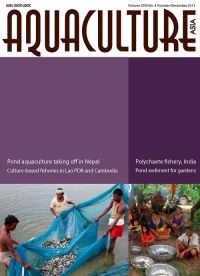
Special session on regional cooperation for improved biosecurity. Pond aquaculture taking off in Nepal. Introduction of culture-based fishery practices in small water bodies in Cambodia: Issues and strategies. A case study on polychaete fishery by the Irular tribal fishing community on the Tamil Nadu coast. Use of pangasius pond sediment for rooftop bag gardening: Potential for rural-urban integrated agriculture-horticulture. Culture-based fisheries exchanges between Lao PDR and Cambodia.
This report, the 60th in the series, contains information about the aquatic animal health status of fifteen states in the Asia-Pacific region. The foreword discusses response to aquatic animal disease emergencies.