NACA member governments are: Australia, Bangladesh, Cambodia, China, Hong Kong SAR, India, Indonesia, I.R. Iran, Kingdom of Saudi Arabia, Korea (DPR), Lao PDR, Malaysia, Maldives, Myanmar, Nepal, Pakistan, Philippines, Sri Lanka, Thailand and Vietnam.
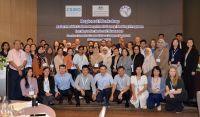
The third Asia-Pacific Laboratory Proficiency Testing Program for Aquatic Animal Diseases has been launched, with a regional workshop in Bangkok bringing together 50 people from 13 countries and territories across the region. The program, supported by the Australian Government Department of Agriculture, Fisheries and Forestry and CSIRO’s Australian Centre for Disease Preparedness, builds on more than a decade of collaboration to strengthen diagnostic capacity, safeguard aquaculture livelihoods, and support safe trade and food security.
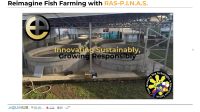
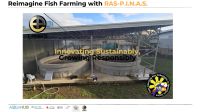
Elisa Claire Sy of E-Primate presents RAS-P.I.N.A.S, a closed-loop, water-efficient system for land-based fish farming. The technology integrates biofiltration, aeration, and mechanical treatment to support high-density production while conserving water and land and reducing disease risk. RAS-P.I.N.A.S also offers flexibility in farm siting, with trade-offs in energy use and infrastructure costs. Recirculating aquaculture systems are gaining traction as a key innovation in Asia’s sustainable aquaculture future.
This presentation by Elisa Claire Sy of E-Primate, showcases how RAS-P.I.N.A.S - a closed-loop, water-efficient technology - enables high-density, land-based fish farming using biofiltration, aeration, and mechanical treatment strategies. Discover how RAS conserves water and land, minimises disease risk, and offers flexibility in farm siting, while recognising the trade-offs of energy demands and infrastructure costs. Learn why RAS is gaining momentum as a key innovation in Asia's sustainable aquaculture future.
With the implementation of new aquatic animal disease reporting arrangements from January 2021 NACA is publishing reported aquatic animal diseases submitted by countries in the Asia-Pacific region. This report covers the fourth quarter of 2024 and the original and updated reports can be accessed from the QAAD page.
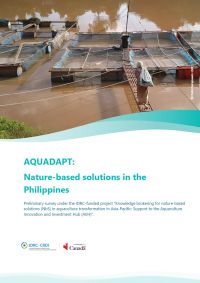
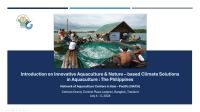
The project conducted a preliminary survey of the effectiveness of various types of nature-based solution (NbS) in use in the Philippines that contribute to climate change resilience by enabling off-grid farm operations and reducing reliance on costly fossil fuels, renewable materials and improved designs that enhance efficiency. Aquaculture enterprises were assessed for this project based on the NbS they utilised and the potential benefits they offer in mitigating climate change impacts and enhancing production systems.
Based on BFAR Regional Field Office Submissions, 50 aquaculture innovations nationwide have been identified to date. The list will be extended and screened as further regions report, in cooperation with the BFAR National Research Centers.
8 November 2024 | Chokanan Prompichai | 4426 views
With the implementation of the new aquatic animal disease reporting in the Asia Pacific region from January 2021 NACA is publishing reported aquatic animal diseases submitted by countries in the Asia-Pacific region. This report covers the second quarter of 2024 and the original and updated reports can be accessed from the QAAD page.
13 August 2024 | Wilfredo Cruz and Sammy Malvas | 4336 views
Presentation on opportunities to transform aquaculture in the Philippines: Challenges, innovations and nature-based solutions by Wilfredo Cruz and Sammy Malvas, Bureau of Fisheries and Agricultural Resources, Department of Agriculture, The Philippines. Presented at the Inception Workshop for the project "Knowledge brokering for nature-based solutions in aquaculture transformation in Asia-Pacific: Support to the Aquaculture Innovation and Investment Hub", 4-5 June 2024, Bangkok.
This project contributes to NACA's recent work with the FAO on aquaculture transformation. The aim is to create more efficient, inclusive, resilient, and sustainable food systems through innovation, investment, and partnerships. NACA is developing an Aquaculture Innovation and Investment Hub (AIIH) to help realise this vision in the region, providing a facility that will bring together innovators, startups, and investors to accelerate transformation. The project will contribute to developing National Innovation and Investment Plans for Thailand, The Philippines, and Fiji, which will address issues including climate change, disease prevention and management, environmental sustainability, gender equality and social inclusion, and resource utilisation and management. The project is part of a wider AQUADAPT initiative, a four-year partnership running from 2023-2027, funded by Canada's International Development Research Centre.
With the implementation of the new aquatic animal disease reporting in the Asia Pacific region from January 2021, and in lieu of the published QAAD Reports (last issue published was 4th quarter of 2020), NACA is publishing reported aquatic animal diseases submitted by countries in the Asia-Pacific region. This report covers the first quarter of 2024 and the original and updated reports can be accessed from the QAAD page.
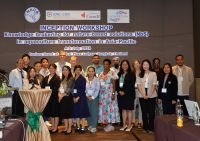
Canada's International Development Research Centre (IDRC) is sponsoring the project "Knowledge Brokering for Nature-Based Solutions in Aquaculture Transformation in Asia-Pacific: Support to the Aquaculture Innovation and Investment Hub." The project is part of a wider IDRC AQUADAPT initiative, a four-year partnership running from 2023-2027. AQUADAPT addresses the intertwined challenges of climate change, biodiversity loss, and food insecurity through applied research on nature-based solutions in aquaculture in Southeast Asia and the Pacific region. AQUADAPT emphasises Gender Equality and Social Inclusion (GESI), ensuring that nature-based solutions are inclusive of all genders and marginalised groups. The project's inception workshop was held in Bangkok from July 4-5, bringing together project teams from Thailand, The Philippines, and Fiji to discuss approaches and methodologies.
With the implementation of the new aquatic animal disease reporting in the Asia Pacific region from January 2021, and in lieu of the published QAAD Reports (last issue published was 4th quarter of 2020), NACA is publishing reported aquatic animal diseases submitted by countries in the Asia-Pacific region. This report covers the fourth quarter of 2023 and the original and updated reports can be accessed from the QAAD page.
With the implementation of the new aquatic animal disease reporting in the Asia Pacific region from January 2021, and in lieu of the published QAAD Reports (last issue published was 4th quarter of 2020), NACA is publishing reported aquatic animal diseases submitted by countries in the Asia-Pacific region. This report covers the third quarter of 2023 and the original and updated reports can be accessed from the QAAD page.
In 2023, FAO and NACA initiated a consultation process on aquaculture effluent management in Asia and the Pacific in collaboration with NACA member governments. Experts across the region gathered information to assess the state of governance, advancements in technology and innovation in aquaculture effluent management. The consultative process culminated in an expert workshop, convened from 14 to 15 November, funded by FAO, to share views and national experiences on aquaculture effluent management.
With the implementation of the new aquatic animal disease reporting in the Asia Pacific region from January 2021, and in lieu of the published QAAD Reports (last issue published was 4th quarter of 2020), NACA is publishing reported aquatic animal diseases submitted by countries in the Asia-Pacific region. This report covers the second quarter of 2023 and the original and updated reports can be accessed from the QAAD page.
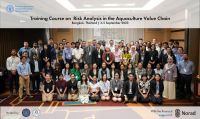
Risk analysis is an essential component of a national aquatic organism health strategy. Now widely applied in many fields, risk analysis provides a science-based framework for evaluating hazards, determining the likelihood and extent of potential harms, mitigating risks and guiding policy decisions. Combining risk and value chain analysis provides a risk-based and people-centred approach to managing disease risks and planning control measures for aquaculture systems. FAO organised a training course on Risk Analysis in the Value Chain from 3-5 September in Bangkok, Thailand, in partnership with NACA, INFOFISH, Thailand Department of Fisheries and the ASEAN Network of Aquatic Animal Health Centres. Financial support was provided by the Norwegian Agency for Development Cooperation and Thailand Department of Fisheries.
This report summaries the proceedings of the 21st meeting of the Regional Advisory Group on Aquatic Animal Health, held 17-18 November 2022. The role of the group is to review trends in disease and emerging threats in the region, identify developments in global disease issues and standards, to evaluate the Quarterly Aquatic Animal Disease Reporting Program and to provide guidance on regional strategies to improve aquatic animal health management.
With the implementation of the new aquatic animal disease reporting in the Asia Pacific region from January 2021, and in lieu of the published QAAD Reports (last issue published was 4th quarter of 2020), NACA is publishing reported aquatic animal diseases submitted by countries in the Asia-Pacific region. This report covers the fourth quarter of 2022 and the original and updated reports can be accessed from the QAAD page.
With the implementation of the new aquatic animal disease reporting in the Asia Pacific region from January 2021, and in lieu of the published QAAD Reports (last issue published was 4th quarter of 2020), NACA is publishing reported aquatic animal diseases submitted by countries in the Asia-Pacific region. This report covers the third quarter of 2022 and the original and updated reports can be accessed at the QAAD page.
With the implementation of the new aquatic animal disease reporting in the Asia Pacific region from January 2021, and in lieu of the published QAAD Reports (last issue published was 4th quarter of 2020), NACA is publishing reported aquatic animal diseases submitted by countries in the Asia-Pacific region. This report covers the second quarter of 2022 and the original and updated reports can be accessed at the QAAD page.