NACA member governments are: Australia, Bangladesh, Cambodia, China, Hong Kong SAR, India, Indonesia, I.R. Iran, Kingdom of Saudi Arabia, Korea (DPR), Lao PDR, Malaysia, Maldives, Myanmar, Nepal, Pakistan, Philippines, Sri Lanka, Thailand and Vietnam.
This report, the 66th in the series, contains information about the aquatic animal health status of fourteen states in the Asia-Pacific region. The foreword discusses key activities of the NACA Regional Aquatic Animal Health Programme.
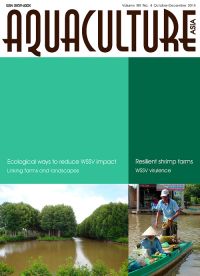
Promising aquaculture practices for sustainable intensification. Culture and breeding of Archcentrus spilurum at Tuticorin District of Tamil Nadu, India. Searching for ecological ways to reduce WSSV impact. Fisheries and aquaculture-based livelihoods prospects in East Kalimantan, Indonesia. Linking farms and landscapes in the governance of sustainable Vietnamese shrimp aquaculture. Resilience of shrimp farming based livelihoods in the Mekong Delta, Vietnam. Farming system affects the virulence of white spot syndrome virus (WSSV) in penaeid shrimp.
This report, the 65th in the series, contains information about the aquatic animal health status of thirteen states in the Asia-Pacific region. The foreword discusses the outcomes of the 13th meeting of the Asia Regional Advisory Group on Aquatic Animal Health.
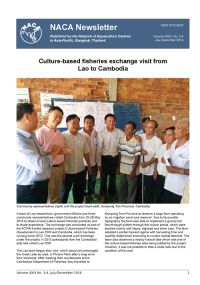
Culture-based fisheries exchange visit from Lao to Cambodia. National Fish Day, Cambodia. WAS Adelaide: Special Session on Regional Cooperation for Improved Biosecurity. Inbreeding and disease in tropical shrimp aquaculture: a reappraisal and caution. Shrimp EMS/AHPND Special Session at DAA9. 2nd International Symposium on Aquaculture and Fisheries Education. Report on Sustainable Fisheries and Aquaculture for Food Security and Nutrition.
This report, the 64th in the series, contains information about the aquatic animal health status of fourteen states in the Asia-Pacific region. The foreword discusses the 9th Symposium on Diseases in Asian Aquaculture.
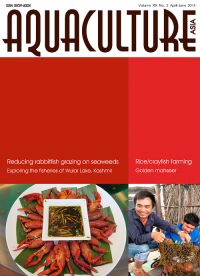
Integrated rice/crayfish farming in Hubei Province, China. Improvement of seaweed Kappaphycus alvarezii culture production by reducing grazing by rabbit fish (Siganus spp.). Exploring the fisheries of Wular Lake, Kashmir, India. Golden mahseer Tor putitora - a possible candidate species for hill aquaculture. Free primers for specific detection of bacterial isolates that cause acute hepatopancreatic necrosis disease. Special session on regional cooperation for improved biosecurity. AHPND detection discussion group established.
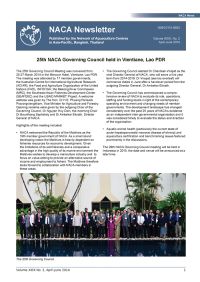
25th NACA Governing Council held in Vientiane, Lao PDR. Dr Cherdsak Viripat elected as next Director General of NACA. 9th Symposium on Diseases in Asian Aquaculture 24-28 November 2014, Vietnam. NACA to convene the 11th AFS Asian Fisheries and Aquaculture Forum. Free primers for specific detection of bacterial isolates that cause acute hepatopancreatic necrosis disease. World Aquaculture Adelaide 2014: Special session on regional cooperation for improved biosecurity. AHPND detection discussion group established. OIE Regional Workshop on Emerging Aquatic Animal Disease Response, in collaboration with NACA, Bali, Indonesia. United Kingdom - Southeast Asia Workshop on Sustainable Aquaculture.
The Asia Regional Advisory Group on Aquatic Animal Health meets annually to discuss regional health issues including emerging disease threats. This report includes a review of regional disease status circa 2013, global and regional disease reporting arrangements, global issues and standards, progress in implementation of the the Regional Technical Guidelines on Health management for the Responsible Movement of Live Aquatic Animals, identification and designation of regional aquatic animal health resources and regional and international cooperation.
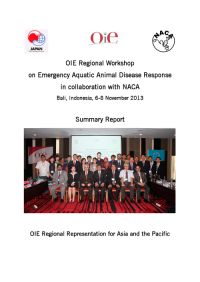
The workshop was held in Bali, Indonesia from 6 to 8 November 2013. The programme included reports on current aquatic animal disease situations in selected countries and presentations on the national aquatic animal health programmes of China, Japan and Korea. In addition, case studies on the molluscan diseases, shrimp diseases and finfish diseases were presented to facilitate the subsequent discussion on emergency response of those diseases in the national and regional level.
This report, the 63rd in the series, contains information about the aquatic animal health status of fifteen states in the Asia-Pacific region. The foreword provides an update on acute hepatopancreatic necrosis disease of cultured shrimp, including a description of an improved PCR method for detection of AHPND bacteria.
International Symposium on Small-scale Freshwater Aquaculture Extension, 2-5 December, Bangkok. 12th Meeting of the Asia Regional Advisory Group on Aquatic Animal Health. National Workshop on EMS/AHPND of Cultured Shrimp held in India. Report on early mortality syndrome / acute hepatopancreatic necrosis syndrome of shrimp. Sustaining Ethical Aquaculture Trade Newsletter. India and the AFSPAN Project. Report on AFSPAN Chilean survey. Feeding and feed management of Indian major carps in Andhra Pradesh.
This report, the 62nd in the series, contains information about the aquatic animal health status of sixteen states in the Asia-Pacific region. The foreword discusses the outcomes of the 12th meeting of the Asia Regional Advisory Group on Aquatic Animal Health.
This report, the 61st in the series, contains information about the aquatic animal health status of fifteen states in the Asia-Pacific region. The foreword discusses the OIE tool for evaluation of performance of aquatic veterinary services.
This report is the proceedings of a workshop held under the FAO technical cooperation project Emergency assistance to control the spread of an unknown disease affecting shrimps held in Hanoi, Viet Nam from 25 to 27 June 2013. The workshop reviewed recent investigations into the cause of acute hepatopancreatic necrosis syndrome, believed to related to a strain of Vibrio parahaemolyticus and drew a number of recommendations on specific and generic actions and measures for reducing the risk of AHPND.
Under the ACIAR-funded project Culture-based fisheries development in Lao PDR and Cambodia a team from the Cambodian side of the project travelled to Lao PDR from 8-12 May. The exchange visits between the researchers and selected community leaders of both countries are a major component of the project, expected to facilitate networking and communication between the teams and to bring about an interchange of ideas and lessons learned.
NACA was pleased to coordinate an aquaculture study tour to Bangladesh, Vietnam and Thailand from 19-26 April for a delegation of twelve fisheries development officials from Assam, India. The delegation included Mr Sri Hemanta Narzary, Commissioner and Secretary for Fisheries; Mr Sri Kailash Chang Damria, State Project Director for the ARIAS Society, Mr Sri Siddhartha Purkayastha, Deputy Directory of Fisheries, and district fisheries development and extension officers.
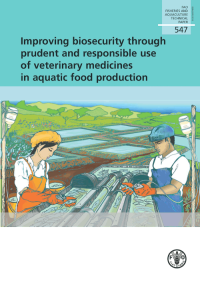
These are the proceedings of the FAO/AAHRI Expert Workshop on Improving Biosecurity through Prudent and Responsible Use of Veterinary Medicines in Aquatic Food Production, held in Bangkok, Thailand, from 15 to 18 December 2009. The workshop discussed the current status of antimicrobial usage in aquaculture and the impacts of their irresponsible use on human health, the aquatic environment and trade. The outcomes are relevant to the development of guiding principles on the responsible use of antimicrobials in aquaculture.
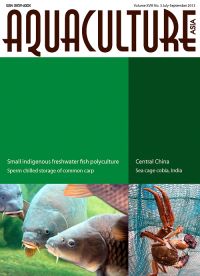
A second trip to Hubei Province, central China. Sea cage growout of cobia Rachycentron canadum in the Gulf of Mannar. Culture of small indigenous fish species in polyculture with Indian major carps and high value crops along pond dykes. Study on sperm chilled storage of common carp Cyprinus carpio in Vietnam. Culture-based fisheries exchanges between Lao PDR and Cambodia. Culprit behind massive shrimp die-offs in Asia unmasked.
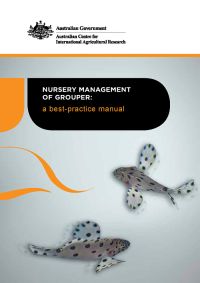
This manual provides practical guidelines for those engaged in the nursery culture of groupers in Indonesia as well as elsewhere in the tropics. It provides information on husbandry of groupers in the nursery phase, to reduce losses due to disease and cannibalism, and thus to increase the profitability of grouper nursing. The guidelines are derived from outcomes of ACIAR-funded research as well as other published information on grouper nursery management.
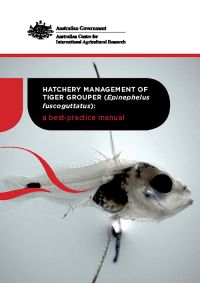
This manual provides guidelines for the production of tiger grouper fingerlings. It outlines best-practice methods for broodstock maintenance, spawning, egg incubation and rearing of larvae through to 2–3 cm, fully metamorphosed juveniles. The guidelines have been developed from the outcomes of ACIAR-funded research, as well as from the experience of Indonesian, Philippine and Australian scientists and commercial hatchery operators, and published information. It provides an aid for improving the availability of grouper seed stock.