Technical publications

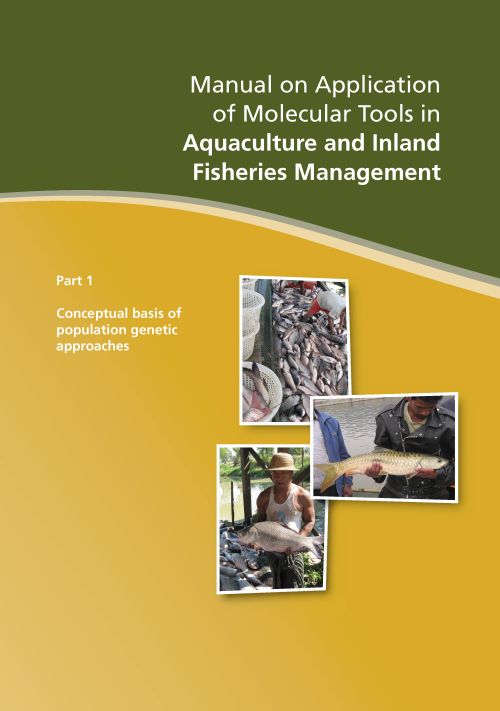
NACA publishes technical papers and manuals for a wide variety of farming systems and related environmental and social issues. Many of these provide guidance on better management practices with a view to improving crop outcomes and on-farm resource utilisation efficiency. By using inputs such as feed and power more efficiently, farmers can simultaneously improve their profitability and environmental performance.

Creative Commons Attribution.
Related

Publications

NACA publishes a wide range of aquaculture publications including technical manuals, workshop proceedings, better practice guidelines and several serials including Aquaculture Asia Magazine, the NACA Newsletter and the Quarterly Aquatic Animal Disease Report. To keep up to date with developments you could consider subscribing to our RSS feed

In this collection

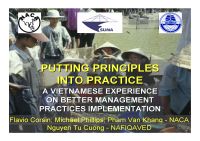
Putting principles into practice: A Vietnamese experience on better management practices implementation

This presentation provides an overview of Vietnamese experience on the implementation of better management Practices (BMPs) and good aquaculture practices (GAP) in shrimp aquaculture. Practices were implemented collectively by encouraging small-scale farmers to form groups that collaborate on issues such as screening seed for disease and improving water quality management. Improvements to crop outcomes were observed. The results presented include the profitability of BMP adopted ponds.

Sổ tay thực hành: Kỹ thuật Nuôi tôm - rừng kết hợp: Tài liệu dành cho cán bộ khuyến ngư

Sổ tay nẩy với mục đích giúp đỡ cho cán bộ khuyến ngư hướng dẫn người nông dân kỹ thuật nuôi tôm nhằm mục đích đạt được sản lương và thu nhập ngày càng cao trong hệ thống nuôi kết hơp tôm - rừng ở Đồng bằng Sông Cửu Long. Với những kỹ thuật đơn giản, thông thường giúp cho ngư dân từng bước gia tăng sản lương mà ít bị rủi ro.

Mixed shrimp-mangrove farming practices: A manual for extension workers

This manual has been prepared to assist extension officers to advise farmers on techniques for improving yields and farm income in mixed shrimp farming-mangrove forestry farming systems in the Mekong Delta. It focuses mainly on simple, common sense techniques that will allow farmers to make step-by-step improvements to production without taking unnecessary risks. The manual is based on a 6-year collaborative research and development project between the Governments of Vietnam and Australia.

Mixed shrimp-mangrove farming practices: A manual for farmers

This manual has been prepared to assist farmers with techniques for improving yields and farm income in mixed shrimp farming-mangrove forestry farming systems in the Mekong Delta, Vietnam. It focuses mainly on simple, common sense techniques that will allow farmers to make step-by-step improvements to production without taking unnecessary risks. The techniques and recommendations covered in this manual are based on the experience of a 6-year collaborative research and development project between Vietnam and Australia.

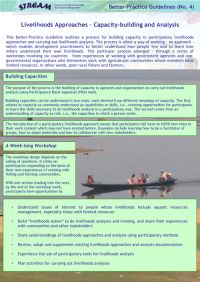
Better practice guidelines: Livelihoods approaches - capacity building and analysis

This guide outlines a process for building capacity in participatory livelihoods approaches and carrying out livelihoods analysis. The process is about a way of working that enables development practitioners to better understand how people live and to learn how others understand their own livelihoods. This particular process emerged from experiences of working with government agencies and non-governmental organisations who themselves work with agricultural communities whose members have limited resources, in other words, poor rural fishers and farmers.

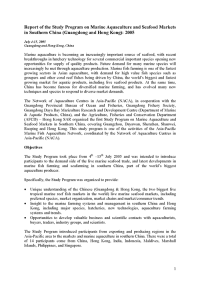
Report of the Study Program on Marine Aquaculture and Seafood Markets in Southern China

A study tour of seafood markets in southern China (Guangdong Province and Hong Kong SAR) was conducted in 2005. The programme provided participants with exposure to some of China's larges live marine seafood markets, provided insight on marine farming systems and management including major species and technologies, and provided participants with the opportunity to develop valuable business and scientific contacts with farmers, buyers, traders, industry groups and scientists.

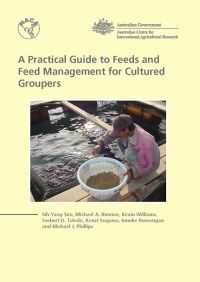
A Practical Guide to Feeds and Feed Management for Cultured Grouper

Most marine fish farms in Asia still rely on what is commonly termed "trash fish". Despite it's apparent abundance and availability, there are some issues and problems related to its use in fish farming. This guide explores new and better farming practices making use of formulated feeds, as well as technical aspects of feed storage and quality control, management of feeding including weaning of groupers onto formulated feeds and economic considerations.

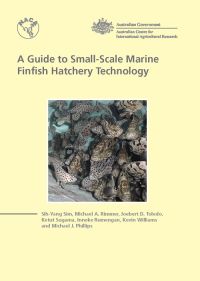
A Guide to Small-scale Marine Finfish Hatchery Technology

Recent improvements in hatchery production technology for high-value marine finfish species such as groupers have led to an increased interest in setting up hatcheries to produce fingerlings for aquaculture. Small-scale hatcheries make this technology available to poor people in developing countries. This guide provides an outline of the requirements to establish a small-scale marine finfish hatchery, particularly the economic aspects.

Livelihoods and fisheries in the lower Mekong basin

People who manage fisheries in the lower Mekong are beginning to think of themselves as a community within a common river basin. This is a different way of thinking; managing fisheries is no longer seen as an isolated activity but as a part of the life of people who live along the river. Previously, fisheries managers might have thought of their job as safeguarding or increasing fish production, but now they must share in the effort to alleviate poverty.

Codes of practice and conduct for marine shrimp aquaculture

The rapid expansion of marine shrimp aquaculture in many tropical developing countries has proceeded without effective environmental regulation. Most countries with shrimp farming do not have an established regulatory apparatus to monitor and enforce environmental and socioeconomic standards. Therefore, voluntary codes of conduct are a possibility for improving overall management and possibly profitability of the marine shrimp aquaculture industry until effective governmental regulation is implemented. This paper reviews the status of existing codes of conduct for shrimp farming.

An improved traditional shrimp culture technique for increasing pond yield

A series of research studies were conducted to refine existing traditional culture practices for the tiger shrimp, Penaeus monodon. Natural food produced in a shrimp pond through fertilisation is not fully consumed in the first two months at a stocking rate of 5,000 postlarvae per hectare. Natural food produced by organic and inorganic fertilisation using the traditional practice can sustain an optimal growth of shrimp at a density of 20,000 postlarvae per hectare for a period of 60 days.

A prototype warm water shrimp hatchery

A successful hatchery usually depends on a number of conditions; among the more important ones are right choice of site, effectiveness and efficiency of operational management. The present technology series attempts to describe the prototype warm water shrimp hatchery established and operated by SEAFDEC Aquaculture Department in collaboration with FAO since 1982. The techniques used in the operation of the hatchery have been refined, repeatedly tested and are now packaged for further testing in different environmental conditions elsewhere in the Philippines and other tropical countries.

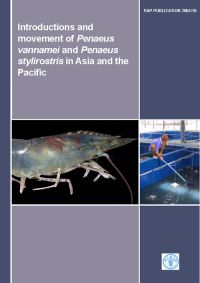
Introductions and movement of Penaeus vannamei and Penaeus stylirostris in Asia and the Pacific

This report has attempted to gather all of the currently available data on the extent of P. vannamei and P. stylirostris importation and culture in Asia, its potential problems and benefits, to provide a source document from which to investigate further the means by which control over this issue might be re-established. Recommendations aimed at controlling the importation, testing and culture of these species have been made for all levels and are included in this report.

eNACA: A digital knowledge-sharing strategy for aquaculture

This paper provides a strategic overview of the development and implementation of a very low cost ICT-based communications network. We address issues relevant to the development of an online community in terms of strategy, services and infrastructure. Our objective is to develop an online community where participants can discuss issues and share information directly. It is based on internet communications and multimedia publishing technologies. At time of writing eNACA is distributing 12,000 free publications per month via download.

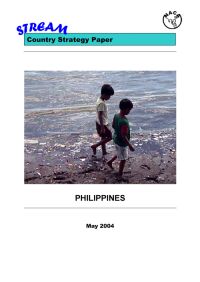
Philippines country strategy paper

In 2002, the Philippines Government signed a Partnership Agreement with the NACA-STREAM Initiative. The initial focal point for STREAM work is Western Visayas, including the Sapian Bay and Banate Bay areas where BFAR Region 6, the STREAM country host, has on-going engagements, and also areas within Regions 6 and 7 where marine ornamentals collection and trading occur. The key disadvantaged groups for whom aquatic resources are a source of livelihood are the primary stakeholders for the initiative.

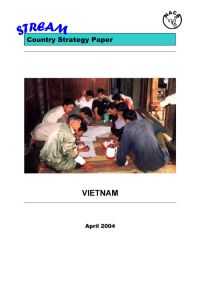
Vietnam country strategy paper

Although Vietnam has long been listed among the poorest countries of the world, it has recently made large strides in reducing poverty and improving food security. However, the dramatic gains in poverty reduction in Vietnam still remain quite fragile. There is growing evidence to indicate that dependence on aquatic resources is correlated to poverty, and that aquatic resources constitute an important component of wider livelihoods strategies (largely from the Mekong Delta, Central Coast and the Northern Mountains).

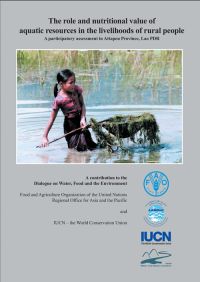
The role and nutritional value of aquatic resources in the livelihoods of rural people: A participatory assessment in Attapeu Province, Lao PDR

This assessment is intended to address the concern that the ecological and livelihood functions and values of rice fields and adjoining wetlands are not fully appreciated in development planning. A participatory assessment was conducted in Attapeu Province, Lao PDR to determine the role of aquatic resources in the nutritional status of people engaged in rural livelihoods and to determine any opportunities, constraints or threats that may exist concerning the management of aquatic resources and future development in the province.

Information access survey, Vietnam

This study aims to provide an overview of media currently used in Vietnam, with particular focus on use of media for extension purposes, to explore access to information, and information exchange between stakeholder groups and institutions within the aquatic resources and fisheries sectors, to investigate the information needs of rural communities involved in fisheries and aquatic resources management and to make recommendations for increasing the efficiency of communication with different stakeholders.

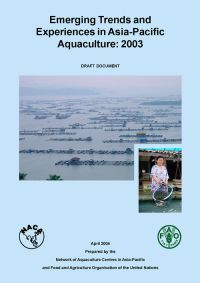
Emerging Trends and Experiences in Asia-Pacific Aquaculture: 2003

This document provides an overview of topical issues in Asian aquaculture for 2003, including a review of its status, progress in research and development, major issues and experiences, together with suggestions on actions for addressing opportunities and constraints. The document was prepared by NACA and FAO to facilitate discussions at the 15th NACA Governing Council meeting, hosted by the Government of Sri Lanka on 21st-25th April 2004.

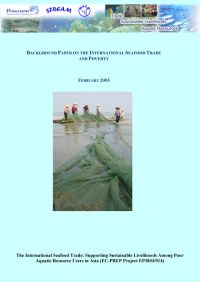
The international seafood trade: Supporting sustainable livelihoods among poor aquatic resource users in Asia

The purpose of this report is to provide an overview of the international seafood trade and poverty, with special reference to the trade in some selected marine products between Asia and the European Union. It represents Output 1 of the project “The International Seafood Trade: supporting sustainable livelihoods among poor aquatic resource users in Asia”, which was funded by the European Community's Poverty Reduction Effectiveness Programme (EC-PREP).