Ornamentals

Farming of ornamental fish, crustaceans and plants for ornamental purposes.

Creative Commons Attribution.

Related

Subject tags

A collection of subject tags relating to technical matters.

In this collection

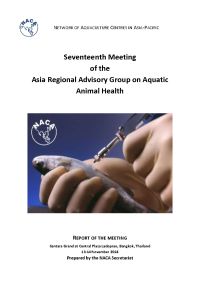
Report of the Seventeenth Meeting of the Asia Regional Advisory Group on Aquatic Animal Health

This report summarises the proceedings of the 17th meeting of the Advisory Group, held 13-14 November 2018 in Bangkok, Thailand. The group's role includes reviewing disease trends and emerging threats in the region, identifying developments in global aquatic disease issues and standards, evaluating the Quarterly Aquatic Animal Disease Reporting Programme and providing guidance on regional strategies to improve aquatic animal health management.

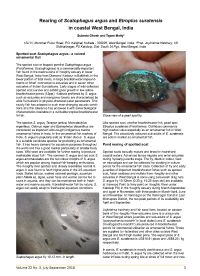
Rearing of Scatophagus argus and Etroplus suratensis in coastal West Bengal, India

In the ornamental fish markets of India, the euryhaline spotted scat Scatophagus argus and pearlspot Etroplus suratensis are popularly sold as ornamental fish. This article describes the nursing of wild-caught spotted scat seed and in-pond breeding of pearlspot to produce marketable sized fish at the Joykrishna hatchery and fish seed farm, located in the Hooghly River estuarine zone in coastal West Bengal, India. The fish are reared in brackishwater ponds for commercial utilisation as ornamental fish, supplying Hyderabad and other cities.

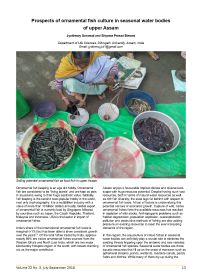
Prospects of ornamental fish culture in seasonal water bodies of upper Assam

India’s share of the international ornamental fish trade is marginal but has been able to show consistent growth over the years. Of the total ornamental fishes traded by India, approximately 85% are native fishes sourced from the Western Ghats and North East India. The aquaculture of native fishes in seasonal water bodies can play a role in both conservation and generation of livelihoods. Imparting knowledge regarding ornamental fish trade and establishing market linkages is required to further develop the industry.

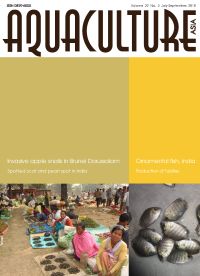
Aquaculture Asia Magazine, July-September 2018

In this issue:

Rearing of spotted scat and pearlspot in coastal West Bengal, India; harvesting Eurayle ferox (makhana) from wetland fisheries of Assam; prospects of ornamental fish culture in seasonal water bodies in Assam; production of tubifex, a new dimention in aquaculture in feeding juvenile fish; invasive apple snails in Brunei Darussalam; aquaculture trends and opportunities in Sindh, Pakistan; NACA Newsletter.

Biology and Management of Invasive Apple Snails

Apple snails have become a major pest of wetland rice in much of Southeast Asia. Two species are involved, Pomacea canaliculata and P. maculata. One or both of these species have become widely established not only in many parts of Southeast Asia but also in other parts of the world. This book provides an update on research into the biology, management and use of apple snails and highlights the need to prevent further spread of these species.

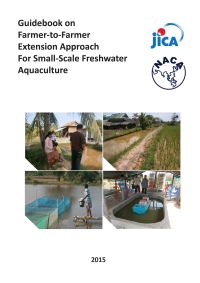
Development of a Guidebook on Farmer-to-Farmer Extension Approaches for Small-scale Aquaculture in the Asia-Pacific Region

The objectives of this project were to i) develop a guidebook in English on "Farmer-to-farmer extension approaches for small-scale aquaculture" and ii) to translate the developed guidebook into selected local dialects in Asia-Pacific and other regions (e.g. Africa). The project made use of the significant results from the JICA projects in Cambodia, Benin and other countries on farmer-to-farmer extension approaches on technology extension for small-scale farmers. The book is available in eleven languages (English, Arabic, Bahasa Indonesia, BurmeseFrenchKhmerLoatian, Malay, NepaliThai and Vietnamese.

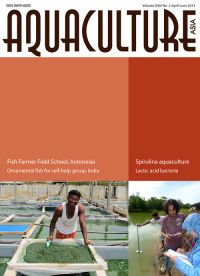
Aquaculture Asia Magazine, April-June 2013

In this issue:

Workshop on mainstreaming gender in NACA. Fish Farmer Field School: Towards healthier milkfish / shrimp polyculture and fish farmer empowerment in South Sulawesi. A success story of Maa Tarini Self Help Group Ornamental Fish Unity, India. Use of lactic acid bacteria in fish farming. AFSPAN field surveys underway. Anti-viral treatment for healthier black tiger prawns. Jungle perch on the comeback trail. Nursery management of grouper manual. Hatchery management of tiger group manual.

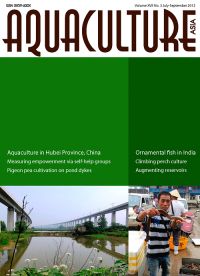
Aquaculture Asia Magazine, July-September 2012

In this issue:

Aquaculture in Hubei Province, central China. Ornamental fish farming - a successful cottage industry in rural and urban India. Measuring empowerment of women through self-help groups in aquaculture. Pigeon pea Cajanus cajan cultivation over fish pond dykes - an economically viable farming approach. Culture of freshwater climbing perch Anabas testudineus. Augmentation of fish production from a small reservoir of Vidarbha: A success story. Emergency consultation on early mortality syndrome of shrimp.

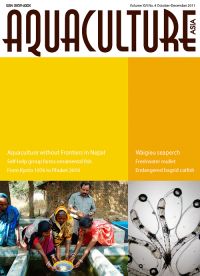
Aquaculture Asia Magazine, October-December 2011

In this issue:

Visit to the AwF funded small-scale aquaculture project in Nepal. Success story of the Barakhandapat Ornamental Fish Breeding Unit, India. From Kyoto 1976 to Bangkok 2000 and Phuket 2010: Aquaculture development and personal transitions. Embryonic and larval development of Waigieu seaperch Psammoperca waigiensis. Culture feasibility of freshwater mullet Rhinomugil corsula in ponds in India. Management in seed production of an endangered catfish Horabagrus brachysoma during its hatchery phase.

Improving biosecurity: a necessity for aquaculture sustainability

Species movement for farming can be one of the many sources of biological threats to the well-being of farmed aquatic animals, humans and ecosystems. Transboundary aquatic animal diseases may occur due to illegal introductions and transfers of live animals. This session will discuss aspects of biosecurity as possible and will identify successes and failures, issues of importance and the role of biosecurity in the sustainable increase in aquaculture production. 

Enhancing the contribution of aquaculture to poverty alleviation, food security and rural development

We are passing through an era of increasing population, food shortages and unsustainable farming practices. We cannot think of food security unless issues connected with poverty and livelihoods are addressed. Since 75 percent of global aquaculture production comes from small-scale farms in developing countries we have to address a number of issues to ensure that the livelihoods and food security of all those involved in the sector are not threatened.

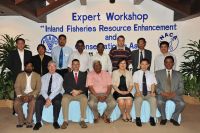
Expert Workshop on Inland Fisheries Resource Enhancement and Conservation in Asia

Over the past few decades inland fisheries resources have come under increasing pressure from water engineering projects, pollution and overfishing. FAO and NACA convened an expert workshop to review inland fisheries resource enhancement and conservation practices in Pattaya, Thailand, 8-11 February. Experts from 10 Asian countries attended the meeting to share experiences and lessons learned. Regional collaborative efforts are required to facilitate assessment of current inland fisheries resource enhancement and conservation practices.

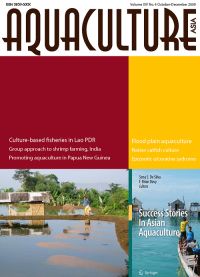
Aquaculture Asia Magazine, October-December 2009

In this issue:

Mussel farming initiatives in North Kerala, India. Selective study on availability of indigenous fish with ornamental value in West Bengal. Aquaculture livelihoods centre in Aceh, Indonesia. e-Sagu Aqua - an innovative information and communication technology model for transfer of technology for aquaculture. Freshwater pearl crop: An emerging enterprise in the Indian subcontinent. Preliminary risk assessment of Pacific white shrimp (P. vannamei) introduced to Thailand for aquaculture. Black gill disease of lobster and more.

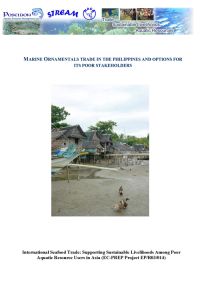
The international seafood trade: Marine ornamentals trade in the Philippines and options for its poor stakeholders

This report provides insight into the status of the marine ornamental fish trade in the Philippines, including policy environment, collection, distribution channels, markets and constraints. The report also reviews the livelihoods of poor stakeholders in market chains including economic and financial aspects, natural and physical resources, livelihood patterns, social structures. The report provides recommendations for policy makers and stakeholders in improving the livelihoods of poor stakeholders in marine ornamental fish collection and market chains and resource management.

Building capacity to combat impacts of aquatic invasive alien species and associated trans-boundary pathogens in ASEAN countries

This is the proceedings of the workshop on Building capacity to combat impacts of aquatic invasive alien species and associated trans-boundary pathogens in ASEAN countries, held in Penang, Malaysia, on the 12th-16th July 2004. The workshop built on the recommendations from a 2002 workshop organised by the Global Invasive Species Program and a 2003 workshop of countries sharing the Mekong watershed, in promoting awareness, coordination mechanisms and information exchange systems and identifying management and risk mitigation measures.


STREAM Journal Volume 5, No. 1, January-March 2006

In this issue: Policy development as a theme and policy briefs as a genre. Decriminalising Cambodian family-scale fishers through a livelihoods approach to law reform. Longer pond leases in Orissa. One-stop Aqua Shop - a "one-window delivery" service center for aqua-farmers and fishers. Fisheries and aquaculture policy formulation process in Pakistan. Improving the international marine ornamental fish trade to sustain and improve the livelihoods of poor people involved in the trade. About the STREAM Journal. About STREAM.

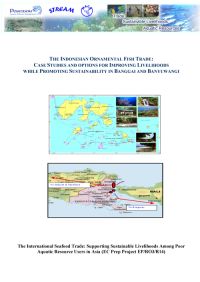
The Indonesian ornamental fish trade: Case studies and options for improving livelihoods while promoting sustainability in Banggai and Banyuwangi

This report provides insight into the status of the marine ornamental fish trade in Indonesia, including policy environment, collection, chain of custody, distribution channels, markets and constraints. The report also reviews the livelihoods of poor stakeholders in market chains including economic and financial aspects, natural and physical resources, livelihood patterns, social structures. The report provides recommendations for policy makers and stakeholders in improving the livelihoods of poor stakeholders in marine ornamental fish collection and market chains.
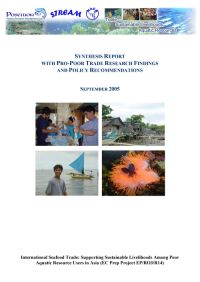
International seafood trade: Supporting sustainable livelihoods among poor aquatic resource users in Asia. Synthesis report with pro-poor trade research findings and policy recommendations

The purpose of the project was to investigate international trade in fisheries products and its relationship to poverty alleviation and livelihoods of poor aquatic resource users in developing countries in Asia, and to identify options to improve the effectiveness of poverty reduction through international seafood trade. The project directly addressed the EC-PREP priority area of trade and development, and indirectly provided valuable insight to two other priority areas: food security and sustainable rural development; and institutional capacity building.

STREAM Journal Volume 4, No. 1, January-March 2005

In this issue: Young people taking bolder steps. Providing a venue for voices to be heard. Rehabilitation of a bundu pond - STREAM's initiative and DOF's action. Coastal resources utilisation and conservation issues in Cox's Bazar, Bangladesh. People, fish and reefs - a livelihoods learning curve. Understanding the marine ornamental trade and its impact on the livelihoods of poor stakeholders in the Philippines. About the STREAM Journal. About STREAM. This edition is also available in Ilonggo and Vietnamese.

Infection with koi herpes virus: Disease card

Koi herpes virus (KHV) outbreaks in the region have significant trade implications for the high value ornamental koi carp industry, and the important food fish common carp. Active trade in ornamental fish poses a potential risk for spread of KHV. Recognising the significance, "infection with koi herpesvirus" has been listed under "diseases prevalent in the region" in the NACA/FAO/OIE regional quarterly aquatic animal disease (QAAD) list, effective for reporting from first quarter of 2004.