25 September 2009Jianshou Liu, Zhongjie Li, Songguang Xie, Weimin Miao, Wangbao Gong and Lang Wu | 1560 Downloads | .pdf | 299.39 KB
Fish species introduction has been a very important method of increasing fisheries production and economic output in China. A good example is the introduction of the icefish Neosalanx taihuensis into reservoirs and lakes in most areas of China. The present study aims to provide basic information on production, management strategies and biological characteristics in target reservoirs and lakes in China and guide introduction and management practices of the fish.
This brief reports on a catfish farming stakeholder workshop and focus group meeting on vulnerability and adaption to climate change held in Can Tho, Vietnam. Stakeholders including catfish farmers in general expressed that climate change is a serious threat, having observed shifts in climatic patterns, saline water intrusion and frequent typhoons. Suggestions to reduce on-farm risks included producing quality fry, developing new culture systems, elevating dykes, livelihood diversification, awareness workshops and financial support to farmers.
The vegetation in Mahakam Delta is predominantly mangrove forest that consists of a pedada zone, Rizophora zone, transition zone, Nipa zone and nibung zone. Prior to 1980, mangrove vegetation in Mahakam Delta was pristine. Considerable changes in the extent of mangrove ecosystem occurred between 1990-2002 until 2001 when about 63% mangrove areas was deforested mainly due to conversion for shrimp ponds. Since 2002, partial efforts for restoration had been taken in mangrove replanting at some sites.
This report, the 45th in the series, contains information about the aquatic animal health status of sixteen states in the Asia-Pacific region. The foreword discusses the Sanitary and Phytosanitary (SPS) Agreement and its relationship to the OIE Aquatic Animal Health Standards.
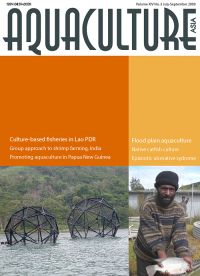
Community management and revenue sharing practices of culture-based fisheries in Lao PDR. Floodplain aquaculture in Bangladesh. Promoting small-scale inland aquaculture in Papua New Guinea. Group approaches to shrimp farming: The key to sustainability. Native catfish culture - a technology package for farmers. Influence of salinity in the growth of the black clam Villorita cyprinoides. EUS in Asia and Africa. Offshore opportunities for artisinal aquaculture. Grouper aquaculture in Brazil. NACA Newsletter.