NORAD funded project on climate change initiated. Sign up for our free email newsletter service! Market chains and biosecurity of 'low value' aquaculture commodities. Global conference on aquaculture 2010. Extending information and technical services to aquaculture farmer groups in Aceh. Giant Prawn 2011, Quindao, China. Alien species in aquaculture and biodiversity: A paradox in food production. Aquatic ecosystems and development: Comparative Asian perspectives. Macrobrachium: The culture of freshwater prawns.
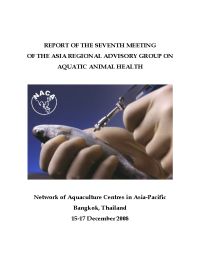
The Asia Regional Advisory Group on Aquatic Animal Health meets annually to discuss regional health issues including emerging disease threats. This report includes a review of regional disease status circa 2008, global and regional disease reporting arrangements, global issues and standards, progress in implementation of the the Regional Technical Guidelines on Health management for the Responsible Movement of Live Aquatic Animals, identification and designation of regional aquatic animal health resources and regional and international cooperation.
This report, the 43rd in the series, contains information about the aquatic animal health status of fifteen states in the Asia-Pacific region. The foreword discusses emerging amphibian diseases in the region.
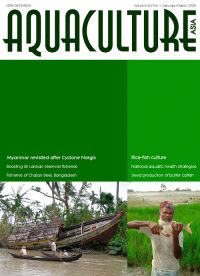
Myanmar revisited. Harvesting, traditional preservation and marketing of fishes of Chalan Beel, Bangladesh. Role of community in production and supply of larger, quality fingerlings. Can rice-fish farming provide food security in Bangladesh? Nutritional and food security for rural poor through multi-commodity production from a lake of eastern Uttar Pradesh. Emerging boost in Sri Lankan reservoir fish production. Farming the freshwater prawn Macrobrachium malcolmnsonii. Breeding and seed production of catfish Ompok pabda.
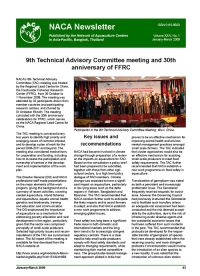
9th Technical Advisory Committee meeting and 30th anniversary of FFRC. Training Workshop on the Use of Molecular Genetics in Conservation held at USM, Malaysia. Japan International Award for NACA Staff. Consortium on freshwater finfish genetics and breeding. Shrimp Farming eNews. Seventh Meeting of the Asia Regional Advisory Group on Aquatic Animal Health. Sri Lankans learn pisciculture at CIFA. India's Central Institute for Freshwater Aquaculture observes 33rd Foundation day.