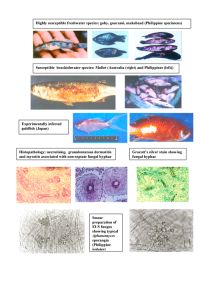
Epizootic ulcerative syndrome (EUS) is a seasonal epizootic condition of wild and farmed, fresh and brackishwater fish. Of complex infectious aetiology, it is characterised by the presence of invasive Aphanomyces infection and necrotising ulcerative lesions typically producing a granulomatous response. The disease is now endemic in South-east and south Asia, and has recently extended to West Asia. EUS is indistinguishable from red spot disease of eastern Australia and mycotic granulomatosis of Japan.
24 August 2004Mark Crane, Motohiko Sano and Cedric Komar | 1793 Downloads | .pdf | 393.23 KB
Koi herpes virus (KHV) outbreaks in the region have significant trade implications for the high value ornamental koi carp industry, and the important food fish common carp. Active trade in ornamental fish poses a potential risk for spread of KHV. Recognising the significance, "infection with koi herpesvirus" has been listed under "diseases prevalent in the region" in the NACA/FAO/OIE regional quarterly aquatic animal disease (QAAD) list, effective for reporting from first quarter of 2004.
This information sheet on slow growth syndrome in Penaeus monodon provides some background information on the possible aetiology and a working case definition. This will be useful for surveillance and epidemiological purposes to collate more information about this syndrome in the region.
9 August 2004Simon Wilkinson, Sih Yang Sim and Yioothana Suansook | 1454 Downloads | .pdf | 114.32 KB
This paper provides a strategic overview of the development and implementation of a very low cost ICT-based communications network. We address issues relevant to the development of an online community in terms of strategy, services and infrastructure. Our objective is to develop an online community where participants can discuss issues and share information directly. It is based on internet communications and multimedia publishing technologies. At time of writing eNACA is distributing 12,000 free publications per month via download.
26 July 2004M.A. Rimmer, K.C. Williams, J.D. Toledo, K. Sugama, T. Ahmad, I. Rumengan and M.J. Phillips | 1508 Downloads | .pdf | 396.92 KB
This is the annual report 2000-2001 of the ACIAR Project FIS/97/73 Improved hatchery and grow-out technolgy for grouper aquaculture in the Asia-Pacific region. The report describes progress by research partners in development of larval rearing, grow-out diet development, and collaboration via the Asia-Pacific Marine Finfish Aquaculture Network. It also provides an indicative research workplan for the year ahead and future plans for the network.