To provide food to the world’s population in 2050, it has been estimated that agricultural output, primarily from crops, livestock and fisheries, including aquaculture, must increase by 60 percent. Intensification of aquaculture is inevitable in the face of increasing demand, limited land areas, and improved technology. Whether we are able to accomplish this in a sustainable manner will depend on global governance and stewardship as much as on technological progress.
In this issue:
Outcomes of emergency consultation on shrimp early mortality syndrome / AHPNS. Workshop on Aquaculture Planning and Management Tools. Workshop on Proficiency Testing Programme for Aquatic Animal Disease Diagnostic Laboratories in Asia-Pacific. AFSPAN Project gets underway.
The Global Conference on Aquaculture 2010 reviewed the present status and trends in aquaculture development, addressed emerging issues relevant to aquaculture development, assessed opportunities and challenges for future aquaculture development and built consensus on advancing aquaculture as a global, sustainable and competitive food production sector. This volume provides information on how aquaculture could be mobilized to alleviate global poverty and improve food and nutrition security in the coming decades.
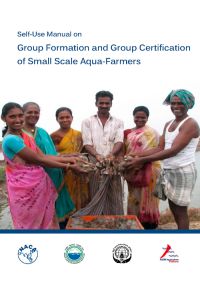
This manual is intended for the use by the current and prospective small-scale farmer groups who are interested in obtaining accreditation for their production process. The objective is to provide them an easy-to-follow, stepwise guide that can be used as a practical tool in their venture of attaining group certification. However, this can be used by the field extension officers and certifiers who are directly involved in the process or other interested parties.
In this issue:
Visit to the AwF funded small-scale aquaculture project in Nepal. Success story of the Barakhandapat Ornamental Fish Breeding Unit, India. From Kyoto 1976 to Bangkok 2000 and Phuket 2010: Aquaculture development and personal transitions. Embryonic and larval development of Waigieu seaperch Psammoperca waigiensis. Culture feasibility of freshwater mullet Rhinomugil corsula in ponds in India. Management in seed production of an endangered catfish Horabagrus brachysoma during its hatchery phase.