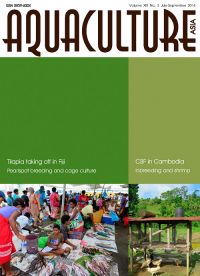
Labour issues in the fishing and aquaculture industries. Commercial tilapia farming at take-off point in Fiji. Tank based captive breeding and seed production of the pearlspot (Etroplus suratensis). Cage culture of pearlspot in Kerala, India. Culture-based fisheries exchange visit from Lao PDR to Cambodia. National Fish Day, Cambodia. WAS Adelaide: Special Session on Regional Cooperation for Improved Biosecurity. Inbreeding and disease in tropical shrimp aquaculture: A reappraisal and caution.
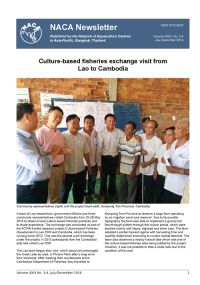
Culture-based fisheries exchange visit from Lao to Cambodia. National Fish Day, Cambodia. WAS Adelaide: Special Session on Regional Cooperation for Improved Biosecurity. Inbreeding and disease in tropical shrimp aquaculture: a reappraisal and caution. Shrimp EMS/AHPND Special Session at DAA9. 2nd International Symposium on Aquaculture and Fisheries Education. Report on Sustainable Fisheries and Aquaculture for Food Security and Nutrition.
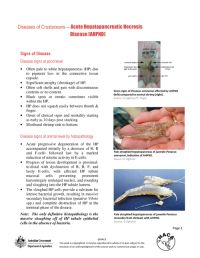
Acute hepatopancreatic necrosis disease (AHPND) has recently been found to be caused by a pathogenic strain of Vibrio parahaemolyticus. This updated disease card provides a summary and guidance on disease signs at the pond level, at the animal level by histopathology, molecular diagnostic tools, host range, presence in Asia-Pacific, prevention and control and links to further information.
We describe a new method for detecting isolates of Vibrio parahaemolyticus that cause acute hepatopancreatic necrosis disease (AHPND). This method is based on the gene sequence of a protein discovered in a sub-fraction of cell-free culture broth from isolates of V. parhaemolyticus that cause AHPND, but not from V. parahaemolyticus or other bacteria that do not cause AHPND. This cell-free preparation caused the typical signs of acute AHPND when administered to shrimp by reverse gavage.
The disease crisis facing shrimp aquaculture may be propelled, in part, by an interaction between management practices that cause inbreeding, and the amplification by inbreeding of susceptibility to disease and environmental stresses. The study describes and numerically simulates gene flow from Penaeus (Litopenaeus) vannamei hatcheries that employ a ‘Breeder Lock’ to discourage use of their PL as breeders, through ‘copy hatcheries’ that breed the locked PL, to inbred shrimp in farm ponds.