This report, the 5rnd in the series, contains information about the aquatic animal health status of thirteen states in the Asia-Pacific region. The foreword discusses the 8th Symposium on Diseases in Asian Aquaculture.
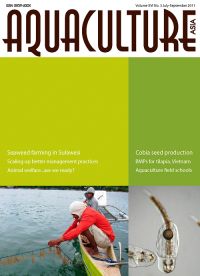
Seaweed farming in Sulawesi, Indonesia. Scaling up better management practices: Empowering small scale farmers. Animal welfare for farmed fish...is Asia-Pacific ready? Aquaculture field schools as an extension methodology. Successful seed production of cobia, Rachycentron canadum in India. 22nd Governing Council Meeting and a new Director General. NACA receives the Magarita Lizárraga Medal. NACA receives Gold Medal Award from the Asian Fisheries Society. Striped catfish farming in the Mekong Delta and more.
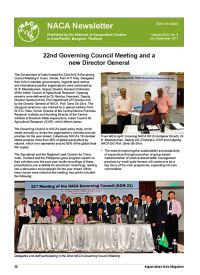
22nd Governing Council Meeting and a new Director General. NACA receives the Margarita Lizárraga Medal. NACA receives Gold Medal Award from the Asian Fisheries Society. Special address by Dr E.G. Silas at the inaugural session of the 22nd Governing Council Meeting 9-12 May, Kochi, India. Striped catfish farming in the Mekong Delta: A tumultuous path to a global success. Sign up for the NACA Email Newsletter. Diseases in Asian Aquaculture VIII: Registration and abstract submission open. Food safety and biosecurity. Ramping up adoption of catfish BMPs. Scaling up BMPs: A national workshop. 2nd Aquaclimate project meeting.
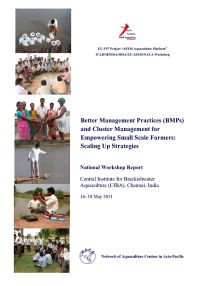
The workshop was held in Chennai, India from 16-18 May 2011, at the Central Institute for Brackishwater Aquaculture. It was convened as an activity of the ASEM Aquaculture Platform, funded by the European Commission’s 7th Framework Programme. The main purpose of the national workshop was to develop practical scaling up strategies at the national level and build consensus for an implementation plan for wider adoption of shrimp BMPs through a cluster management approach.
This project was conducted to demonstrate small scale shrimp farmer group access to international markets through certification schemes. This project proved that small-scale farmers organised into groups, can improve their technical capacities, and achieve access to markets. This achievement was the result of strong partnerships with producers, private sector and government agencies assisting to develop a sustainable business model for small scale aquaculture. Cost of compliance was found to be a significant barrier to entry.