International requirements on food safety, traceability, animal health and welfare and social responsibility are increasingly stringent. The burden of compliance and the cost of certification are particularly heavy for small scale farmers who are often excluded by the limited resources at their disposal. Working in groups can help small scale farmers attain economies of scale necessary to address compliance issues and participate in certification schemes, improving their competitive position.
This report, the 52nd in the series, contains information about the aquatic animal health status of thirteen states in the Asia-Pacific region. The foreword discusses transboundary disease issues and contingency planning.
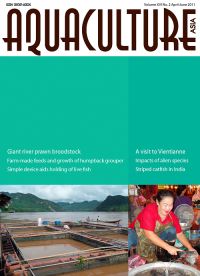
A visit to Vientianne, Lao PDR. Development of captive broodstock of giant river prawn Macrobrachium rosenbergii. Alien introduction and its impact on native fisheries and aquatic bioiversity of West Bengal, India. Ecological impacts of exotic fish species in India. Farm-made feeds support good growth and survivial of the humpback grouper. An easy way to hold live fish. Litopenaeus vannamei introduction: Sound management or expediency? Newsletter and more.
Collaborative project "Grouper/cluster certification of aqua societies" completed. Report of the Advisory Group on Aquatic Animal Health available. Guidelines on Aquaculture Society Certification released. Listen to us online. Workshop on ecosystem approach to inland fisheries: Data needs and implementation strategies. Disease advisory: Infectious myonecrosis (IMN) status and threat. 7th Regional Grouper Hatchery Production Training Course, 25 September - 15 October, Situbondo, Indonesia.
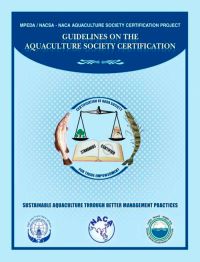
These guidelines prepare and enable aquaculture societies to seek group certification from independent third party certification programmes. The guidelines are independent of commodity and certification standards. They were developed as part of a collaborative MPEDA/NaCSA/NACA project on the certification of aquaculture societies. Draft guidelines developed by the project partners were discussed at the inception meeting on aquacutlure society certifiction held at Kakinada during 1-2 September 2009.