NACA member governments are: Australia, Bangladesh, Cambodia, China, Hong Kong SAR, India, Indonesia, I.R. Iran, Kingdom of Saudi Arabia, Korea (DPR), Lao PDR, Malaysia, Maldives, Myanmar, Nepal, Pakistan, Philippines, Sri Lanka, Thailand and Vietnam.
The EURASTiP Exchange Programme provides opportunities for industry, researchers and educators from Europe and south-east Asia to connect and gain new perspectives while sharing innvovative ideas to help develop long term partnerships. Bursaries of up to €3,000 per exchange are available (subject to eligibility criteria) to support international innovation and collaboration. The deadline for applications is 20 September 2018. For more information on how to apply please see the EURASTiP website.
The 76th edition of the Quarterly Aquatic Animal Disease Report contains information from 14 governments. The foreword discusses the outcomes of a Stakeholder Consultation on Progressive Management Pathway to Improve Aquaculture Biosecurity, organised by the Food and Agriculture Organization of the United Nations, Mississippi State University and the World Bank.
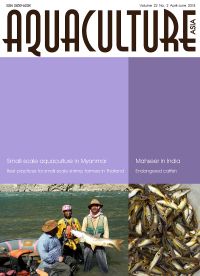
Mahseer in recreational fisheries and ecotourism in India; Small-scale aquaculture of wild fish in Myanmar: A preliminary report from the Bago Region; Current know how and possibility for growout culture of an endangered catfish, Horabagrus brachysoma; Accelerated poverty alleviation of tribal households - cage fish farming by displaced fishers in reservoirs of Jharkhand; Adaptive learning in sustainable aquaculture: Best practices for small-scale shrimp farmers in Thailand; NACA Newsletter.
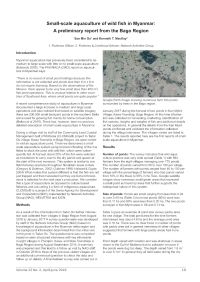
Myanmar aquaculture has previously been considered to be medium to large scale with little to no small-scale aquaculture. Here we report on an indigenous small-scale aquaculture system in Myanmar based on natural monsoon stocking of rice fields with wild fish, which are subsequently trapped, fed and grown out, with a portion used as broodstock to supplement the next years production. The practice is widespread and interviews with farmers suggest that it has been in place for at least 40 years.
This report summarises the proceedings of the 16th meeting of the Advisory Group, held 26-27 August 2017 in Bali, Indonesia. The group's role includes reviewing disease trends and emerging threats in the region, identifying developments in global aquatic disease issues and standards, evaluating the Quarterly Aquatic Animal Disease Reporting Programme and providing guidance on regional strategies to improve aquatic animal health management. The meeting included discussion on Tilapia Lake Virus (TiLV) and developments in antimicrobial resistance.
This collection contains video recordings of the lectures from the Regional Training Course on Culture-based Fisheries in Inland Waters, held at Nha Trang University, Vietnam. The objective of the course was to provide participants with the skills to assist local communities to plan and manage culture-based fisheries; a relatively simple and low cost technology that can deliver nutritional and economic benefits to rural communities with few livelihood options. The course was sponsored by the United Nations University Fisheries Training Programme.
The 75th edition of the Quarterly Aquatic Animal Disease Report contains information from 14 governments. The foreword discusses the 10th Symposium on Disease in Asian Aquaculture, and the 11th Technical Group Meeting and election of a new Executive Committee for the Fish Health Society (2018-2020).
The first ever Regional Training Course on Culture-based Fisheries in Inland Waters was held at Nha Trang University from 30 October to 8 November. The objective of the course was to provide participants with the skills to assist local communities to plan and manage culture-based fisheries. These practices are an example of a relatively simple and low cost technology that can deliver nutritional and economic benefits to rural communities, which often have few livelihood options.
The 74th edition of the Quarterly Aquatic Animal Disease Report contains information from 15 governments. The foreword describes an Emergency Regional Consultation for Prevention and Management of Tilapia Lake Virus (TiLV) in the Asia-Pacific region.
Since 2009, tilapia aquaculture has been threatened by mass die-offs in Israel and Ecuador, which have been caused by a novel Orthomyxo-like (RNA) virus named Tilapia lake virus. This has been reported as a newly emerging virus that causes syncytial hepatitis of tilapia. An emergency regional consultation was held in Guangzhou, China from 27-28 September 2017 to discuss and plan actions on the overall prevention and management of this disease.
IDRC and the National University of Singapore (NUS) are offering fellowships for Southeast Asian entrepreneurs, leaders in business, government, and civil society who want to better understand Southeast Asian value chains. The four-day program from 19-22 March 2018 will give participants a useful toolkit of ideas to take full advantage of a connected ASEAN Economic Community. Women leaders and participants from Cambodia, Indonesia, Laos, Malaysia, Myanmar, the Philippines, Thailand, Timor-Leste, and Vietnam are especially encouraged to apply.
The 73rd edition of the Quarterly Aquatic Animal Disease Report contains information from 14 governments. The foreword provides a disease advisory on tilapia lake virus (TiLV), an emerging threat to farmed tilapia in the Asia-Pacific region.
A regional consultation on aquaculture feed production and use in Asia-Pacific was held from 7-9 March 2017. The consultation reviewed the current situation of aquaculture feed production and use, sourcing of ingredients, policy and research needs. This collection contains audio recordings of the technical presentations made by experts, international organisations, the private sector and governments in the region. The report of the consultation is in press and will be made available for download in due course.
Recently, we released a warning of TiLV in Thailand and an improved RT-PCR detection methodology. The Fish Health Platform in Centex, BIOTEC/Mahidol University has also obtained positive test results for TiLV in other Asian countries where it has not yet been reported. Many countries have been translocating tilapia fry/fingerlings prior to and even after the description of TiLV. We have prepared a map listing countries with confirmed reports of TiLV infections and 43 other countries that we believe have imported infected fish.
The 73rd edition of the Quarterly Aquatic Animal Disease Report contains information from 14 governments. The foreword provides information about the implementation of a National Surveillance Programme for Aquatic Animal Diseases (NSPAAD) in India.
Freshwater aquaculture in Myanmar is dominated by rohu, but other carps, tilapia and giant freshwater prawn are also cultured. At present around 25% of freshwater finish farmers in Myanmar are using commercial feeds from factory mills while the remaining 75% still use locally available rice bran only or rice bran and oil cakes. Soft shell mud crab and marine fish farming are thoroughly dependent on trash fish. A significant local feedmill industry exists, but many ingredients need to be imported.
The 72nd edition of the Quarterly Aquatic Animal Disease Report contains information from 12 governments. The foreword provides information about the 15th Meeting of the Asia Regional Advisory Group on Aquatic Animal Health.
This report, the 71st in the series, contains information about the aquatic animal health status of sixteen states in the Asia-Pacific region. The foreword discusses changes to the Quarterly Aquatic Animal Disease Report, including a move to electronic-only distribution.
This report, the 70th in the series, contains information about the aquatic animal health status of nine states in the Asia-Pacific region. The foreword discusses tilapia lake virus, a new viral disease of farmed tilapia.