Improved larval rearing of Heteropneustes fossilis with live fish food organism - a method practised in the farmer’s field
21 January 2026 | R.N. Mandal, Kabyashree Bala, B.N. Paul, A Das, S. Adhikari, H. Houque, A. Hussan, S. Sarkar, and P.K. Sahoo | 647 Downloads | .pdf | 8.54 MB
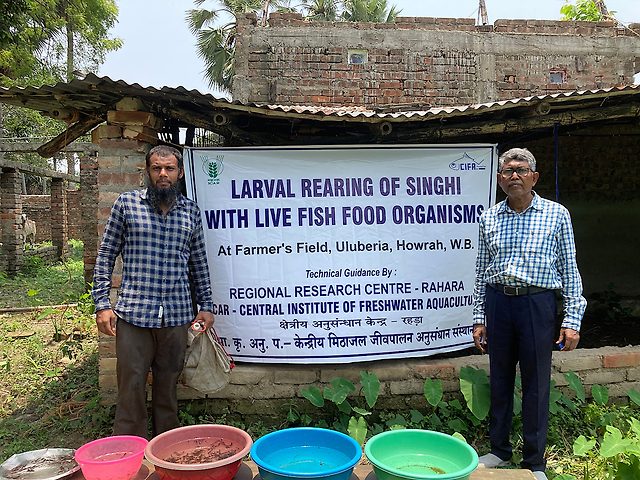
Heteropneustes fossilis (stinging catfish or singhi) is a nutritionally valuable freshwater catfish widely distributed across Asia. The species has high protein content, beneficial fatty acids, and essential minerals, making it valuable for treating anaemia and supporting maternal health. However, larval rearing remains a critical challenge for farmers, as larvae naturally prefer live foods over manufactured feeds.
This article documents a successful farmer-level innovation in singhi larval rearing using Moina sp., a cladoceran zooplankton, as the primary live food. Mr Imran Molla, a fish farmer from Howrah district, West Bengal, India, received training from the Regional Research Centre, ICAR-CIFA, Rahara, on Moina culture techniques. He established 25 circular polyethylene tanks (12,000 L capacity each) for mass production of Moina using locally available resources including waste bread, mustard oil cake, and meat residue.
The method involves segregating singhi larvae into five age groups (4-6 days, 7-10 days, 11-18 days, 19-25 days, and 26-35 days) in separate cemented tank compartments to reduce cannibalism. Different sizes of Moina are fed to match the mouth aperture of each age group. Larvae begin feeding on Moina four days post-hatching when the yolk sac disappears and the mouth aperture reaches approximately 650 μm.
Mr Molla produces an average of 42,000 fry per tank over 30 days, yielding approximately one million fry monthly across all tanks. This generates earnings of Rs 2,500,000 (US$33,245) per breeding season. The method offers several advantages over manufactured feed: minimal water exchange requirements, higher larval survival rates, lower management inputs, and reduced risk of water quality deterioration. The approach is cost-effective, environmentally sustainable, and replicable by other farmers facing similar challenges in catfish larval rearing.
1769043669_improved-larval-rearing-heteropneustes-fossilis.pdf
Creative Commons Attribution.
Related
Aquaculture Asia Magazine, January-March 2026
24 January 2026 | 11508 views | .pdf | 21.85 MB