From scarcity to supply: The Nalbari magur (Clarias batrachus) seed hub in north-eastern India
21 January 2026 | S.K. Sahoo, A.K. Sahu, A. Das, B.C. Mohapatra, P.P. Chakraborty, N.K. Barik, A.K. Chaudhari, S.N. Sahoo, S.S. Giri, and P.K. Sahoo | 755 Downloads | .pdf | 1.67 MB
Magur (Clarias batrachus) is a high-value indigenous catfish highly preferred by consumers in eastern and north-eastern India for its taste, nutritional value, and low intramuscular spines. Despite strong market demand, expansion of magur aquaculture has been severely constrained by the unavailability of quality seed. Wild stocks have declined due to overexploitation, habitat degradation, and pollution, while farmers have been reluctant to adopt the species due to breeding difficulties, high seed mortality, and lack of local
seed supply.
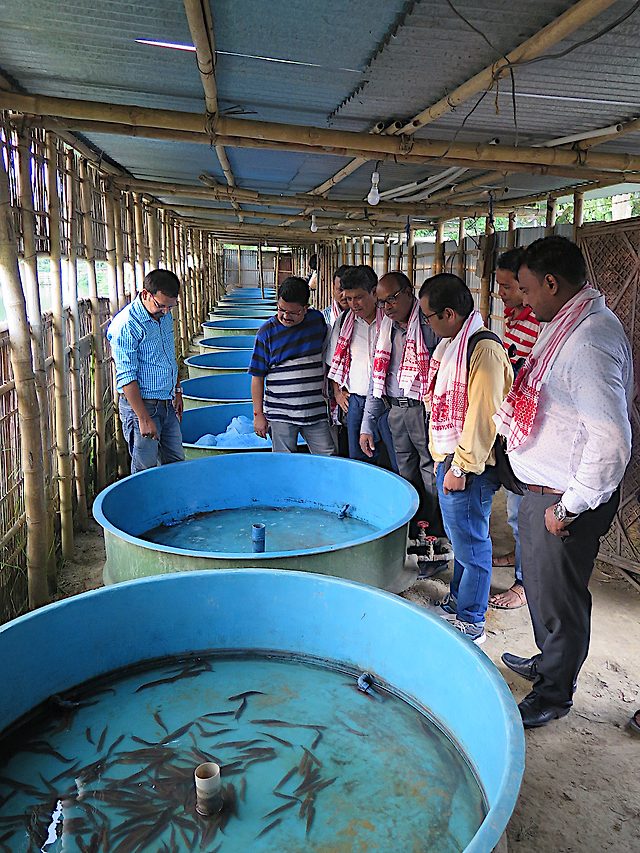
This article documents how targeted institutional intervention transformed Nalbari district in Assam into a major magur seed production hub for north-eastern India. ICAR-Central Institute of Freshwater Aquaculture (ICAR-CIFA), in partnership with Krishi Vigyan Kendra (KVK) Nalbari and the Department of Fisheries, Assam, conducted baseline surveys and selected 30–40 motivated farmers for capacity building over a two-year period. Scientists provided hands-on training in captive breeding techniques, larval rearing protocols, and
hatchery management.
A critical technological breakthrough was the development of a fibreglass-reinforced plastic (FRP) magur hatchery that offered lightweight, durable, and modular design particularly suitable for flood-prone conditions in the Brahmaputra valley. The article details the standardised breeding protocol: hormone-induced spawning of female brooders, artificial fertilisation, incubation in flow-through systems, and larval rearing using ICAR-CIFA-developed 'Starter-M' feed achieving survival rates of 80% or higher.
Farmers now produce 300,000-500,000 fry per season, selling at Rs 2-5 per fry and Rs 5-10 per fingerling. More than 25 functional hatcheries now operate in Nalbari and neighbouring districts, with approximately 70 farmers actively engaged in magur seed production. The model demonstrates how combining farmer capacity with context-appropriate technology and species-specific feeds can convert seed scarcity into a scalable enterprise. Challenges remain, including seasonal flooding and timely availability of quality inputs, but peer learning and horizontal technology transfer have strengthened adoption across similar agro-climatic regions.
1768998878_nalbari-magur-seed-hub.pdf
Creative Commons Attribution.
Related
Aquaculture Asia Magazine, January-March 2026
24 January 2026 | 11511 views | .pdf | 21.85 MB