Food Security, Safety and Certification

Food safety is a key concern for international trade in fish products. The constantly changing regulatory environment and safety requirements of importing countries pose a special challenge to small-scale aquaculture producers.

The programme assists members to assure the safety and quality of aquaculture products through the adoption of science-based better management practices. Policy issues concerning aquaculture certification and activities in market access are also addressed.

The programme focuses on assisting small-scale farmers to adapt to the changing trade and safety environment. Cluster-based management approaches and formation of farmer societies are promoted as practical mechanisms for implementation of better management practices.

Key activities

  • Evaluation of commodity-specific better management practices for meeting domestic and international food safety standards.
  • Facilitating establishment of national residue testing and monitoring programmes and sharing of information amongst member countries.
  • Improving access to markets by small-scale farmers.
  • Improving market development for low-cost aquaculture commodities.
  • Address biosecurity and associated human health issues regarding the consumption of fish and processed products.
  • Development of farmer groups and cluster-based certification concepts and methodologies.

Creative Commons Attribution.

Related

Subject tags

A collection of subject tags relating to technical matters.

In this collection

WAS Journal Special Issue: Global Conference on Aquaculture Millennium +20 Thematic Reviews

Eight thematic reviews prepared as preparation for the Global Conference on Aquaculture Millennium +20 (GCA +20) have been published in a Special Issue of the Journal of the World Aquaculture Society "Aquaculture for Food and Sustainable Development". A group of experts prepared advanced working drafts of each thematic review and the key findings from each theme were presented and discussed by expert panels during the GCA +20. Participants were then invited to provide their feedback and perspectives on the reviews and their key messages for consideration in finalisation of the papers. The reviews are available for free download.

Aquaculture transformation: Innovation and investment for sustainable intensification and expansion of aquaculture in Asia and the Pacific region

The document provides an overall vision and framework intended to accelerate aquaculture transformation in Asia and the Pacific region through innovations and investment, and to provide guidance to partners from the public, private and development communities to actively engage with the region in transforming aquaculture to more efficient, inclusive, resilient and sustainable food systems. The document served as background information for discussion in the High-Level Meeting on Aquaculture Transformation in Asia and the Pacific Region, 22–23 November 2022, organised by the FAO Regional Office for Asia and the Pacific and the Network of Aquaculture Centres in Asia-Pacific. The document is broadly aligned with FAO’s Blue Transformation Roadmap, paying specific attention to the context and needs of aquaculture within Asia and the Pacific region. The Paper translates the Roadmap into a vision and priority actions for aquaculture transformation in the region by 2030.

High-level meeting on aquaculture transformation in Asia and the Pacific region

As a follow on from the September FAO/NACA workshop on aquaculture transformation, FAO and NACA convened a high-level meeting to discuss the issue and the outcome of the previous consultation with policy makers. The meeting was held virtually from 22-23 November and was attended by 79 senior officials from 25 countries and international organisations, with observers from industry and international NGOs. Specific objectives of the high-level meeting were to: Engage senior policy makers and business leaders in the process of defining regional targets, action areas and initiatives for aquaculture transformation in the region by 2030, identify strategies and mechanisms to stimulate innovation and investment, and to recommend follow up actions and commitments.

NACA Newsletter, Vol. XXXVII, October-December 2022

In this issue:

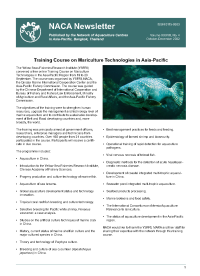
Training Course on Mariculture Technologies in Asia-Pacific; FAO/NACA Virtual Workshop on Aquaculture Transformation in Asia and the Pacific Region; Belt & Road Forum for International Freshwater Fishery Industry Innovation; 8th Global Conference on Gender in Aquaculture and Fisheries, 21-23 November; Reported Aquatic Animal Diseases in the Asia-Pacific Region during the First Quarter of 2022; International Training Course on Biology and Pathology of the Penaeid Shrimp 2022; Angkasa Putra inaugurated as first President of the South-East Asian Fisheries and Aquaculture Student Association; Artemia webinars: Video recordings of technical presentations available.

Post-doctoral Scholarships for women in STEM at the University of Stirling

The University of Stirling has been awarded funds by the British Council to provide funding for four Early Academic Fellowships for Women in STEM. These fellowships will be 6-12 months in duration. The scholarships are available to women who are passport holders and permanent residents of India, Pakistan, Bangladesh, Nepal and Sri Lanka. For further information please visit the University of Stirling website. The deadline for submissions is 31 March 2022.

FAO Reviews of Aquaculture now available online

We are pleased to announce that the FAO Reviews of Aquaculture have been published online at the FAO website, including the six Regional Reviews and a Global Synthesis, which were developed and published in conjunction with the Global Conference on Aquaculture Millennium +20 (GCA+20). The publications are linked below. Video presentations of the reviews, including expert panel discussions and question and answer sessions, are also available from the GCA+20 website.

Apply now: Training Course on Mariculture Technology in Asia-Pacific

A free training course on mariculture technologies will be offered online via Zoom from 18 October to 5 November, by the Yellow Sea Fisheries Research Institute (YSFRI), People’s Republic of China. The course will cover genetics and breeding of mariculture species; large-scale propagation; disease control and prevention; nutrition research and feed development; technology for different farming models; equipment research, engineering and construction of farming facilities; quality and safety inspection technology for aquatic products. Space is limited, applications close 11 October.

Global Conference on Aquaculture Millennium +20

The GCA +20 was successfully held as a hybrid event from 22-25 September, with physical participation at the venue in Shanghai, China, and international participation via video conference. A total of 1,728 people participated in the event, of which 500 were physically present in Shanghai. A key output from the GCA +20, the Shanghai Declaration is a call to action that highlights the principles and strategic pathways to maximise the contribution of sustainable aquaculture in achieving the Sustainable Development Goals, with a special focus on “Leaving no one behind”.

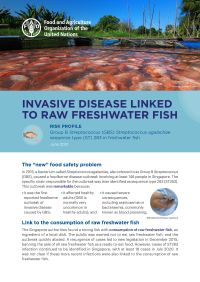
Invasive disease linked to raw freshwater fish: Group B Streptococcus

In 2015, a bacterium called Streptococcus agalactiae, also referred to as Group B Streptococcus (GBS), caused a foodborne disease outbreak involving at least 146 people in Singapore, associated with the consumption of raw freshwater fish. The specific strain responsible for the outbreak was later identified as sequence type 283 (ST283). Invasive GBS ST283 disease is also found in other countries in and around Southeast Asia. FAO has published a fact sheet and a risk profile for GBS ST283, which are available for free download. These documents provide guidance on risk reduction, and practical recommendations for food safety competent authorities.

Free online Training on Mariculture Technologies for the Asia-Pacific Region

The Yellow Sea Fisheries Research Institute, Chinese Academy of Fisheries Sciences and NACA are organising a free online training course on mariculture technologies, to be held from 21-25 September 2020. The programme will cover breeding, disease control and prevention, nutrition and feed research, breeding model construction, farm technology development, engineering, quality, safety and inspection technology for aquatic products. The course is open to government officials, researchers, enterprise managers and technicians from developing countries. The deadline for applications is 19 September 2020.

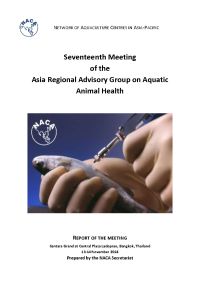
Report of the Seventeenth Meeting of the Asia Regional Advisory Group on Aquatic Animal Health

This report summarises the proceedings of the 17th meeting of the Advisory Group, held 13-14 November 2018 in Bangkok, Thailand. The group's role includes reviewing disease trends and emerging threats in the region, identifying developments in global aquatic disease issues and standards, evaluating the Quarterly Aquatic Animal Disease Reporting Programme and providing guidance on regional strategies to improve aquatic animal health management.

FAO and NACA to convene Global Conference on Aquaculture 2020

FAO and NACA have signed an agreement to convene a global conference on aquaculture in 2020. This will be the fourth conference in a series that began at the dawn of the industry in Kyoto, 1976. Aquaculture 2020 will be held late in the year in China. Arrangements, programme and partner details will be announced via the NACA website in due course.

Why fish and aquaculture?

Video presentation on the rationale for increased fish production and consumption.

First training course on culture-based fisheries held in Nha Trang, Vietnam

The first ever Regional Training Course on Culture-based Fisheries in Inland Waters was held at Nha Trang University from 30 October to 8 November. The objective of the course was to provide participants with the skills to assist local communities to plan and manage culture-based fisheries. These practices are an example of a relatively simple and low cost technology that can deliver nutritional and economic benefits to rural communities, which often have few livelihood options.

NACA Newsletter, Vol. XXXII, No. 3, July-September 2017

In this issue:

28th NACA Governing Council, Dhaka, Bangladesh; register for the First Regional Training Course on Culture-based Fisheries; 11th Indian Fisheries and Aquaculture Forum, Kochi, 21-24 November; audio recordings for regional feed consultation now available; tilapia lake virus; Proceedings of the International Symposium on Aquatic Animal Health and Epidemiology for Sustainable Asian Aquaculture; ICAR-CIBA launch "Vanami Shrimpapp", a mobile app on Pacific white shrimp (Penaeus vannamei) farming; Pakistan officials train on aquaculture certification.

NACA Newsletter, Vol. XXXII, No. 1-2, January-June 2017

In this issue:

The 15th meeting of the Asia Regional Advisory Group on Aquatic Animal Health; a regional consultation on responsible production and use of feed in aquaculture; a report on the Giant Prawn 2017 conference; a preview of the new NACA website; and new initiatives on a very serious emerging issue - reducing the human and animal health risks from development of anti-microbial resistance in the aquaculture industry.

Shell colour variation in farmed Litopenaeus vannamei: Comparison of white shell (regular) and brown shell (unusual) L. vannamei

The regular shell colour of farmed Litopenaeus vannamei is off-white to greenish-white but instances of L. vannamei with brown-shell colour do occur in farmed shrimp. A study was conducted to determine if there were differences vis-à-vis shell colour, meat colour, meat composition and meat texture. White-shelled vannamei was determined to be better in terms of meat composition and texture profile but brown-shelled vannamei yielded a more brightly red-coloured cooked product.

Certification of fishmeal and fish oil in aquaculture feed production and utilisation

Due to the recent increase in aquaculture and the rising demand for marine ingredients for use in pelleted feeds, there is concern that aquaculture is contributing to the over-exploitation of fishing stocks. There is a growing need for aquaculture enterprises to be able to demonstrate responsible practices, including the source of any marine ingredients used in the compound feed. Responsible sourcing can be demonstrated by purchashing ingredients that have been approved under the IFFO RS standard.

Traceability of aquaculture products in relation to feed and feed ingredients

Concerns about the health and safety of consumers are the driving force for the enforcement of traceability systems for aquaculture products. DOF's strategy to improve food safety related to shrimp production is a “Farm-to-Table” approach. This has been implemented through the development of a Code of Conduct for the marine shrimp industry, establishment of Good Aquaculture Practices for hygienic shrimp production, and documentation requirements for movement of chemical agents and purchase of aquatic animals.

Perspectives on culture-based fisheries developments in Asia

This book is the proceedings of the “Regional Consultation on Culture-Based Fisheries Development in Asia”, held in Siem Reap, Cambodia, 21-23rd of October 2014, under the auspices of the Australian Centre for International Agricultural Research (ACIAR), the Mekong River Commission (MRC) and the Network of Aquaculture Centres in Asia-Pacific (NACA). The consultation was jointly organised by NACA and the Fisheries Administration of the Royal Government of Cambodia.