Freshwater finfish

Information relating to aquaculture of freshwater finfish.

Creative Commons Attribution.

Related

Species / commodity tags

Major farmed commodity or species groups.

In this collection

Aquaculture Asia Magazine, January-March 2020

In this issue:

Mahseer sanctuaries of Meghalaya: A conservation and recreational perspective; Impacts of climate change on aquaculture in Vietnam: A review of local knowledge; Simple means of water aeration adopted by progressive fish breeders in West Bengal, India; Breeding striped snakehead (Channa striata) using the concrete tank method in the Cangkringan Area, Special Region of Yogyakarta; NACA Newsletter.

Mahseer sanctuaries of Meghalaya: A conservation and recreational perspective

This article presents available information regarding the present status of chocolate mahseer and the conservation measures been undertaken in the East Garo Hills of Meghalaya. A total of 54 sanctuaries have been established since 2012 in Garo, Khasi and Jaintia hills under the Meghalaya State Aquaculture Mission project of the Fish Farmers Development Agency. The sanctuaries have been established with the objective to preserve and enhance aquatic biodiversity, protect indigenous fish species, preserve breeding and feeding grounds, and serve as tourist attractions to provide livelihood opportunities.

Breeding striped snakehead (Channa striata) using the concrete tank method in the Cangkringan Area, Special Region of Yogyakarta

The striped snakehead (Channa striata) is a species of swamp fish that has a high economic value. Intensive fishing has reduced the wild populations. Hatchery production of this species has the potential for both commercial aquaculture supportive breeding programmes to conserve fish resources and increase the natural population. Below we describe a protocol we used for controlled spawning and hatchery operations for striped snakehead.

11th Symposium on Diseases in Asian Aquaculture, Kuching, Malaysia

The 11th Symposium on Diseases in Asian Aquaculture (DAA11) marks 30 years since the Fish Health Section - Asean Fisheries Society (FHS-AFS) establishment and it will be celebrated in Malaysia. Local hosts, the Department of Fisheries Malaysia (DOF) under the Ministry of Agriculture and Agro-based Industry together with the Ministry of Modernisation of Agriculture, Native Land and Regional Development Sarawak (MANRED) will be organising the event in cooperation with the FHS-AFS.

Aquaculture Asia Magazine, October-December 2019

In this issue:

Trends in water chestnut Trapa bispinosa farming in West Bengal, India; Improving livelihoods and increasing coastal resilience: A look at integrated mangrove-shrimp aquaculture in Vietnam; Snow trout fisheries in Arunachal Pradesh of the Eastern Himalayas; Gender issues in the fisheries sector of India; NACA Newsletter.

Snow trout fisheries in Arunachal Pradesh of the Eastern Himalayas

Snow trout are known for their economic importance and are recognised as potential species for food and recreation. However, very little information is available on their taxonomy, distribution, biology, habitat and food value. The demand for this group of fish has increased drastically with increasing fishing pressure due to the lack of sustained aquaculture alternatives in this hill locked part of the world. This article describes the status of snow trout fisheries in the snow fed streams, rivers and upland lakes of Arunachal Pradesh, India.

ASEAN Regional Technical Consultation on Aquatic Emergency Preparedness and Response Systems for Effective Management of Transboundary Disease Outbreaks in Southeast Asia

The ASEAN Regional Technical Consultation on Aquatic Emergency Preparedness and Response Systems for Effective Management of Transboundary Disease Outbreaks in Southeast Asia was held from 20-22 August 2018 in Bangkok, Thailand. The consultation discussed the status of and/or need for aquatic emergency preparedness and response systems for effective management of transboundary disease outbreaks in Southeast Asia. Issues were addressed through country reports, technical presentations and a workshop.

18th Meeting of the Asia Regional Advisory Group on Aquatic Animal Health

The Advisory Group (AG) is a body of technical experts that meets annually to provide advice to NACA member governments on aquatic animal health management. The group is drawn from academia, the private sector and government. The role of the AG is to review disease trends in the region, identify emerging threats and developments in global aquatic disease issues and standards, evaluate the Quarterly Aquatic Animal Disease Reporting Programme operated by NACA/FAO/OIE and regional governments, and to provide guidance on strategies to improve aquatic animal health management. This year’s meeting took place from 18-19 November at the Amari Don Muang Airport Hotel in Bangkok.

NACA Newsletter, Vol. XXXIV No. 4, October-December 2019

In this issue:

Cooperation with the Bangladesh Shrimp and Fish Foundation; Global Conference on Aquaculture 2020 update; Quarterly Aquatic Animal Disease Report, January-March 2019; A fresh look at inland fisheries and their role in food security and livelihoods; Tuskfish 2 Beta: Testers wanted; APAARI Regional Workshop on Underutilized Fish and Marine Genetic Resources and Their Amelioration; Joint Research Project on Utilization of Thailand Local Genetic Resources to Develop Novel Farmed Fish for Global Market; Impacts of climate change on fisheries and aquaculture.

Aquaculture Asia Magazine, July-September 2019

In this issue:

Farming of Asian seabass Lates calcarifer in freshwater impoundments in West Bengal, India; An integrated approach to contemporary fish farming practice incorporating traditional knowledge in mid hills in India: A success story; Mud crab farming: An alternative livelihood in the Indian Sundarban; Trout fisheries resources and potentialities in the Menchukha region of Arunachal Pradesh; NACA Newsletter.

Trout fisheries resources and potentialities in the Menchukha region of Arunachal Pradesh

The success of any aquaculture project or fish farm depends to a large extent on selection of a suitable site. Site selection using the conventional method, based on very limited data, can result in inaccurate information and cause discrepancies among the implementing agencies. The utilisation of remote sensing and geographic information systems can provide a useful source of additional information. This article provides a GIS-based analysis of the suitability of sites for trout farming and the establishment of sport fisheries in the Menchukha valley, Arunachal Pradesh.

An integrated approach to contemporary fish farming practice incorporating traditional knowledge in mid hills in India: A success story

Farming in the mid hills is largely characterised by small land holdings, low productivity, scarcity of agricultural land and irrigation facilities, and uneven terrain. Low returns in farming and unemployment problems in the mid-hills are compelling youth to move to the cities to find livelihoods. Adoption of integrated farming practices utilising available land, water and waste products more efficiently can improve farm productivity and income. The achievements of a young farmer from a remote village working to motivate others are documented in this article.

Farming of Asian seabass Lates calcarifer in freshwater impoundments in West Bengal, India

The Asian seabass Lates calcarifer is a highly preferred foodfish in West Bengal, with a high meat content and commercial value compared to Indian major carps. Found in estuarine systems on the north-east and south-east coasts of the Bay of Bengal, Asian seabass is a hardy, euryhaline fish and suitable for culture in coastal marine, inland saline, brackishwater and freshwater ecosystems. During the past decade, Asian seabass has received greater attention and has been increasingly farmed commercially in modified-extensive systems in large freshwater impoundments (termed ‘mithen gheri’ in local dialect).

Report of the Seventeenth Meeting of the Asia Regional Advisory Group on Aquatic Animal Health

This report summarises the proceedings of the 17th meeting of the Advisory Group, held 13-14 November 2018 in Bangkok, Thailand. The group's role includes reviewing disease trends and emerging threats in the region, identifying developments in global aquatic disease issues and standards, evaluating the Quarterly Aquatic Animal Disease Reporting Programme and providing guidance on regional strategies to improve aquatic animal health management.

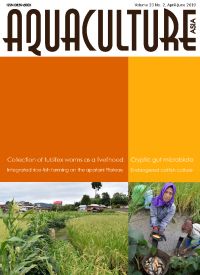
Aquaculture Asia Magazine, April-June 2019

In this issue:

Collection of tubifex worms from the Adi Ganga canal, West Bengal as means of livelihood; Some facts for the grow-out culture of an endangered catfish, Clarias magur; The cryptic domain of gut microbiota in composite culture of Indian major carps; Integrated rice-fish farming in hilly terraces of the Apatani Plateau, Arunachal Pradesh.

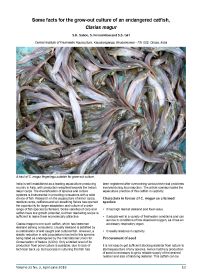
Some facts for the grow-out culture of an endangered catfish, Clarias magur

Although relatively slow growing, market demand for Clarias magur is sufficient to make it economically attractive for aquaculture. Supply of this species is through a combination of wild caught and cultured fish. However, a drastic reduction in wild populations has led to C. magur being listed as endangered by the International Union for Conservation of Nature. Only limited quantities of cultured fish are available. The article communicates the aquaculture practices of C. magur including hatchery, nursery and grow out.

The cryptic domain of gut microbiota in composite culture of Indian major carps

The digestive tract of all vertebrates including fish is known to harbour a complex microbial ecosystem with a large, diverse and dynamic collection of microorganisms. These microbes become an integral component of the host animal with intimate host-microbe associations. In the following study, we employed both bacterial enumeration and culture independent DNA fingerprinting approach to examine the presence of host-specific gut microbiota in Indian major carps related to their occupancy of distinct ecological niches.

Integrated rice-fish farming in hilly terraces of the Apatani Plateau, Arunachal Pradesh

Rice-fish farming is a popular activity amongst the Apatani tribe of the Ziro valley, conducted in their wet rice terraces. The strains of fish cultured include mirror carp Cyprinus carpio specularis, scale carp C. carpio communis and leather carp C. carpio nudus, cultivated synchronously with local rice cultivars (Oryza sativa), viz. eamo, ampu, mipya, pyapu, pyaping and eylang. This article describes the integrated farming practices and socio-economic circumstances of the Apatani in the Yachuli, Hapoli, Hong, Hari, Hija, Bula, Dutta and Old Ziro villages.
Quarterly Aquatic Animal Disease Report, July-September 2018

The 79th edition of the Quarterly Aquatic Animal Disease report contains information from eleven governments. The foreword discusses the outcomes of the 17th Meeting of the Asia Regional Advisory Group on Aquatic Animal Health, held in Bangkok, 13-14 November 2018.

Aquaculture Asia Magazine, January-March 2019

In this issue:

Current status of freshwater cage aquaculture in India; Fattening of mud crab Scylla serrata in estuarine region of south-eastern West Bengal; Aquaponics - sustainable farming method in the fight against hunger; aquatic invasive apple snails (Pomacea spp.) in Timore-Leste - current status, spread and management in rice fields; NACA Newsletter.