NACA implements collaborative development assistance projects on issues of regional interest. Individual projects draw heavily on the personnel and facilities of participating centres in member states. Projects are essentially implemented by participating centres with the Secretariat acting as a coordinating body. NACA supports technical exchange, capacity building, institutional strengthening and policies for sustainable aquaculture development. Network partners include research centres, member governments, farmer associations, development agencies and the Food and Agriculture Organization of the United Nations.
NACA publishes a wide range of aquaculture publications including technical manuals, workshop proceedings, better practice guidelines and several serials including Aquaculture Asia Magazine, the NACA Newsletter and the Quarterly Aquatic Animal Disease Report. To keep up to date with developments you could consider subscribing to our RSS feed.
The Asian Institute of Technology (AIT) is launching a new Certificate programme on Sustainable Asian Aquaculture via the AARM Academic programme, for one semester beginning August 2017. This certificate programme is a combination of well-designed course work and hands-on experience in specialised areas (fish/shrimp hatchery or farming). The programme is useful for both students (with credit transfer) and for working professionals and entrepreneurs (without credits).
Inspiring story of aquaculture in Sikkim - a journey from conservation to farming; farming of scampi and tiger shrimp together - a case study from West Bengal; Labeo pangusia - a candidate for diversification of hill aquaculture; sustainability of an integrated livestock-fish-crop farming system as a small scale enterprise; sustainable coastal aquaculture in India; potential scope and prospects of domestic fish market in Chhattisgarh.
7 June 2017 | Simon Wilkinson | 1621 Downloads | .pdf | 156.05 KB
Tilapia lake virus (TiLV) is a relatively recent pathogen causing serious mortalities in farmed tilapia. The virus appears to be spreading via the usual pathway of importation of live fish with inadequate regard for biosecurity protocols. Countries that are at risk should establish surveillance for TiLV. Unusual tilapia mortalities should be investigated. Importation of live tilapia should probably be reconsidered until adequate biosecurity arrangements are in place. Links to some recent advisories and publications are provided.
7 June 2017 | Prakash Sharma and Riteshkumar S. Tandel | 2685 Downloads | .pdf | 5.38 MB
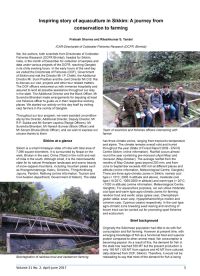
Sikkim is a small Himalayan state of India with three climatic zones ranging from tropical to temperate to alpine. The moderate-cool and warm agro-climatic zones are suitable for farming rainbow trout and exotic carp species, while brown trout hatchery and ranching can be conducted in the alpine areas. We report on the status of exotic carp and trout farming in Sikkim including farming practices, constraints faced by local farmers and possible solutions.
7 June 2017 | Debajit Sarma, Atul Borgohain, Kaustubh Bhagawati and A.K. Singh | 2135 Downloads | .pdf | 4.97 MB
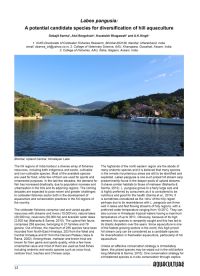
Labeo pangusia is a highly prized hill stream carp found mainly in the deeper pools of upland streams. Heavy fishing pressure has led to depletion of wild populations in recent years and the species is likely to become threatened if a conservation strategy is not developed. We report on an investigation into the reproductive biology of this species and on the result of successful induced breeding trials.
7 June 2017 | Bibha Chetia Borah and Sonmoina Bhuyan | 3127 Downloads | .pdf | 1.82 MB
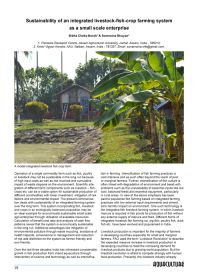
We examined the sustainability and economic viability of a model integrated livestock-fish-crop farming system developed by the Fisheries Research Centre, Assam Agricultural University, over an extended period of 13 years. The system was developed as an ecologically sustainable alternative technology for small and margin farmers. It incorporates two livestock components, pig and poultry, with horticulture and carp polyculture. Analysis of cash flow and benefit-cost ration revealed the system to be economically sustainable over the long term.
26 May 2017 | CGIAR Research Program on Fish Agri-food Systems | 5661 Downloads | .pdf | 218.9 KB
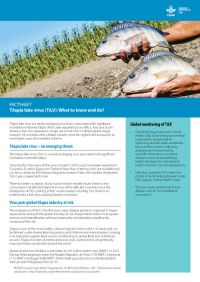
Tilapia lake virus is a newly emerging virus that is associated with significant mortalities in farmed tilapia. This fact sheet describes the threat to industry, clinical signs, diagnosis, risk factors, prevention and control options and actions that must be taken to minimise the impact of this disease on the global tilapia aquaculture industry. All countries with a tilapia industry must be vigilant and act quickly to investigate cases of mortalities in farms.
20 May 2017 | H.T. Dong, T. Rattanarojpong and S. Senapin | 5237 Downloads | .pdf | 375.4 KB
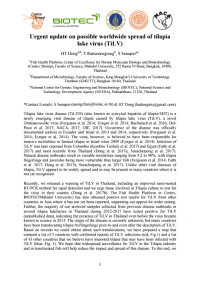
Recently, we released a warning of TiLV in Thailand and an improved RT-PCR detection methodology. The Fish Health Platform in Centex, BIOTEC/Mahidol University has also obtained positive test results for TiLV in other Asian countries where it has not yet been reported. Many countries have been translocating tilapia fry/fingerlings prior to and even after the description of TiLV. We have prepared a map listing countries with confirmed reports of TiLV infections and 43 other countries that we believe have imported infected fish.
17 May 2017 | Office International des Epizooties | 5462 Downloads | .pdf | 48.33 KB
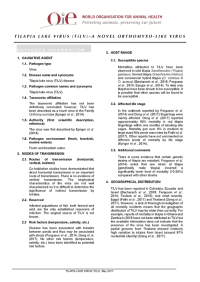
This disease card published by the World Organisation for Animal Health (OIE) provides information about tilapia lake virus (TiLV), a recently observed pathogen causing significant mortalities in cultured tilapia. The disease card provides details of the pathogen, modes of transmission, host range, geographical distribution, clinical signs, diagnostic methods, socio-economic significance, transmission risk and a list of available references. We urge laboratories to test for TiLV when abnormal tilapia mortalities occur.
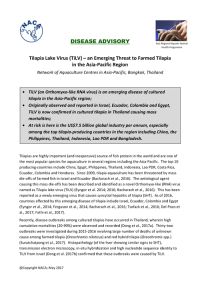
Tilapia lake virus (TiLV) is an emerging disease of cultured tilapia in the Asia-Pacific region. Originally observed and reported in Israel, Ecuador, Colombia and Egypt, TiLV is now confirmed in cultured tilapia in Thailand causing mass mortalities. At risk is here is the US$7.5 billion global industry per annum, especially among the top tilapia-producing countries in the region including China, the Philippines, Thailand, Indonesia, Lao PDR and Bangladesh. This advisory describes signs of the disease and PCR detection methods.
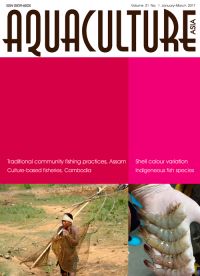
Anti-microbial resistance in aquaculture; participatory market chain approaches to boost fish nurseries; traditional community fishing practices of rural Assam; practical significance of restricted feeding regimes in aquaculture; Bangana dero: A potential indigenous fish species for diversification of carp culture; shell colour variation in farmed Litopenaeus vannamei: Comparison of white- and brown-shelled shrimp; culture-based fisheries: A low-tech, greenhouse friendly approach to improving food and income for Cambodian families.
20 April 2017 | H.T. Dong, S. Siriroob, W. Meemetta, W. Santimanawong, W. Gangnonngiw, N. Pirarat, P. Khunrae, T. Rattanarojpong, R. Vanichviriyakit and S. Senapin | 6183 Downloads | .pdf | 242.8 KB
Tilapia lake virus (TiLV) is an emerging virus that causes syncytial hepatitis of tilapia with mortalities of up to 90%. Recent disease outbreaks in Thai tilapia farms have been associated with high cumulative mortalities and histopathological features typical of SHT. Infection has now been confirmed. The semi-nested RT-PCR protocol described here may be used freely for non-commercial applications to detect TiLV. The authors urge laboratories in Asia to test for TiLV when abnormal tilapia mortality occurs.
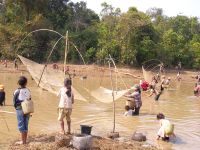
Culture-based fisheries (CBF) are often conducted in small water bodies, perennial and or seasonal, that retain water for at least six to eight months of the year. CBF are stock enhancement practices in water bodies that are generally incapable of supporting sustainable fisheries through self-recruiting fish populations, and where the stock is managed and owned, either individually and or collectively. Feed is rarely added and the stock are left to forage on natural foods.
18 March 2017 | Ch. Basudha, N. Sobita Devi and Sinthoileima, Ch. | 2909 Downloads | .pdf | 3.63 MB
Bangana dero is one of the most popular indigenous minor carps in the north eastern states of India, fetching triple the market prices of Indian major carps. B. dero is a bottom feeder and feeds on insect larvae, molluscs, algae, zooplankton and detritus. Over the last two decades the occurrence of wild juveniles of this fish in Indian rivers has fallen drastically. A protocol for induced breeding, larviculture, nursery rearing and growout including polyculture of B. dero is described.
In Nepal, low quality and seasonal access to fish seed is an important restriction on the development of the aquaculture sector. Commercialisation of fish farming cannot progress rapidly in the absence of critical inputs and a regular supply of quality fish seed is an integral requirement for the transition of fish farming from a subsistence activity to a commercial enterprise. Participatory market chain approaches are a key tool for the social and economic improvement of farmers and market participants.
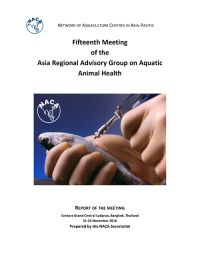
The Asia Regional Advisory Group on Aquatic Animal Health meets annually to discuss regional health issues including emerging disease threats. This report includes a review of regional disease status circa 2016, global and regional disease reporting arrangements, global issues and standards, progress in implementation of the the Regional Technical Guidelines on Health management for the Responsible Movement of Live Aquatic Animals, identification and designation of regional aquatic animal health resources and regional and international cooperation.
The 15th meeting was held from 21-23 November 2016, in Bangkok, Thailand. A special session was held on addressing the use of anti-microbial substances in aquaculture and the development of anti-microbial resistance. This is an issue of global concern for both human and animal health, and it had been addressed by a resolution at FAO’s Thirty-ninth Conference in June 2015. The meeting reviewed in detail the status of aquatic animal disease in the region.