8 September 2004 | Graham Haylor | 1359 Downloads | .pdf | 176.2 KB
This paper advocates strategies, processes and practices that enable: livelihoods approaches rather than resource-based approaches, ‘direct’ institutional and policy development, rather than ‘project demonstrations’, and support for regional, national and local communications. It was presented at the Symposium on Participatory approaches in reservoir fisheries management: Issues, challenges and policy, October 4-6th 2004 at the Culture Club Resort, Dambulla, Sri Lanka hosted by the National Aquaculture Development Authority in collaboration with FAO..
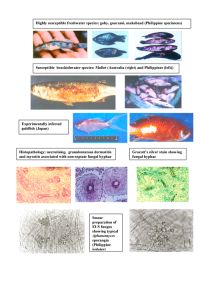
Epizootic ulcerative syndrome (EUS) is a seasonal epizootic condition of wild and farmed, fresh and brackishwater fish. Of complex infectious aetiology, it is characterised by the presence of invasive Aphanomyces infection and necrotising ulcerative lesions typically producing a granulomatous response. The disease is now endemic in South-east and south Asia, and has recently extended to West Asia. EUS is indistinguishable from red spot disease of eastern Australia and mycotic granulomatosis of Japan.
24 August 2004 | Mark Crane, Motohiko Sano and Cedric Komar | 1790 Downloads | .pdf | 393.23 KB
Koi herpes virus (KHV) outbreaks in the region have significant trade implications for the high value ornamental koi carp industry, and the important food fish common carp. Active trade in ornamental fish poses a potential risk for spread of KHV. Recognising the significance, "infection with koi herpesvirus" has been listed under "diseases prevalent in the region" in the NACA/FAO/OIE regional quarterly aquatic animal disease (QAAD) list, effective for reporting from first quarter of 2004.
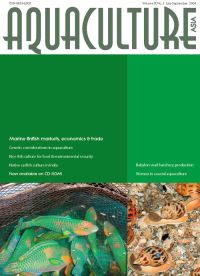
Genetic considerations in fisheries and aquaculture with regards to biodiversity. Rice-fish culture for food and environmental security. Land-based aquaculture of spotted babylon Babylonia areolata in Thailand: Hatchery-based seedling operation. Shrimp health question and answer. Women in coastal aquaculture. Insights into live marine food fish markets in Asia. Farming practices, market chains and prices of marine finfish in Malaysia, Indonesia and Hong Kong.
Genetic impacts of translocation on aquatic biodiversity in Asia. Carp culture in Iran. Opportunities and challenges in Myanmar aquaculture. Impacts of monosex Macrobrachium culture on seed availability in India. Use of new technology and skills for eco-friendly production of tiger shrimp Penaeus monodon. Larval rearing and spat production of the windowpane shell Placuna placenta. HACCP in shrimp farming. First breeding success of Napoleon wrasse Cheilinus undulatus and coral trout Plectropomus leopardus.
An Emergency Disease Control Task Force on a Serious Disease of Koi and Common Carps in Indonesia was organised by NACA in June 2002. The Task Force conducted an emergency assessment of the disease situation in July through field and laboratory examinations of collected samples. The Task Force collected information about the disease occurrence. Koi herpes virus was detected from all case samples which indicates that it may have played a role in the observed mortalities.
3 February 2004 | Haylor, G., Briggs, M.R.P., Pet-Soede, L., Tung, H., Yen, N.T.H., Adrien, B., O'Callaghan, B., Gow, C., De Vantier, L., Santos, R., Pador, E., de la Torre, M., Bulcock, P., and Savage, W. | 26855 views | .pdf | 2.25 MB
Wild-harvest fisheries for live reef fish are largely over-exploited or unsustainable. Sustainable aquaculture – such as that of groupers – is one option for meeting increasing demand for reef fish as well as potentially maintaining livelihoods of coastal communities. This report draws upon secondary literature, media sources and four diverse case studies from at-risk reef fisheries, to frame a strategy for encouraging sustainable aquaculture as an alternative to destructive fishing practices. It was commissioned by the APEC Secretariat.
3 February 2004 | Matthew Briggs | 6880 Downloads | .pdf | 582.74 KB
Sulawesi has the largest coral reef area in Indonesia, at the epicenter of worldwide marine biodiversity, but is one of the areas most threatened in Southeast Asia by destructive fishing practices. This case study reviews the potential for aquaculture to provide alternative livelihoods for fishers within the context of an integrated, community-based coastal management plan with involvement of local communities empowered to control and steward their resources so that they can conserve and utilise them sustainably.
30 January 2004 | Malene Felsing, Graham Haylor, Gautam Dutta, Brajendu Kumar, Smita Shweta, A. Natarajan, Gulshan Arora and Virendra Singh | 1921 Downloads | .pdf | 239.11 KB
The feasibility of integrated aquaculture in seasonal water bodies in rainfed farming areas of Eastern India was assessed in on-farm trials. Fry of Indian major carps: Catla, mrigal, rohu, common carp, and silver barb, and advanced fingerlings of Indian major carps were raised to marketable size. Key factors for the success of aquaculture in seasonal water bodies are access to credit, production enhancing inputs and water bodies that hold water for more than 120 days of the year.
This report presents an overview of the state of aquatic resources in the Philippines, its performance and importance in the Philippine economy, and explores the situation of poverty in the "aquatic resources sector." The report describes the policy environment that guides the action of key actors in the sector. A general analysis of some trends in relation to factors that keep the poor from participating and benefiting from aquatic resource management is also provided.
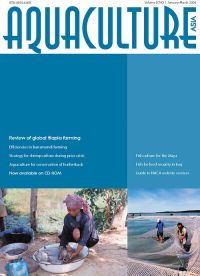
Aquaculture and food security in Iraq. Natural breeding in captivity - conservation of the threatened freshwater featherback Notopterus notopterus. Culture of Penaeus japonicus. Enzymes for sustainable aquaculture. Review of global tilapia farming practices. Fish culture in Yucatan, Mexico. Shrimp farm project planning, preparation and implementation. Coping with low shrimp prices. Efficiencies in barramundi culture. The innovative contributions of women in aquaculture. Marine finfish section. What's new on the web. Aquaculture calendar.
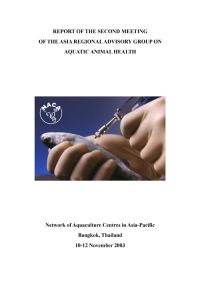
The Asia Regional Advisory Group on Aquatic Animal Health meets annually to discuss regional health issues including emerging disease threats. This report includes a review of regional disease status circa 2003, global and regional disease reporting arrangements, global issues and standards, progress in implementation of the the Regional Technical Guidelines on Health management for the Responsible Movement of Live Aquatic Animals, identification and designation of regional aquatic animal health resources and regional and international cooperation.
Lymphocystis is a common, chronic and benign infection caused by an iridovirus that results in uniquely hypertrophied cells, typically in the skin and fins of only the more advanced orders of fishes.
This disease card provides information on the epizootic of koi and common carp in Indonesia. The pattern of the recent epidemic in koi and common carp in Indonesia is consistent with that of an infectious disease, but there is as yet no definitive aetiological diagnosis. The Regional Aquatic Animal Health Advisory Group of NACA in its first meeting decided to list Koi mass mortality under Unknown diseases of serious nature in the Quarterly Aquatic Animal Disease report.
The Manual of Procedures for the Implementation of the Asia Regional Technical Guidelines on Health Management for the Responsible Movement of Live Aquatic Animals provides background material and detailed technical procedures to assist countries and territories in the Asia Region in implementing the Asia Regional Technical Guidelines on Health Management for the Responsible Movement of Live Aquatic Animals. The Technical Guidelines were initiated due to increased recognition that disease emergence is often linked to live aquatic animal movements.
The Asia Regional Technical Guidelines on Health Management for the Responsible Movement of Live Aquatic Animals and their associated implementation plan, the Beijing Consensus and Implementation Strategy provide expert guidance for national and regional efforts in reducing the risks of disease due to trans-boundary movement of live aquatic animals. The Technical Guidelines were initiated due to increased recognition that disease emergence is often linked to live aquatic animal movements and causes significant socio-economic losses.
19 November 2003 | P. Leung and K.R. Sharma (eds.) | 2314 Downloads | .pdf | 1.56 MB
The sixteen papers in this volume were largely based on the data from a survey of more than 5,000 shrimp and close to 6,000 carp farms in sixteen countries and territories in the Asia-Pacific region. They provide an economic and technical efficiency of production analysis for Asian shrimp and carp farming systems. This survey was conducted under the ADB/NACA regional study and workshop on aquaculture sustainability and the environment (RETA 5534).
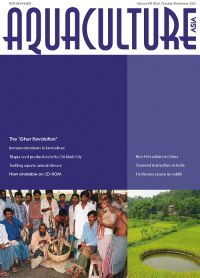
Freshwater prawn Macrobrachium nobilii for rural nutrition. Snapshots of a socially responsible farm in Sri Lanka. Introduction of rainbow trout in Nepal. Tilapia seed production in Ho Chi Minh City, Vietnam. Seaweed mariculture - scope and potential in India. Growth enhancement of carp and prawn through dietary suppliementation with salt. Fertilisation and water quality management in small ponds. The "Gher Revolution". Exercising responsibilities to tackle aquatic animal disease. Immunostimulants in aquaculture.
Ornamental fish farming in India. Tilapia for Indian aquaculture? Peri-urban food production in southeast Asia. Socio-economic consequences of shrimp farming in Andhra Pradesh. Breeding techniques for golden arowana Scleropages formosus. Captive breeding of peacock eel Macrognathus aculeatus. Substrate-based aquaculture systems. Extension in shrimp health management - experiences from India. Treatment of disease in freshwater shrimps and crabs in China. Larval rearing techniques for humpback grouper Cromileptes altivelis.
Peri-urban aquaculture in Kolkata. Diffusion and adoption of shrimp farming technologies. Aquaculture education in India. Information system on fish germplasm resources in China. Freshwater crustacean aquaculture in China. The role of macronutrients. Innovations by Bengal farmers. Scientific guidelines for freshwater prawn farmers in India. Status of mariculture in Indonesia. Use of probiotics in larval rearing. Problems in shrimp culture during the wet season.