Gender

The Gender Programme was established to ensure that NACA implements the action plans on gender mainstreaming within its activities. With a continued interest in embracing gender integration among relevant agencies, NACA aims to build up capacity of members in gender mainstreaming in all its undertakings, and motivate support and action globally.

Insufficient capacity for gender research and application among stakeholders is a hindrance to effectively implement programs integrating the gender dimensions in development. Adding a gender dimension in aquaculture value chains will give assurance to consumers that seafood has been produced sustainably.

Key activities

Key activities of the programme are:

  • Women, Youth and Aquaculture Development Programme.
  • Organising and supporting symposia on Gender in Aquaculture and Fisheries.
  • Capacity building on gender integration and mainstreaming.
  • Curriculum development on gender in aquaculture and fisheries education.
  • In-country gender assessment reports for policy, action and research.
  • Publication of case studies and success stories on gender in aquaculture value chains.
  • Coordinating the Regional Gender Practitioners’ Network and mentoring programmes.
  • Campaigns and policy advocacy for gender integration in aquaculture.

Creative Commons Attribution.
Related

Subject tags

A collection of subject tags relating to technical matters.

In this collection

Nature-based Aquaculture for Entrepreneurs and Innovators

Mariska Bottema (WorldFish) and Rebecca McMillan (IDRC) discuss the concept of nature-based aquaculture, why it matters for innovation and entrepreneurship, and how it can support ecosystems, communities, and profitability. Topics include: Defining nature-based aquaculture and its connection to nature-based solutions; criteria such as climate resilience, ecosystem health, reduced antimicrobial use, and inclusivity; global examples: mangrove–shrimp integration, women-led seaweed farming, integrated multi-trophic systems, and rice–fish farming; supportive technologies including IoT, renewable energy, and life cycle assessment; and opportunities for entrepreneurs: resilient farms, reduced risks, lower costs, premium markets, funding, and partnerships.

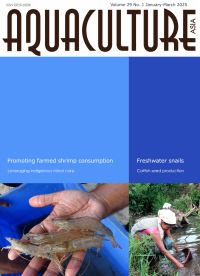
Aquaculture Asia Magazine, January-March 2025

In this issue:

  • Promoting farmed shrimp consumption in India’s domestic market: A step towards sustainability
  • Leveraging indigenous minor carp for sustainable aquaculture in Northeast India
  • Shaping the future of Indian aquaculture: A path to captive catfish seed success
  • Sustainable freshwater snail farming: Advancing nutrition security and rural livelihoods in Northeast India
  • Promotion and protection of small fish species through farming: An initiative in Tripura
  • NACA Newsletter

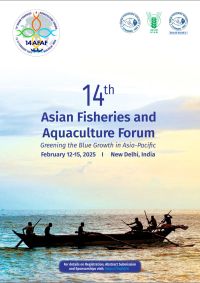
14th Asian fisheries and Aquaculture Forum: Early bird closes 10 November

The 14th Asian Fisheries and Aquaculture Forum (14AFAF) will be held from 12-15 February 2025 in New Delhi, India. Submission of abstracts has been extended until 5 November, and early bird registration closes on 10 November, so get in quick!

The forum is a scientific meeting organised by the Asian Fisheries Society (AFS) once every three years to understand the global trends and address issues and challenges faced by the fisheries and aquaculture sector. The main purpose of this Forum is to provide an international platform for eminent scientists, young researchers, and other stakeholders across the globe to share their research experiences and innovative ideas. By facilitating the exchange of diverse range of knowledge and expertise, the Forum with the Theme ‘Greening the Blue Growth in Asia-Pacific’ aims to address key issues towards developing sustainable fisheries and aquaculture.

Project introduction: Knowledge brokering for nature-based solutions in aquaculture transformation in Asia-Pacific

This presentation provides an introduction and overview to the project "Knowledge brokering for nature-based solutions in aquaculture transformation in Asia-Pacific: Support to the Aquaculture Innovation and Investment Hub". The project contributes to NACA and FAO's work on aquaculture transformation, which aims to create more efficient, inclusive, resilient, and sustainable food systems through innovation, investment, and partnerships.

NACA is developing an Aquaculture Innovation and Investment Hub (AIIH) to help realise this vision in the region, providing a facility that will bring together innovators, startups, and investors to accelerate transformation. The presentation was given at the project inception workshop on 4 June 2024 in Bangkok. The project is funded by Canada's International Development Research Centre.

Knowledge brokering for nature-based solutions in aquaculture and transformation in Asia-Pacific: Support to the Aquaculture Innovation and Investment Hub

This project contributes to NACA's recent work with the FAO on aquaculture transformation. The aim is to create more efficient, inclusive, resilient, and sustainable food systems through innovation, investment, and partnerships. NACA is developing an Aquaculture Innovation and Investment Hub (AIIH) to help realise this vision in the region, providing a facility that will bring together innovators, startups, and investors to accelerate transformation. The project will contribute to developing National Innovation and Investment Plans for Thailand, The Philippines, and Fiji, which will address issues including climate change, disease prevention and management, environmental sustainability, gender equality and social inclusion, and resource utilisation and management. The project is part of a wider AQUADAPT initiative, a four-year partnership running from 2023-2027, funded by Canada's International Development Research Centre.

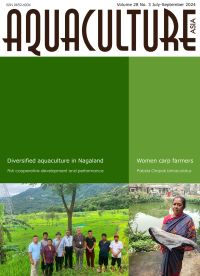
Aquaculture Asia Magazine, July-September 2024

In this issue:

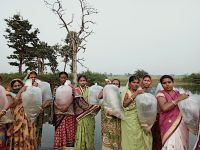
  • Progressive women carp farmers of Haldia, Purba Medinipur, West Bengal, India.
  • Captive breeding of Ompok bimaculatus (pabda): An indigenous catfish of North East India.
  • Reaching out to the unreached through diversified aquaculture in Nagaland.
  • Fish cooperatives: Development and performance through sustainable development goals for food and feed ecosystems.
  • NACA Newsletter.

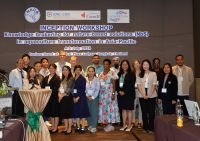
Inception workshop: Knowledge brokering for nature-based solutions in aquaculture transformation

Canada's International Development Research Centre (IDRC) is sponsoring the project "Knowledge Brokering for Nature-Based Solutions in Aquaculture Transformation in Asia-Pacific: Support to the Aquaculture Innovation and Investment Hub." The project is part of a wider IDRC AQUADAPT initiative, a four-year partnership running from 2023-2027. AQUADAPT addresses the intertwined challenges of climate change, biodiversity loss, and food insecurity through applied research on nature-based solutions in aquaculture in Southeast Asia and the Pacific region. AQUADAPT emphasises Gender Equality and Social Inclusion (GESI), ensuring that nature-based solutions are inclusive of all genders and marginalised groups. The project's inception workshop was held in Bangkok from July 4-5, bringing together project teams from Thailand, The Philippines, and Fiji to discuss approaches and methodologies. 

Aquaculture Asia Magazine, April-June 2024

In this issue:

  • Scientific aquaculture to promote better livelihoods for Scheduled Caste farmers.
  • Rainbow trout in Jammu and Kashmir: Present status and strategies for expansion.
  • Community participation in marine ornamental aquaculture: An integral approach on livelihood empowerment of islander women and conservation of reef ecosystems at the Lakshadweep Islands, India.
  • Training programmes organised by West Bengal Fisheries Department in South 24 Parganas in the beginning of 2024.
  • Exploring the possibility of captive production of a near threatened catfish, Rita chrysea for Indian aquaculture.
  • NACA Newsletter.

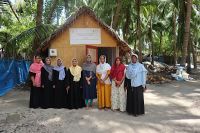
Community participation in marine ornamental aquaculture: Empowerment of women and conservation of reef ecosystems at the Lakshadweep Islands

Promoting and encouraging community participation in marine ornamental aquaculture presents an alternative approach to enhancing the economic status of marginalised individuals, particularly women, in the Lakshadweep islands. Additionally, it aids in curbing the wild capture of marine ornamental organisms, thereby relieving pressure on natural resources. The article examines the strategy of community-based marine ornamental aquaculture and its significance in bolstering the economy of islanders, particularly women, in the Lakshadweep Sea. It seeks to investigate effective approaches to promote the sustainability of the coral reef ecosystem in the region. High-value marine ornamental organisms, such as fishes and shrimps, are cultivated in community aquaculture units using simplified technology. These organisms are supplied to aquarists and hobbyists, thus supplementing the income of local women islanders.

Aquaculture Asia Magazine, January-March 2024

In this issue:

  • Neolissochilus hexagonolepis (chocolate mahseer): A flagship species for diversification of hill aquaculture in Northeast India.
  • Aquarium fish culture in open village ponds in South 24 Parganas, West Bengal.
  • Women nurtured transformative aquaculture in rural Bengal.
  • Breeding and seed production technology of striped spiny eel Macrognathus pancalus to benefit fish farmers.
  • Grow-out culture of the loach Lepidocephalichthys thermalis in modified tanks.
  • NACA Newsletter.

WAS Journal Special Issue: Global Conference on Aquaculture Millennium +20 Thematic Reviews

Eight thematic reviews prepared as preparation for the Global Conference on Aquaculture Millennium +20 (GCA +20) have been published in a Special Issue of the Journal of the World Aquaculture Society "Aquaculture for Food and Sustainable Development". A group of experts prepared advanced working drafts of each thematic review and the key findings from each theme were presented and discussed by expert panels during the GCA +20. Participants were then invited to provide their feedback and perspectives on the reviews and their key messages for consideration in finalisation of the papers. The reviews are available for free download.

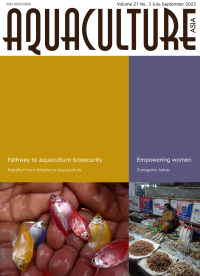
Aquaculture Asia Magazine, July-September 2023

In this issue:

  • Pathway to aquaculture biosecurity: Mitigating risks, managing progressively and engaging the value chain
  • Important considerations for feed and feeding management during Indian catfish culture
  • A transitional journey from fisheries to aquaculture in Moyna
  • Colour widow tetra: A new and highly preferred aquarium fish in West Bengal
  • Expanding the horizon of aquaculture through women's empowerment
  • NACA Newsletter

Expanding the horizon of aquaculture through women's empowerment

The concept of “empowerment” was introduced at the International Women’s conference in 1985 at Nairobi, which defined empowerment as a “redistribution of social power and control of resources in favour of women”. In recent years the development of women has emphasised providing equal opportunities to women by removing gender bias, empowering, and creating self-reliance among them. Empowerment of women and gender equality is recognised globally as a key element to achieve progress in all areas. Globally, the role of women and the need to consider gender issues in aquaculture development was first recognised by the FAO-NORAD sponsored workshop on “Women in Aquaculture” in 1987.

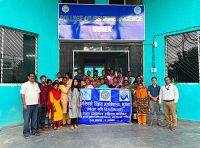
Augmenting entrepreneurial attitude among tribal women of Jharkhand, India

Today, tribal people comprise 8.6 percent of the Indian population and are one of the most disadvantaged sections of society. Many tribal groups in different parts of the country depend on natural resources for their livelihoods, to which their access has been progressively eroded. With financial support from ICAR-CIFT the College of Fisheries, Gumla, undertook seven training programmes for tribal women from economically marginalised tribal communities in the preparation and marketing of value-added fisheries products. The training encouraged women to develop small businesses building on their micro-entrepreneurship.

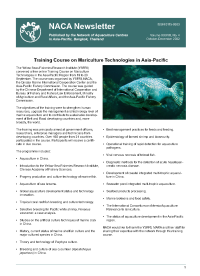
NACA Newsletter, Vol. XXXVII, October-December 2022

In this issue:

Training Course on Mariculture Technologies in Asia-Pacific; FAO/NACA Virtual Workshop on Aquaculture Transformation in Asia and the Pacific Region; Belt & Road Forum for International Freshwater Fishery Industry Innovation; 8th Global Conference on Gender in Aquaculture and Fisheries, 21-23 November; Reported Aquatic Animal Diseases in the Asia-Pacific Region during the First Quarter of 2022; International Training Course on Biology and Pathology of the Penaeid Shrimp 2022; Angkasa Putra inaugurated as first President of the South-East Asian Fisheries and Aquaculture Student Association; Artemia webinars: Video recordings of technical presentations available.

8th Global Conference on Gender in Aquaculture and Fisheries, 21-23 November

GAF-8, the 8th Global Symposium on Gender in Aquaculture and Fisheries – will be held from 21-23 November, 2022, hosted by the Society of Fisheries Technologists (India) (SOFTI), Kochi and the ICAR-Central Institute of Fisheries Technology, Kochi. GAF-8 is a stand-alone event, that will be packed with a variety of different activities and sessions covering all aspects. The GAF8 session and event themes, call for abstracts and other information will be available shortly. Please see the GAF website for registration and other details.

Aquaculture Asia Magazine, July-September 2022

In this issue:

Dynamics of small-scale aquaculture development in India: A review; Green water technology as an essential support to larval rearing of hilsa shad; Collection of freshwater molluscs and sale of meat by women in Purba Medinipur, West Bengal, India; A success story of ornamental fish farming as a tool for alternative livelihood of tribal women in Keonjhar District, Odisha, India; Recent trends in seed production of stinging catfish, Heteropneustes fossilis, in India; NACA Newsletter.

A success story of ornamental fish farming as a tool for alternative livelihood of tribal women in Keonjhar District, Odisha, india

In Odisha, India, ornamental fish farming, culture and seed production are being utilised by self help groups to provide livelihoods for poor people in rural communities. The objective of self help groups is to sustainably increase the income of poor families to bring them above the poverty line. This is being achieved through a process of social mobilisation, training and capacity building, and provision of some necessary facilities. This article documents the evolution of ornamental fish farming by the Pragati Self Help Group in Bhatunia Village.

Collection of freshwater molluscs and sale of meat by women in Purba Medinipur, West Bengal, India

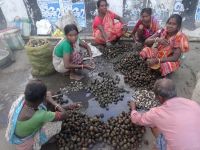
The common freshwater snail Bellamya bengalensis, golden apple snail Pila globosa and freshwater pearl mussel Lamellidens marginalis are naturally found in West Bengal. These molluscs are also an important source of protein for poor rural communities, and are also gaining popularity in middle and high income suburban areas for their nutritional and traditional medicinal values. They also represent a significant source of employment and income generation for women from Scheduled Tribes and Scheduled Castes. This article documents the collection, preparation, trade and use of freshwater molluscs in Paschim Medinipur and Purba Medinipur districts of West Bengal.

Aquaculture Asia Magazine, July-September 2021

In this issue:

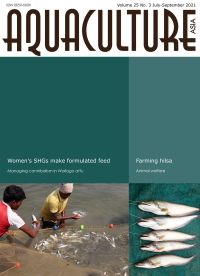
Opinion: Benefits of animal welfare in Indian aquaculture; Imparting skill on formulated fish feed preparation to women’s self-help groups in villages – an experience; Farming of the anadromous shad, Tenualosa ilisha: Signs of taking off in India; Some facts on cannibalism in Wallago attu and its management during captive seed production; NACA Newsletter.