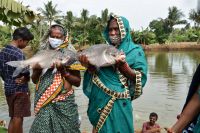
Dynamics of small-scale aquaculture development in India: A review Himansu K. De, Gour S. Saha, Abhijit S. Mahapatra and Simantini Shasani
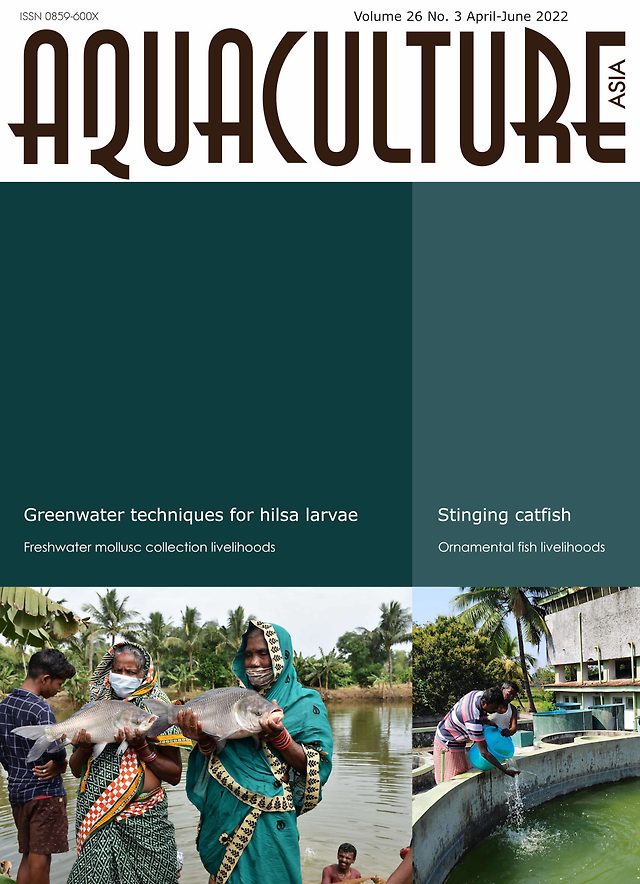
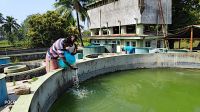
Green water technology as an essential support to larval rearing of hilsa shad D.N. Chattopadhyay, R.N. Mandal, A. Chakraborty, P.K. Roy, A. Das, A. Hussan, S. Adhikari, B.R. Pillai and S.K. Swain
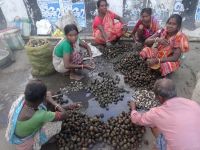
Collection of freshwater molluscs and sale of meat by women in Purba Medinipur, West Bengal, India Subrato Ghosh
A success story of ornamental fish farming as a tool for alternative livelihood of tribal women in Keonjhar District, Odisha, India Saibala Parida, Saroj Kumar Swain and Sangram Kumar Sahoo
Recent trends in seed production of stinging catfish, Heteropneustes fossilis, in India S.K. Sahoo, S. Ferosekhan, S.N. Sahoo, P.C. Das and S.S. Giri
Aquaculture Asia Magazine is an autonomous publication that gives farmers and scientists in developing countries a voice. Stories concern the small-scale aquaculture prevalent in the region and the circumstances of farmers trying to make ends meet in an increasingly globalised world. We accept articles on any aspect of aquaculture and the related processing, marketing, economic, environmental and social issues. An RSS feed is available if you wish to stay informed of new issues.
29 August 2022 | S.K. Sahoo, S. Ferosekhan, S.N. Sahoo, P.C. Das and S.S. Giri | 3075 Downloads | .pdf | 783.03 KB
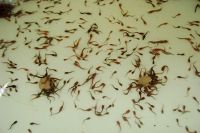
Hatchery production of stinging catfish (Heteropneustes fossilis) seed is increasing as it is a good fish species favoured by consumers due to its high protein and lower fat content. Stinging catfish naturally breeds in the monsoon season, and is found gravid in the wild during July-September. In captivity it can be successfully produced using either induced or natural breeding techniques. This article summarises what is known about stinging catfish biology, and methods for its captive breeding, rearing of larvae and fry, feeding strategies and health concerns, to aid production of seed of this valuable catfish.
In Odisha, India, ornamental fish farming, culture and seed production are being utilised by self help groups to provide livelihoods for poor people in rural communities. The objective of self help groups is to sustainably increase the income of poor families to bring them above the poverty line. This is being achieved through a process of social mobilisation, training and capacity building, and provision of some necessary facilities. This article documents the evolution of ornamental fish farming by the Pragati Self Help Group in Bhatunia Village.
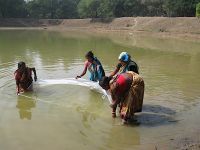
The common freshwater snail Bellamya bengalensis, golden apple snail Pila globosa and freshwater pearl mussel Lamellidens marginalis are naturally found in West Bengal. These molluscs are also an important source of protein for poor rural communities, and are also gaining popularity in middle and high income suburban areas for their nutritional and traditional medicinal values. They also represent a significant source of employment and income generation for women from Scheduled Tribes and Scheduled Castes. This article documents the collection, preparation, trade and use of freshwater molluscs in Paschim Medinipur and Purba Medinipur districts of West Bengal.
19 August 2022 | D.N. Chattopadhyay, R.N. Mandal, A. Chakraborty, P.K. Roy, A. Das, A. Hussan, S. Adhikari, B.R. Pillai and S.K. Swain | 2601 Downloads | .pdf | 2.89 MB
Green water technology is a technique that promotes phytoplankton to grow profusely, and includes several methods by which desirable microalgae are produced for the purpose of rearing larval fish and crustaceans. Naturally occurring phytoplankton, which serve as feed for fish and crustacean larvae, are grown and proliferate under a controlled system. This article describes the use of greenwater and co-feeding techniques in the rearing of hilsa, Tenualosa ilisha, principally making use of Chlorella and rotifers.
19 August 2022 | Himansu K. De, Gour S. Saha, Abhijit S. Mahapatra and Simantini Shasani | 1664 Downloads | .pdf | 2.59 MB
Development of small-scale aquaculture has dominated development discourse because of its potential to fight malnutrition and poverty, to ensure food security and enhance the socio-economic condition of people living at the bottom of the pyramid. Aquaculture has contributed to strengthening livelihoods and food security in southeast Asian countries, contributing to the livelihood of the poor farmers through improved food supply, income and employment.