Hatchery and nursery

Information related to hatchery management, larval rearing and seed production in aquaculture.

Creative Commons Attribution.

Related

Subject tags

A collection of subject tags relating to technical matters.

In this collection

Participating R&D centres

Directory of research and development centres and other partners that participate in the Network of Aquaculture Centres in Asia-Pacific.

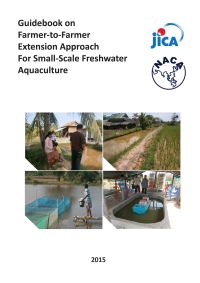
Development of a Guidebook on Farmer-to-Farmer Extension Approaches for Small-scale Aquaculture in the Asia-Pacific Region

The objectives of this project were to i) develop a guidebook in English on "Farmer-to-farmer extension approaches for small-scale aquaculture" and ii) to translate the developed guidebook into selected local dialects in Asia-Pacific and other regions (e.g. Africa). The project made use of the significant results from the JICA projects in Cambodia, Benin and other countries on farmer-to-farmer extension approaches on technology extension for small-scale farmers. The book is available in eleven languages (English, Arabic, Bahasa Indonesia, BurmeseFrenchKhmerLoatian, Malay, NepaliThai and Vietnamese.

Guidelines for hatchery production of Pa Phia fingerlings in Lao PDR

The objective of this manual was to provide basic guidelines for the hatchery production of Pa Phia (Labeo chrysophekadion) fingerlings. It includes information on managing and spawning broodstock, genetic guidelines, egg incubation, hatching larviculture and fry rearing. Although the guidelines were specifically developed for production of Pa Phia at government hatcheries in the Lao PDR, they may be applied to other, related, species and could be adopted and commercialised by the private sector hatcheries

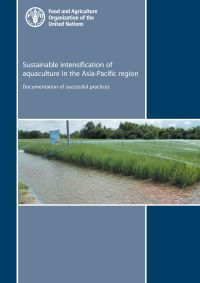
Sustainable intensification of aquaculture in the Asia-Pacific region: Documentation of successful practices

This publication is the major output of a regional programme jointly implemented by FAO and NACA in 2015 to document and disseminate successful practices that contribute to the sustainable intensification of aquaculture in the Asia-Pacific region. Twelve practices are described that contribute to at least one of the following: Improved production and resource use efficiency (land, water, feed, energy); improved environmental benefits; strengthened economic viability and farmers' resilience; and improved social acceptance and equity.

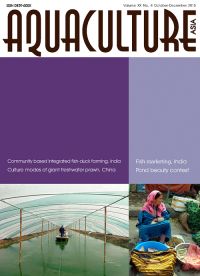
Aquaculture Asia Magazine, October-December 2015

In this issue:

Aquaculture feed supply chain attracting scrutiny. Pond beauty contest, Ram Kumar and social development. Culture modes of giant freshwater prawn in Yangtze River Delta for early harvest. Fish marketing in Kashmir, India - a case study of Srinagar. Community-based integrated fish-duck farming: A boon for rural development in agro-climatic conditions of Assam, India. Gastropod and bivalve fishery of Kakinada Bay, Andhra Pradesh, India: Management and conservation issues.

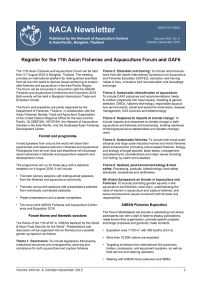
NACA Newsletter, Volume XXX, No. 4, October-December 2015

In this issue:

Register for the 11th Asian Fisheries and Aquaculture Forum and GAF6. 6th Global Symposium on Gender in Aquaculture and Fisheries. Global Conference on Climate Change Adaptation for Fisheries and Aquaculture. A Review of women's access to fish in small-scale fisheries. Aquaculture operations in floating HDPE cages: a field handbook. Aquaculture seed and feed production and management in Bangladesh: Status, issues and constraints.

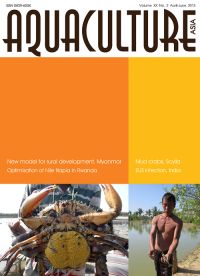
Aquaculture Asia Magazine, April-June 2015

In this issue:

Anti-microbials and alternatives. Successful demonstration of new model for rural development in Myanmar. Optimisation of Nile tilapia (Oreochromis niloticus) production in ponds based on improved farm management practices in Rwanda. EUS infection in freshwater fishes of Andhra Pradesh. Development of pond-reared broodstock / spawners of green mud crab Scylla serrata. ASEAN Gender Network launched. A two-tube nested PCR detection method for AHPND bacteria. 9th Regional Grouper Hatchery Production Training Course.

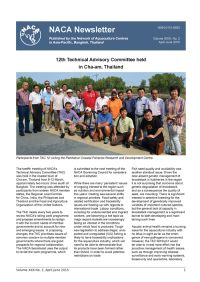
NACA Newsletter, Volume XXX, No. 2, April-June 2015

In this issue:

12th Technical Advisory Committee held in Cha-am, Thailand. Audio recordings: WAS special session on regional cooperation for improved biosecurity. AFSPAN Final Technical Report now available! Pillay Aquaculture Foundation Awards for Scientists in Least Developed Countries. Gender seminar conducted and ASEAN Gender Network launched. A two-tube, nested PCR detection method for AHPND bacteria. 9th Regional Grouper Hatchery Production Training Course. Developing an environmental monitoring system to strengthen fisheries and aquaculture in the Lower Mekong Basin. Asia-Pacific Regional Workshop on the Status of Aquatic Genetic Resources for Food and Agriculture.

Future considerations for the domestication and breeding of penaeid shrimp

Domestication in livestock industries is the process in which animal populations change in response to the artificial environments of farming production systems. Significant and widespread economic gains have been achieved through genetic improvements made through domestication and selective breeding of commercially farmed shrimp species, particularly Litopenaeus vannamei. Different policies on the translocation of shrimp genetic resources have influenced the approaches to shrimp domestication in different countries. The present paper examines the different approaches.

Inbreeding and disease in shrimp aquaculture: A reappraisal and a caution

Tropical shrimp aquaculture is facing a disease crisis that may be propelled by an interaction between management practices that cause inbreeding, and the amplification by inbreeding of susceptibility to disease and other stresses. Broodstock accumulate inbreeding and lose genetic diversity when they experience bottlenecks or are chronically too small. The genetic lock is a practice that leads to inbreeding at farm level. Inbreeding may be amplifying the severity of diseases, including the major current threats.

12th Technical Advisory Committee held in Cha-am, Thailand

The twelfth meeting of NACA’s Technical Advisory Committee (TAC) was held in the coastal town of Cha-am, Thailand from 9-12 March. The TAC meets every two years to review NACA’s rolling work programme and propose amendments to realign it with the current needs of member governments and to account for new and emerging issues. In proposing changes, the TAC prioritises issues of common concern to member governments where there are prospects for regional collaboration.

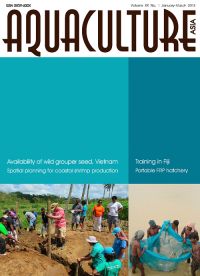
Aquaculture Asia Magazine, January-March 2015

Further training provided to aquaculturists in Fiji. Spatial planning for sustainable coastal shrimp production. Availability of grouper (Serranidae) fingerlings and seed in the coral reef of Son Tra Peninsula, central Viet Nam. Small-scale carp seed production through portable FRP hatchery at Khanguri, Odisha. Regional consultation on culture-based fisheries developments in Asia. Gender Assessment Synthesis Workshop. Broodstock management in aquaculture. Urgent appeal to control spread of the shrimp microsporidian parasite Enterocytozoon hepatopenaei (EHP).

NACA Newsletter, Volume XXX, No. 1, January-March 2015

In this issue:

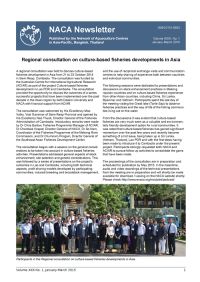
Regional consultation on culture-based fisheries developments in Asia. Gender Assessment Synthesis Workshop. NACA participation in the 5th Global Symposium on Gender in Aquaculture and Fisheries, Lucknow, India. Broodstock Management in Aquaculture: Long term effort required for regional capacity building. Urgent appeal to control spread of the shrimp microsporidian parasite Enterocytozoon hepatopenaei (EHP).

Regional consultation on culture-based fisheries developments in Asia

A regional consultation was held to discuss culture-based fisheries development in Asia from 21 to 23 October 2014 in Siem Reap, Cambodia. The consultation was funded by the Australian Centre for International Agricultural Research as part of the project Culture-based fisheries development in Lao PDR and Cambodia. The consultation provided the opportunity to discuss the outcomes of a series successful projects that have been implemented over the past decade in the Asian region.

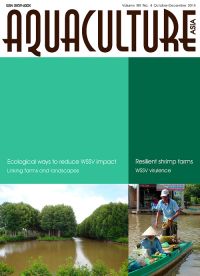
Aquaculture Asia Magazine, October-December 2014

Promising aquaculture practices for sustainable intensification. Culture and breeding of Archcentrus spilurum at Tuticorin District of Tamil Nadu, India. Searching for ecological ways to reduce WSSV impact. Fisheries and aquaculture-based livelihoods prospects in East Kalimantan, Indonesia. Linking farms and landscapes in the governance of sustainable Vietnamese shrimp aquaculture. Resilience of shrimp farming based livelihoods in the Mekong Delta, Vietnam. Farming system affects the virulence of white spot syndrome virus (WSSV) in penaeid shrimp.

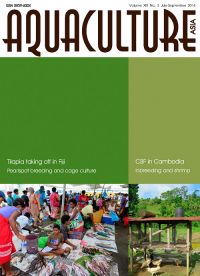
Aquaculture Asia Magazine, July-September 2014

In this issue:

Labour issues in the fishing and aquaculture industries. Commercial tilapia farming at take-off point in Fiji. Tank based captive breeding and seed production of the pearlspot (Etroplus suratensis). Cage culture of pearlspot in Kerala, India. Culture-based fisheries exchange visit from Lao PDR to Cambodia. National Fish Day, Cambodia. WAS Adelaide: Special Session on Regional Cooperation for Improved Biosecurity. Inbreeding and disease in tropical shrimp aquaculture: A reappraisal and caution.

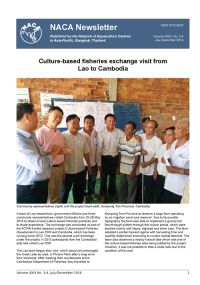
NACA Newsletter, Volume XXIX, No. 3-4, July-December 2014

In this issue:

Culture-based fisheries exchange visit from Lao to Cambodia. National Fish Day, Cambodia. WAS Adelaide: Special Session on Regional Cooperation for Improved Biosecurity. Inbreeding and disease in tropical shrimp aquaculture: a reappraisal and caution. Shrimp EMS/AHPND Special Session at DAA9. 2nd International Symposium on Aquaculture and Fisheries Education. Report on Sustainable Fisheries and Aquaculture for Food Security and Nutrition.

Inbreeding and disease in tropical shrimp aquaculture: a reappraisal and caution

The disease crisis facing shrimp aquaculture may be propelled, in part, by an interaction between management practices that cause inbreeding, and the amplification by inbreeding of susceptibility to disease and environmental stresses. The study describes and numerically simulates gene flow from Penaeus (Litopenaeus) vannamei hatcheries that employ a ‘Breeder Lock’ to discourage use of their PL as breeders, through ‘copy hatcheries’ that breed the locked PL, to inbred shrimp in farm ponds. 

Aquaculture Asia Magazine, April-June 2014

In this issue:

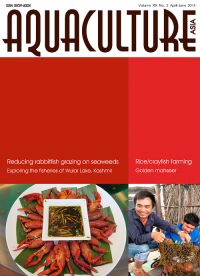
Integrated rice/crayfish farming in Hubei Province, China. Improvement of seaweed Kappaphycus alvarezii culture production by reducing grazing by rabbit fish (Siganus spp.). Exploring the fisheries of Wular Lake, Kashmir, India. Golden mahseer Tor putitora - a possible candidate species for hill aquaculture. Free primers for specific detection of bacterial isolates that cause acute hepatopancreatic necrosis disease. Special session on regional cooperation for improved biosecurity. AHPND detection discussion group established.

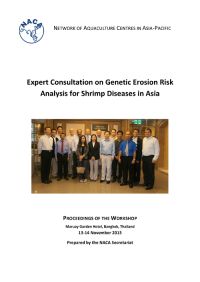
Expert consultation on genetic erosion risk analysis for shrimp diseases in Asia

Shrimp aquaculture in tropical regions is facing a disease-induced catastrophe of lost production. There is reason to believe that current broodstock management practices may induce genetic erosion that increases susceptibility to disease and vulnerability to epizootics. The basic tenet for this Expert Consultation is that an important aggravating factor in the disease crisis is an agro-economic system that locks shrimp breeders, hatcheries and farmers into behaviour that induces high levels of inbreeding.