Health and Biosecurity

The Health and Biosecurity Programme assists members to reduce the risks of aquatic animal disease impacting the livelihoods of farmers, national economies, trade, environment and human health by:

  • Improving regional cooperation in aquatic animal health and welfare.
  • Developing and implementing national strategies on aquatic animal health.
  • Improving surveillance, reporting and response to disease emergencies.
  • Promoting harmonisation of diagnostic procedures and risk assessment.
  • Widespread promotion of better aquatic animal health management practices at the farm level.

Key activities

Key activities of the programme include:

  • Convening the annual meeting of the Asia Regional Advisory Group on Aquatic Animal Health, coordinating the Quarterly Aquatic Animal Disease Report and bringing regional issues to the attention of global standard setting bodies such as the Office International des Epizooties.
  • Establishment and expansion of a three-tier shared resource in aquatic animal health.
  • Development of farm-level health management tools for key aquaculture commodities.
  • Supporting regional disease surveillance and reporting.
  • Strengthening aquatic animal health and biosecurity in the region.
  • Facilitating harmonisation in disease diagnostic techniques.
  • Developing resource material in support of diagnosis and surveillance.

Contacts

Creative Commons Attribution.
Related

Subject tags

A collection of subject tags relating to technical matters.

In this collection

Emerging Trends and Experiences in Asia-Pacific Aquaculture: 2003

This document provides an overview of topical issues in Asian aquaculture for 2003, including a review of its status, progress in research and development, major issues and experiences, together with suggestions on actions for addressing opportunities and constraints. The document was prepared by NACA and FAO to facilitate discussions at the 15th NACA Governing Council meeting, hosted by the Government of Sri Lanka on 21st-25th April 2004.

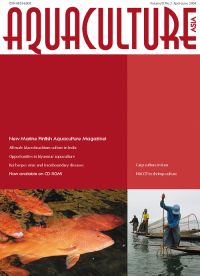
Aquaculture Asia Magazine, April-June 2004

In this issue:

Genetic impacts of translocation on aquatic biodiversity in Asia. Carp culture in Iran. Opportunities and challenges in Myanmar aquaculture. Impacts of monosex Macrobrachium culture on seed availability in India. Use of new technology and skills for eco-friendly production of tiger shrimp Penaeus monodon. Larval rearing and spat production of the windowpane shell Placuna placenta. HACCP in shrimp farming. First breeding success of Napoleon wrasse Cheilinus undulatus and coral trout Plectropomus leopardus.

Recommendations of the Expert Consultation on Rapid Diagnosis of Shrimp Viral Diseases, Chennai 2002

The recommendations are derived from discussions at the consultation and three expert working groups and were adopted during the final plenary session of the Expert Consultation. Together they represent a powerful set of recommendations in use of rapid diagnostic tools for better health management in shrimp aquaculture. They have been put together in this summary document for rapid dissemination to potential users, researchers and other interested parties, in India and elsewhere.

Chemical and biological amendments used in shrimp farming (abstract)

This article compares the use of chemical and biological amendments in shrimp farming in Asia and the Americas. The information comes mainly from the author’s experience in Thailand and Ecuador, as well as from the literature. The amendments are discussed according to three major categories: (1) water and soil quality management products, (2) biocides, and (3) feed additives. Certain agents, while necessary to successful shrimp farming, should be used only when needed and in a safe and responsible manner. 

Basic overview of the regulatory procedures for authorisation of veterinary medicines with emphasis on residues in food animal species

This report presents a précis of the regulatory procedures for authorisation of veterinary medicines in Europe and the USA. In particular it concentrates upon the requirements for consumer safety in regard to presence of residues of veterinary medicines in the edible tissues of food animal species. In both Europe and the USA the regulations in regard to veterinary residues and consumer safety require that countries wishing to export into those markets demonstrate equivalent standards to the domestic requirements.

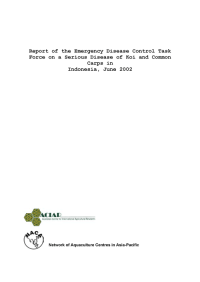
Report of the Emergency Disease Control Task Force on a Serious Disease of Koi and Common Carps in Indonesia, June 2002

An Emergency Disease Control Task Force on a Serious Disease of Koi and Common Carps in Indonesia was organised by NACA in June 2002. The Task Force conducted an emergency assessment of the disease situation in July through field and laboratory examinations of collected samples. The Task Force collected information about the disease occurrence. Koi herpes virus was detected from all case samples which indicates that it may have played a role in the observed mortalities.

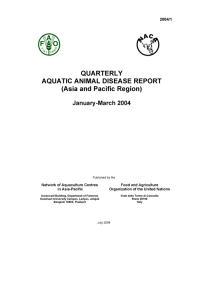
Quarterly Aquatic Animal Disease Report, January-March 2004

This report, the 23rd in the series, contains information about the aquatic animal health status of twenty states in the Asia-Pacific region. The foreword discusses a project on Capacity and Awareness Building on Import Risk Analysis for Aquatic Animals, funded by the APEC Fisheries Working Group.

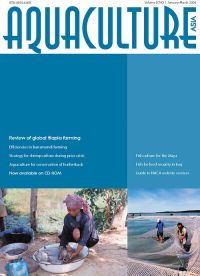
Aquaculture Asia Magazine, January-March 2004

In this issue:

Aquaculture and food security in Iraq. Natural breeding in captivity - conservation of the threatened freshwater featherback Notopterus notopterus. Culture of Penaeus japonicus. Enzymes for sustainable aquaculture. Review of global tilapia farming practices. Fish culture in Yucatan, Mexico. Shrimp farm project planning, preparation and implementation. Coping with low shrimp prices. Efficiencies in barramundi culture. The innovative contributions of women in aquaculture. Marine finfish section. What's new on the web. Aquaculture calendar.

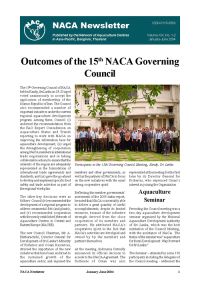
NACA Newsletter Volume XIX, No. 1-2, January-June 2004

In this issue:

Outcomes of the 15th Governing Council. Aquaculture seminar. Council Chair for 2004-2005. Shrimp disease and coastal management - four years. New Import Risk Analysis publications. Reducing the risk of shrimp disease outbreaks in Vietnam. Network of Aquaculture Centres in Central and Eastern Europe. OASIS: The One Stop Aqua Shop Information Service. Other recent STREAM activities. New faces at NACA.

Report of the second meeting of the Asia Regional Advisory Group on Aquatic Animal Health, 10-12 November 2003

The Asia Regional Advisory Group on Aquatic Animal Health meets annually to discuss regional health issues including emerging disease threats. This report includes a review of regional disease status circa 2003, global and regional disease reporting arrangements, global issues and standards, progress in implementation of the the Regional Technical Guidelines on Health management for the Responsible Movement of Live Aquatic Animals, identification and designation of regional aquatic animal health resources and regional and international cooperation.

Case studies of Ecuadorian shrimp farming (abstract)

This case study review shrimp aquaculture development in Ecuador. The prevailing farming systems and practices are described. Most farms are extensive or semi-intensive and the industry is shifting to hatchery-reared PL rather than wild due to unpredictability in wild PL supply and disease outbreaks. A survey of water quality intake and outfall from farms is reported on with suggestions for farm design to reduce nutrient load in outfall is discussed. Health issues and mangrove degredation are discussed. 

Mixed shrimp farming-mangrove forestry models in the Mekong Delta: Termination report

The goal of this project was to optimise the economic yield from mixed shrimp aquaculture-mangrove forestry farming systems in Ca Mau Province, Vietnam, in a sustainable manner. Specific objectives were to investigate factors controlling the yields of shrimp and wood from shrimp farming-mangrove systems, experiment with shrimp pond and mangrove forest management to evaluate different culture options, identify improved practices and assist government to transfer the results of the project to the wider coastal farming community.

Trans-boundary aquatic animal pathogen transfer and the development of harmonized standards on aquaculture health management

This document provides the report of the joint APEC/FAO/NACA/SEMARNAP workshop on “Trans-boundary aquatic animal pathogen transfer and the development of harmonized standards on aquaculture health management,” held at Puerto Vallarta, Mexico, 2000. The workshop reviewed the impacts of trans-boundary pathogens, management strategies and harmonisation of of aquatic animal health management measures. Participants adopted the “Puerto Vallarta Plan of Action” incorporating recommendations for to control the spread of serious aquatic animal pathogens.

Lymphocystis disease: Disease card

Lymphocystis is a common, chronic and benign infection caused by an iridovirus that results in uniquely hypertrophied cells, typically in the skin and fins of only the more advanced orders of fishes.

Withering syndrome of abalone: Disease card

This disease card provides information on the causative agent, transmission, host range, distribution and diagnosis of abalone withering syndrome. The disease is caused by an intracellular bacterium Candidatus Xenohaliotis californiensis of the family Rickettsiaceae. Information on diagnosistic methods and references are provided.

Mass mortality of koi and common carp: Disease card

This disease card provides information on the epizootic of koi and common carp in Indonesia. The pattern of the recent epidemic in koi and common carp in Indonesia is consistent with that of an infectious disease, but there is as yet no definitive aetiological diagnosis. The Regional Aquatic Animal Health Advisory Group of NACA in its first meeting decided to list Koi mass mortality under Unknown diseases of serious nature in the Quarterly Aquatic Animal Disease report.

Manual of procedures for the implementation of the Asia Regional Technical Guidelines on Health Management for the Responsible Movement of Live Aquatic Animals

The Manual of Procedures for the Implementation of the Asia Regional Technical Guidelines on Health Management for the Responsible Movement of Live Aquatic Animals provides background material and detailed technical procedures to assist countries and territories in the Asia Region in implementing the Asia Regional Technical Guidelines on Health Management for the Responsible Movement of Live Aquatic Animals. The Technical Guidelines were initiated due to increased recognition that disease emergence is often linked to live aquatic animal movements.

Asia Regional Technical Guidelines on Health Management for the Responsible Movement of Live Aquatic Animals

The Asia Regional Technical Guidelines on Health Management for the Responsible Movement of Live Aquatic Animals and their associated implementation plan, the Beijing Consensus and Implementation Strategy provide expert guidance for national and regional efforts in reducing the risks of disease due to trans-boundary movement of live aquatic animals. The Technical Guidelines were initiated due to increased recognition that disease emergence is often linked to live aquatic animal movements and causes significant socio-economic losses.

Economics and Management of Shrimp and Carp Farming in Asia

The sixteen papers in this volume were largely based on the data from a survey of more than 5,000 shrimp and close to 6,000 carp farms in sixteen countries and territories in the Asia-Pacific region. They provide an economic and technical efficiency of production analysis for Asian shrimp and carp farming systems. This survey was conducted under the ADB/NACA regional study and workshop on aquaculture sustainability and the environment (RETA 5534).

Quarterly Aquatic Animal Disease Report, October-December 2003

This report, the 22nd in the series, contains information about the aquatic animal health status of seventeen states in the Asia-Pacific region. The foreword discusses the role of disease surveillance programmes and issues realted to the OIE Aquatic Animal Health Standards Commission.