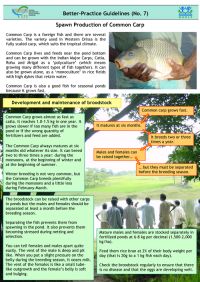
Common carp is a foreign fish and there are several varieties. The variety used in Western Orissa is the fully scaled carp, which suits the tropical climate. Common carp lives and feeds near the pond bottom and can be grown with the Indian major carps, catla, rohu and mrigal as a 'polyculture' (which means growing many different types of fish together). It can also be grown alone, as a 'monoculture' in rice fields with high dykes that retain water.
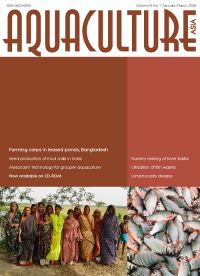
Nursery rearing of silver barb Puntius goniotus. Artemia enrichment and biomasss production for larviculture. Seed production of mud crab Scylla serrata in India. Macrobrachium on the southwest coast of India. Fish wastes in urban and suburban markets of Kolkata: Problems and solutions. Groups of poor women farming carps in leased ponds, Bangladesh. Lymphocystis disease and diagnostic methods in China. Mesocosm technology advances grouper aquaculture in northern Australia.
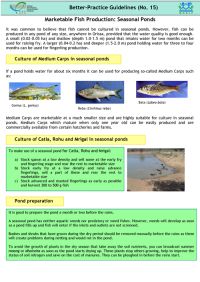
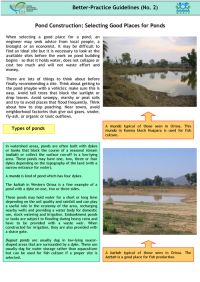
It was common to believe that fish cannot be cultured in seasonal ponds. However, fish can be produced in any pond of any size, anywhere in Orissa, provided that the water quality is good enough. A small and shallow pond that retains water for two months can be used for raising fry. A larger and deeper pond holding water for three to four months can be used for fingerling production.
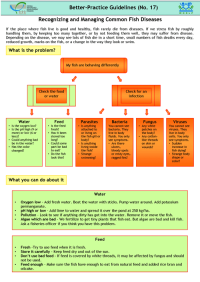
If the place where fish live is good and healthy, fish rarely die from diseases. If we stress fish by roughly handling them, by keeping too many together, or by not feeding them well, they may suffer from disease. Depending on the disease, we may see lots of fish die in a short time, small numbers of fish deaths every day, reduced growth, marks on the fish, or a change in the way they look or swim.
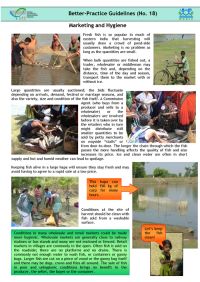
Fresh fish is so popular in much of eastern India that harvesting will usually draw a crowd of pond side customers. Marketing is no problem so long as the quantities are small. When bulk quantities are fished out a trader, wholesaler or a middleman may take the fish and depending on the distance, time of the day and season, transport them to the market with or without ice.
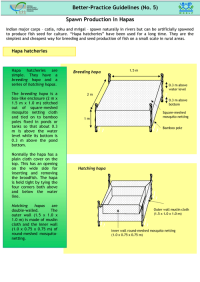
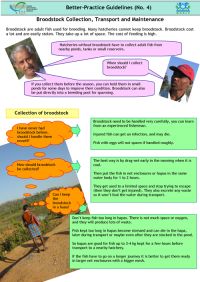
These guidelines illustrate good practice for broodstock handling and management using practices that are suitable for small-scale operations. This document is also available in Oriya.
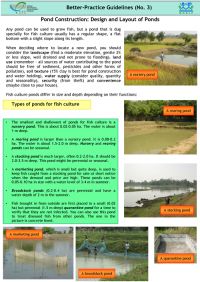
Any pond can be used to grow fish, but a pond that is dug specially for fish culture usually has a regular shape, a flat bottom with a slight slope along its length. When deciding where to locate a new pond, you should consider the landscape, land use, soil texture (15% clay is best for pond construction and water holding), water supply (consider quality, quantity and seasonality), security (from theft) and convenience (maybe close to your house).
When selecting a good place for a pond, an engineer may seek advice from local people, a biologist or an economist. It may be difficult to find an ideal site but it is necessary to look at the available sites before the work on pond building begins – so that it holds water, does not collapse or cost too much and will not waste effort and money. There are lots of things to think about before finally recommending a site.
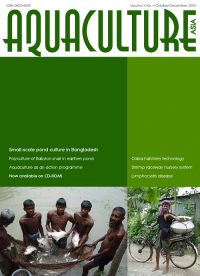
Small-scale pond culture in Bangladesh. Issues and challenges in community-based aquaculture. Aquaculture as an action programme building confidence and self-worth. Transforming policy recommendations into pro-poor service provision. Grow out of spotted Babylon to marketable size in polyculture with seabass. Influence of economic conditions and global shocks on grouper markets. Status of cobia hatchery technology in Vietnam. Organic shrimp raceway system. Macrobrachium rosenbergii in Vembanad Lake. Management of monogenean parasites.
8 September 2004 | Graham Haylor | 1359 Downloads | .pdf | 176.2 KB
This paper advocates strategies, processes and practices that enable: livelihoods approaches rather than resource-based approaches, ‘direct’ institutional and policy development, rather than ‘project demonstrations’, and support for regional, national and local communications. It was presented at the Symposium on Participatory approaches in reservoir fisheries management: Issues, challenges and policy, October 4-6th 2004 at the Culture Club Resort, Dambulla, Sri Lanka hosted by the National Aquaculture Development Authority in collaboration with FAO..
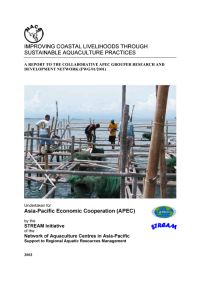
3 February 2004 | Haylor, G., Briggs, M.R.P., Pet-Soede, L., Tung, H., Yen, N.T.H., Adrien, B., O'Callaghan, B., Gow, C., De Vantier, L., Santos, R., Pador, E., de la Torre, M., Bulcock, P., and Savage, W. | 26855 views | .pdf | 2.25 MB
Wild-harvest fisheries for live reef fish are largely over-exploited or unsustainable. Sustainable aquaculture – such as that of groupers – is one option for meeting increasing demand for reef fish as well as potentially maintaining livelihoods of coastal communities. This report draws upon secondary literature, media sources and four diverse case studies from at-risk reef fisheries, to frame a strategy for encouraging sustainable aquaculture as an alternative to destructive fishing practices. It was commissioned by the APEC Secretariat.
3 February 2004 | Matthew Briggs | 6880 Downloads | .pdf | 582.74 KB
Sulawesi has the largest coral reef area in Indonesia, at the epicenter of worldwide marine biodiversity, but is one of the areas most threatened in Southeast Asia by destructive fishing practices. This case study reviews the potential for aquaculture to provide alternative livelihoods for fishers within the context of an integrated, community-based coastal management plan with involvement of local communities empowered to control and steward their resources so that they can conserve and utilise them sustainably.
19 November 2003 | P. Leung and K.R. Sharma (eds.) | 2314 Downloads | .pdf | 1.56 MB
The sixteen papers in this volume were largely based on the data from a survey of more than 5,000 shrimp and close to 6,000 carp farms in sixteen countries and territories in the Asia-Pacific region. They provide an economic and technical efficiency of production analysis for Asian shrimp and carp farming systems. This survey was conducted under the ADB/NACA regional study and workshop on aquaculture sustainability and the environment (RETA 5534).
Ornamental fish farming in India. Tilapia for Indian aquaculture? Peri-urban food production in southeast Asia. Socio-economic consequences of shrimp farming in Andhra Pradesh. Breeding techniques for golden arowana Scleropages formosus. Captive breeding of peacock eel Macrognathus aculeatus. Substrate-based aquaculture systems. Extension in shrimp health management - experiences from India. Treatment of disease in freshwater shrimps and crabs in China. Larval rearing techniques for humpback grouper Cromileptes altivelis.
Peri-urban aquaculture in Kolkata. Diffusion and adoption of shrimp farming technologies. Aquaculture education in India. Information system on fish germplasm resources in China. Freshwater crustacean aquaculture in China. The role of macronutrients. Innovations by Bengal farmers. Scientific guidelines for freshwater prawn farmers in India. Status of mariculture in Indonesia. Use of probiotics in larval rearing. Problems in shrimp culture during the wet season.
Fertilisation, soil and water quality management. Commercialisation of giant freshwater prawn culture in India. Aquaculture in reservoir-fed canal systems. Production of black-lip pearl oyster Pinctada margaritifera. Hybridisation hassles. Breeding sea cucumber Holothuria scabra in Vietnam. Use of palm kernel meal in feeds. Getting the most out of your feed. Marine finfish aquaculture in Myanmar. Penaeus monodon culture in low-salinity areas. Fisheries and aquaculture in Nepal.
Aquaculture for poverty alleviation and food security. Shrimp pond waste management. Properties of liming materials. Seed production of mud crab Scylla spp. The dilemmas of strain selection. Seed production of the crucifix crab Charybdis feriatus. A general approach to disease treatment and control. Breeding and seed production of mangrove snapper Lutjanus argentimaculatus. Responsible use of antibiotics in shrimp farming. Health management for cultured marine fishes. Molecular methods for rapid detection of pathogens in seafood.
Roll-out of national aquatic animal health strategies continues. STREAM concludes inception phase of 'Improved Policy on Aquaculture Service Provision to Poor People' Project in India. Expert consultation on rapid diagnosis of shrimp viral diseases held in Chennai, India. ACIAR/NACA Workshop on Feeds and Feeding Constraints in Inland Aquaculture: Research and Extension Priorities. NACA supports health management in Indian shrimp farming. Marine Finfish Aquaculture aquaculture programme gears up for workshop. Launch of Trans-Himalayan Coldwater Fisheries Network Website. NACA Organises Emergency Assistance to Indonesia in the Control of a Serious Koi and Common Carp Disease.
The Kathmandu symposium on coldwater fishes made recommendations covering three major themes: (1) distribution and conservation of coldwater fishes; (2) role of coldwater fishes in rural development and poverty alleviation; and (3) coldwater fisheries and aquaculture development. This report presents the the recommendations of the three working groups. The symposium recommended regional cooperation among countries of the Trans-Himalayan region be strengthened for effective sharing and exchange of skills, experiences and technical cooperation.